
A Russian cargo vessel believed to be transporting military supplies remained ablaze in the Baltic Sea after suspected Ukrainian drones struck it the previous day.
The damaged Sparta II drifted into Finnish waters and dropped anchor after all 16 Russian crew members were evacuated to another Russian ship nearby.
The incident came as air-raid sirens sounded in Kaliningrad, Russia’s heavily militarised Baltic enclave, amid fears that the region could also face a drone attack.
Finnish military officials believe two drones hit the vessel, identifying Ukraine as the likely source. Finnish Prime Minister Petteri Orpo subsequently warned on X that the war was “spilling over” into neighbouring areas.
The Sparta II was travelling from St Petersburg towards Kaliningrad when it was attacked. Coast Guard crews were using water cannons to cool the ship after overnight efforts to extinguish the fire failed.
A Russian helicopter responding to the incident briefly entered Finnish airspace. Finland has since introduced temporary airspace and maritime restrictions, saying the measures are intended to protect civilians.
Kaliningrad’s governor said air-raid sirens were activated after authorities detected a “suspicious object” approaching from the direction of Lithuania, though he offered no supporting evidence.
There is no confirmed evidence that Ukraine attacked Kaliningrad. Lithuania has “categorically” denied any involvement, saying it has never authorised its airspace to be used for an assault on Russia.
Russian President Vladimir Putin warned last month that Moscow could consider using nuclear weapons if Kaliningrad faced a Western threat.

A Finnish Border Guard’s handout photo of smoke rising from the Russian cargo ship Sparta II

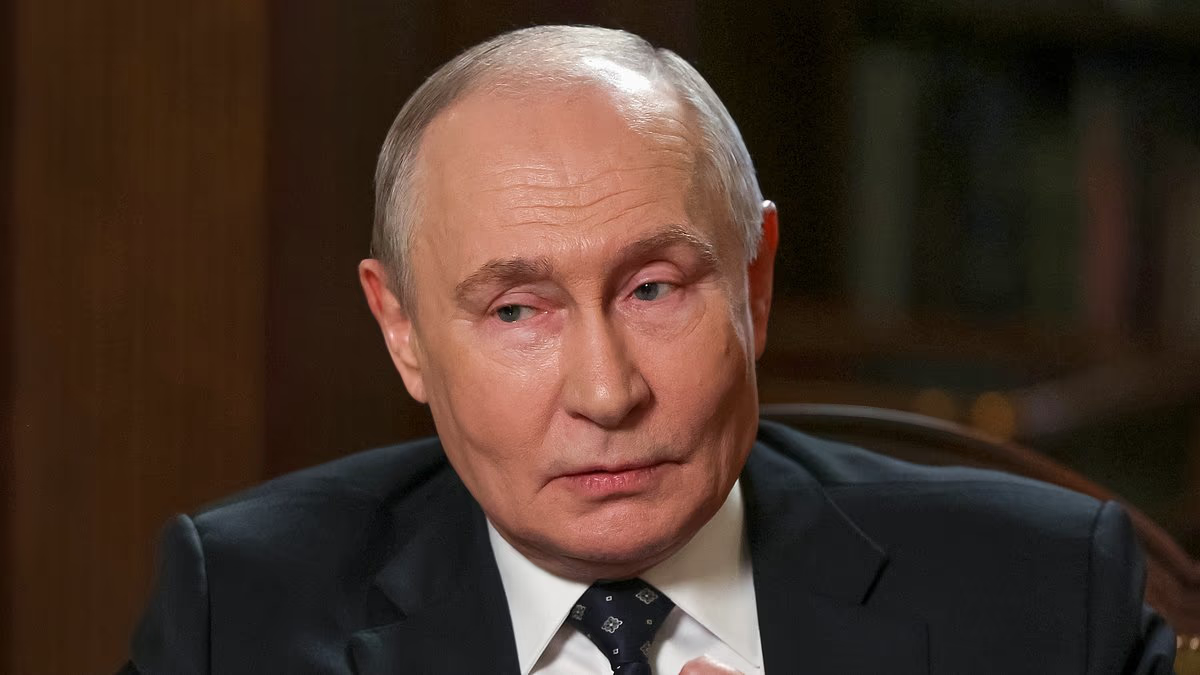
Russian President Vladimir Putin has threatened to use nuclear weapons in the event of any attack on Kaliningrad
Kaliningrad lies between Poland and Lithuania on the Baltic coast, more than 600 miles west of Moscow.
Ukraine has launched repeated waves of military drones towards Russia’s northwestern Leningrad region this year. Some have entered the airspace of nearby Baltic states, fuelling concern that the war could spill into NATO territory.
Sirens sounded overnight in the port town of Baltiysk, home to the headquarters of Russia’s Baltic Fleet.
Authorities also restricted aircraft takeoffs and landings in Kaliningrad, where Russia deploys nuclear-capable Iskander-M ballistic missile systems.
Kaliningrad regional governor Alexei Besprozvannykh said a drone-warning system had been activated in the Nemansky district and blamed NATO for the situation.
“It reacted to a suspicious object coming from the direction of Lithuania,” he claimed, without presenting evidence.
He later said there was “no threat” and that the alert would be lifted shortly.
Videos and images circulated online appearing to show explosions in Kaliningrad, accompanied by claims that Ukraine had launched an attack from nearby NATO territory.
However, the footage was actually linked to the separate conflict in Iran.
Despite that, some reports claimed Kaliningrad—formerly Königsberg, the historic capital of East Prussia and one of Germany’s major eastern cities—had come under attack for the first time since the Second World War.
A genuine strike on the enclave would create a dangerous new front between Russia and Ukraine and could pull additional European countries and NATO members into the conflict.
Putin issued the following warning last month: “If it comes to a direct attack on the Russian Federation (referring to Kaliningrad) the question of Russia using all the weapons at our country’s disposal will inevitably and immediately be on the agenda. This is inevitable.”
Any drone travelling from Ukraine to Kaliningrad would likely have to cross Polish or Lithuanian airspace, unless it followed a much longer route around the Gulf of Finland.
Another possibility would be an attack launched from international waters in the Baltic Sea.
Nevertheless, there is currently no evidence that Ukraine attacked Kaliningrad.
Lithuania has also firmly rejected claims that its airspace was used to target the Russian exclave.
Lithuanian Foreign Affairs Minister Kęstutis Budrys said: “Lithuania categorically rejects false claims circulating on social media regarding Lithuania’s alleged involvement in the drone attack against the Kaliningrad region of the Russian Federation.
“The Republic of Lithuania has never authorized the use of its airspace for attacks against targets in the Russian Federation, including in the present case.”
Poland has repeatedly warned that Russia could use so-called false-flag operations connected to Kaliningrad.

Thick grey clouds of smoke billow from the ship’s bridge after two drones attacked the vessel

A close-up of the fire which erupted on board the ship sailing on the Baltic Sea today
Last week, Polish newspaper Rzeczpospolita cited security and intelligence sources alleging that Russia’s GRU military intelligence service was planning an operation designed to resemble a Ukrainian crossing of the Polish-Russian border, followed by an attack on a facility in Kaliningrad.
The alleged scenario could produce significant casualties and provide Putin with a justification for retaliation.
Exiled Russian military analyst Jan Matveyev said over the weekend that he could “easily imagine a purely Russian provocation” connected to the Kaliningrad scare.
He suggested it could involve “an attack on themselves in order to blame Europe for everything, either for allowing Ukrainian Armed Forces drones through its airspace, or for European drones directly attacking Kaliningrad region.”
Kaliningrad has long been viewed as a potential flashpoint for a wider war—a nuclear-armed Russian stronghold surrounded by NATO territory.
Military planners have warned that a Russian attempt to seize the narrow Suwałki corridor between Poland and Lithuania, which separates Kaliningrad from Russia’s ally Belarus, or a NATO effort to isolate the enclave, could trigger a direct confrontation between Moscow and the Western alliance.
The latest fears follow the fire aboard the Sparta II, which was carrying military supplies and was reportedly hit by drones in international waters in the Gulf of Finland on Saturday.
Finland’s Defence Forces said the vessel was attacked west of Russia’s Gogland island before drifting into Finnish territorial waters, corroborating an earlier account from Russian officials.
The ship was sailing from St Petersburg to Baltiysk when it was struck, amid suspicions that its cargo had military connections.
Leningrad region Governor Aleksandr Drozdenko said two drones attacked the ship in international waters, roughly three nautical miles from Russia’s border.
He said the crew had been evacuated quickly while the authorities assessed the damage.
Finland’s defence ministry said it had reinstated temporary aviation and maritime restrictions in the eastern Gulf of Finland. The precautionary measures were intended to protect civilians and give authorities room to respond if drones needed to be intercepted.
Orpo said the war was “spilling over into our neighbouring areas”.
He added that “Ukraine has the right to fight against the aggressor”.

Defence Secretary Wes Streeting met with Ukrainian President Volodymyr Zelensky on Saturday
The incident prompted Defence Secretary Wes Streeting to describe Putin as a “cold-blooded killer” during a visit to Kyiv.
Tensions between Russia and the European Union also intensified after Russian missiles and drones entered Poland on Friday, near an area where hundreds of British troops were conducting military exercises.
Poland said two Russian missiles struck its territory and accused Moscow of carrying out an “intentional provocation”.
Earlier, Donald Trump appeared to offer an explanation for Russia’s actions, telling Fox News that Putin had been sending drones into Poland and firing “a couple of little missiles, by mistake”.
One rocket crashed into a field and exploded around 47 miles from the location of 300 British soldiers taking part in the so-called Coalition of the Willing.
NATO aircraft were scrambled after two Kh-101 cruise missiles and a jet-powered suicide drone breached Polish airspace on Friday morning.
A second strike hit Rudnik na Sadem, approximately 22 miles from the military base, while a third landed near Molodycz, about 50 miles away.
Speaking on Saturday, Streeting said: “It’s no good Putin turning up to international summits, walking up the red carpet and talking the language of peace, if in the days that follow we see heavy bombardment, particularly of civilian infrastructure.
“So I think in Europe we know exactly who we’re dealing with in Putin … he is a cold-blooded killer.”
Streeting called the incident in Poland an “outrageous provocation”, saying: “It seems more than a coincidence that those airspace violations took place at the same time as the multinational force for Ukraine exercise.”
He also called for “a response”.
The incident occurred in the same week that Moscow was accused of involvement in an assassination attempt targeting a Ukrainian-American rapper in Denmark.


