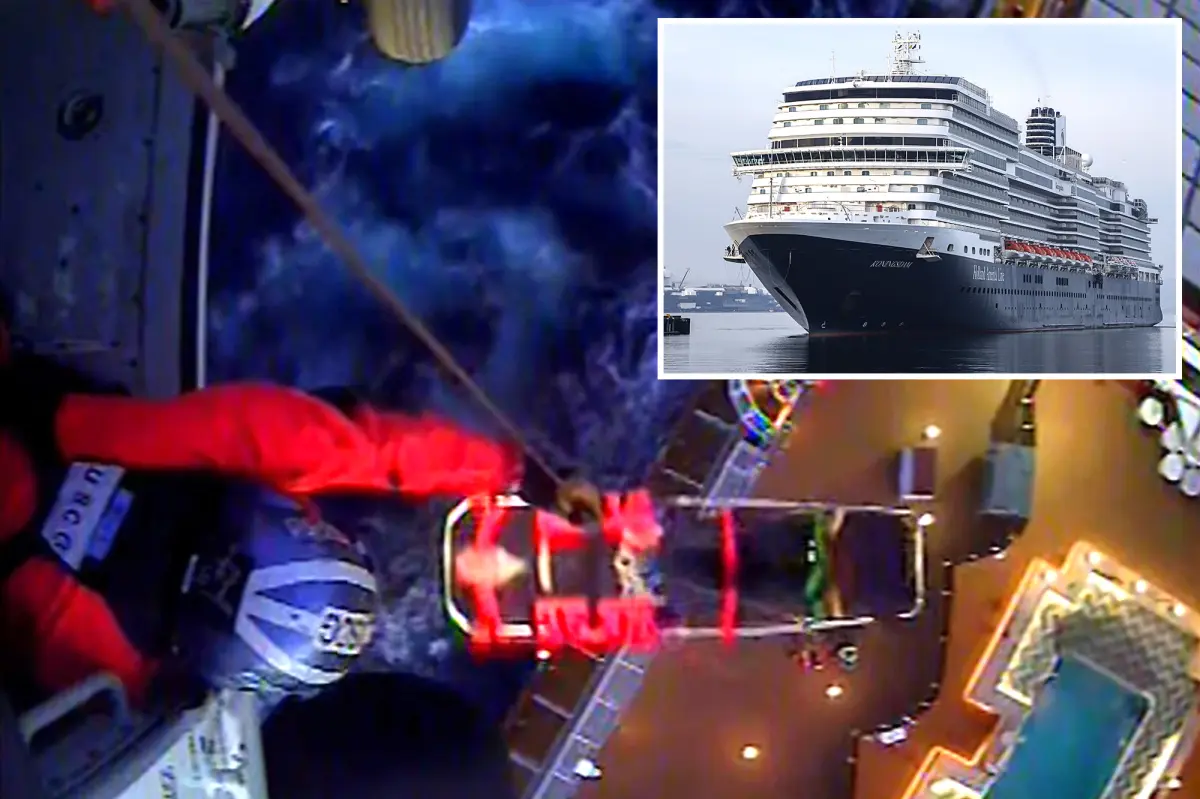

A 74-year-old cruise passenger was airlifted to a San Diego-area hospital after experiencing symptoms consistent with a possible heart attack while aboard a ship off the Southern California coast.
The medical emergency occurred on the Koningsdam, a 983-foot Holland America Line vessel sailing under the Dutch flag about 80 miles west of San Diego.
The ship’s captain contacted the U.S. Coast Guard, setting an early-morning rescue operation in motion.
At about 3 a.m., Coast Guard Air Station Ventura received a request to evacuate the passenger.
After consulting with the duty flight surgeon, officials sent an MH-60 Jayhawk helicopter to the cruise ship.
The helicopter arrived at approximately 5:45 a.m. The crew hoisted the passenger from the ship and flew him to Scripps Memorial Hospital in La Jolla for treatment.
Rescuing a patient from a large vessel far offshore requires precise coordination, and Coast Guard officials said the operation presented a number of challenges.
“Responding to medical emergencies aboard vessels far offshore requires careful coordination and a timely response to ensure patients receive the medical care they need,” said Lt. Aiden Becker, a search and rescue mission coordinator with Coast Guard Sector San Diego.
Becker said Coast Guard crews receive specialized training to conduct these evacuations and safely transfer patients to medical professionals.
Officials have not released an update on the passenger’s condition.
The California Post has contacted authorities for additional information but has not received a response.
The Koningsdam belongs to Holland America Line’s Pinnacle-class fleet and regularly departs from San Diego on cruises along the Pacific Coast and to destinations in Mexico.
The Coast Guard carried out another dramatic rescue near the San Diego coastline last month.
An 86-year-old sailor and his dog were rescued nearly 500 miles off San Diego after disappearing during a months-long voyage from Oregon to the South Pacific.
The sailor and his four-legged first mate left Astoria, Oregon, aboard the Willow Wind in August, bound for Pago Pago in American Samoa — a remote destination about 5,000 miles southwest of California.
YOU MIGHT ALSO LIKE: Former New Jersey GOP Aide and Second Woman Indicted Over Alleged Fake Anti-Trump Attack
But no one had heard from them since Aug. 20, prompting a search after they failed to reach their destination as expected.
On Saturday, Oct. 24, watchstanders with the Coast Guard Pacific Area received a report about the overdue sailor and his dog, according to the U.S. Coast Guard Southwest District.
The search intensified days later, when a Coast Guard station in Alameda received an emergency radio beacon signal from the Willow Wind on Tuesday, Oct. 27.
Crews from Coast Guard Air Station Sacramento, including a C-27 Spartan aircraft and an HC-130 Hercules aircrew, were dispatched to search for the missing sailor. Officials also asked nearby vessels to assist.
The sailboat was eventually located, and the motor vessel Grand Orion reached the area early the next morning.
Rough seas then forced rescuers to halt the operation for several hours before they could safely reach the stranded sailor and his dog.
Later that day, the pair were pulled from the sailboat, which had been left adrift with damaged sails, officials said.
However, the rescue operation was not yet complete.
A Coast Guard Air Station San Diego MH-60 Jayhawk crew hoisted the sailor and his dog from the Grand Orion into the helicopter about 170 miles west of Ventura.
“When emergency medical personnel were able to evaluate the mariner, he was weak and had difficulty walking, but no major injuries,” the Coast Guard told The California Post.
The 86-year-old was taken to Scripps Mercy Hospital for further evaluation.
According to SeaRoutesNav, the sailor and his dog had traveled more than 1,000 nautical miles by the time they were found.
“We are grateful to the merchant mariners and Coast Guard crews whose coordinated efforts brought this search to a successful conclusion,” said Coast Guard Cmdr. Jason Nguyen, chief of the Southwest District command center.
“This case highlights the importance of carrying emergency communication equipment and creating a float plan so someone ashore knows your voyage plans.”
The voyage from Astoria to Pago Pago would normally take four to seven weeks, depending on the boat’s speed, weather conditions and route, according to the Maritime Safety Information website.


