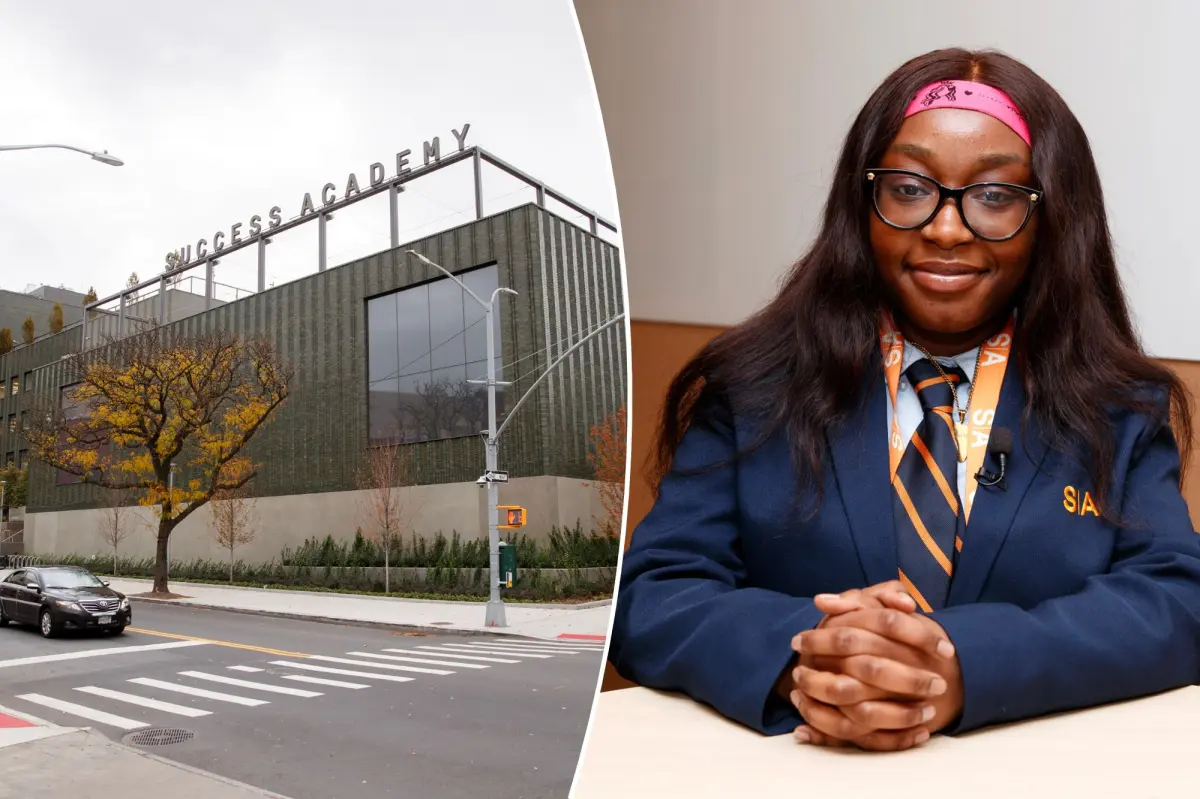
A new K–12 school in New York City features six dance studios, a rooftop athletic field, middle school students tackling logic questions drawn from the LSAT and high schoolers taking as many as five AP courses while setting their sights on Ivy League colleges.
Despite those elite-sounding amenities, the school is not a private academy on Manhattan’s Upper East Side. It is the first standalone campus operated by Success Academy, the charter-school network founded in 2006. Until now, the organization had relied on existing buildings and shared facilities with traditional public schools.
The Bronx campus opened in August and serves 2,400 students chosen through a random lottery, not an entrance exam. It is Success Academy’s first purpose-built school, and founder and CEO Eva Moskowitz intentionally located it in the nation’s poorest congressional district to make a broader argument about public education.
“There’s nothing wrong with the children,” Moskowitz told me during a visit earlier this month. “There’s something wrong with the system that fails to deliver for kids and families now going on a half-century.”
The six-story, 300,000-square-foot building is an architectural showpiece, with a 300-seat auditorium, a two-story gymnasium, ceramics rooms and outdoor terraces on the roof.
“Children deserve a building like this,” Moskowitz said.
The campus reportedly cost $245 million to construct. Moskowitz said a comparable project overseen by the School Construction Authority, the public agency that manages construction for the Department of Education, could have cost more than twice that amount. Because Success Academy is not bound by all the same regulations as union-run schools, she said, it can move more efficiently during the building process.
For Audrey, a high school junior who has attended Success since third grade, the campus itself has become one of the best parts of school. Her favorite subject is AP physics.
“It’s the first time we’re having a whole school to ourselves … every day you see something new around this beautiful campus,” she said enthusiastically.
Success Academy is also challenging familiar assumptions about charter schools — namely, that they achieve strong results by selecting only top-performing students or keeping classes unusually small.
“Ninety-four percent of our kids are kids of color, and our schools are located in the most economically disadvantaged areas of the city,” Moskowitz said. Classrooms average 40 students, and admission is determined by lottery.
The network promotes what it describes as a “culture of excellence,” built around firm rules and ambitious expectations.
The school day generally begins at 7:30 a.m. and ends at 4:30 p.m., considerably longer than the typical public-school schedule of roughly 8 a.m. to 2:30 p.m. Those additional hours are used not only for academics but also for chess, dance, theater, athletics and visual arts. Success Academy calls these activities “co-curriculars,” rather than extracurriculars, to emphasize that they receive the same importance as classroom subjects — opportunities often more readily available to children from affluent families.
Frequent absences or lateness are not taken lightly and may ultimately result in a student repeating a grade.
“We’re old-fashioned … you used to have to get to school on time,” Moskowitz said. She added that students often embrace the rule themselves. “If you’re in Harlem at 7:30 a.m., you will see a little kid drag their parent running down the block because they want to get to school on time.”
Shannon Beatty, principal of the new campus, said students are already waiting outside when she arrives at 6:30 each morning. Teachers begin calling families as early as 6:45 if they believe parents need a reminder to get their children moving.
“It’s possible to not only have high standards, but also to insist that kids can meet those standards,” Beatty said. “Right now, that [belief] is what’s lacking in other schools.”
Politeness and self-discipline — what Moskowitz calls “habits of the mind” — are also central to the school’s approach. Elementary students walk quietly between classrooms instead of running, and classical music replaces the usual bell to signal class changes.
They are taught to use “please” and “thank you,” write carefully and compose professional emails.
Academic rigor begins in the early grades. Students are introduced to logic in second grade, and Moskowitz said many middle school exercises are adapted from LSAT questions. Every student is expected to take AP courses beginning in eighth grade. Some take an especially demanding course load: Audrey completed five AP exams during her freshman year.
KEEP READING: Teaching Assistant Accused of Sending Explicit Texts to Boyfriend’s Underage Son
“Kids don’t come out of the womb caring about their musical success, their athletic success, their academic success,” Moskowitz said. “You have to build a culture where winning and achieving is something that’s pleasurable for kids.”
Moskowitz, a former New York City councilwoman, opened the first Success Academy school in Harlem two decades ago. It began with 165 students in kindergarten and first grade, and she served as its principal.
“I wasn’t building schools for black kids or Latin kids. I was trying to build world-class schools that any parent would want to send their kid to,” said Moskowitz, who ultimately enrolled her own children in Success Academy.
The network now serves approximately 22,000 students across New York City. Over the past nine years, every graduating senior — more than 1,000 students in total — has been accepted into a four-year college.
Moskowitz also says the organization has succeeded by resisting educational fads and concentrating on methods she believes produce results.
“Any educator worth their salt knows that kids need phonics to learn to read. It’s not the whole reading program, but you will fail to teach kids to read if you don’t teach phonics,” she said. “And we did that from day one.”
Still, Success Academy has not won broad support from New York’s education establishment.
Moskowitz identifies teachers unions — along with “the elected officials who do their bidding” — as among the network’s most persistent obstacles. The United Federation of Teachers and its state affiliates have repeatedly challenged Success Academy, including over its use of Department of Education buildings and the approval of new charter schools.
“It has been a battle royale,” Moskowitz said. “They see us as competition to a monopolistic system.”
During her time on the City Council, Moskowitz chaired the education committee and held hearings examining contracts for teachers, principals and custodians. She believes that scrutiny, combined with her political views, made her a particular target.
“I’m a liberal Democrat, but I’m for school choice,” she said.
Her opposition may also stem from her rejection of the argument that New York City’s public schools simply lack the funding required to succeed.
“In New York City… [we’re spending] somewhere between $36,000 a child and $38,000 [per year]. So there’s no way you can make the argument in New York City that the problem is money.” Nationally, the average is closer to $18,000 per student.
Yet expanding the Success Academy model involves more than confronting unions and political critics. The network must also find enough teachers capable of meeting its demanding academic standards.
Moskowitz said Success received 58,000 applications during a recent hiring cycle for fewer than 1,000 teaching positions. But some candidates struggled with the material they would be expected to teach, including fifth-grade mathematics they were supposed to have already mastered.
Success Academy has announced plans to create a graduate school of education aimed at providing stronger preparation for teachers.
The network is also preparing to expand outside New York City for the first time. Five new elementary schools are scheduled to open in Florida in fall 2027.
Moskowitz remains confident in the effort.
“We’re a can-do country, and yet we’ve almost given up on our children. Why would we do that?” she said. “We don’t have to accept educational dysfunction. We really don’t. And morally we can’t afford to.”