

A prominent evangelical Christian leader is tracing the descendants of Jews who were forcibly converted to Catholicism in Spain and Portugal during the Inquisition roughly 500 years ago. Through her work, she hopes to help people of Hispanic and Latino heritage—known as Anussim or crypto-Jews—rediscover possible Jewish roots.
In her documentary, “The Lost Jews of the Inquisition,” Laurie Cardoza-Moore told News Outlet that she wants to help people like herself uncover a family history that may have been hidden for generations.
Cardoza-Moore said the Israeli government believes there may be millions of Anussim, or hidden Jews, around the world. “Some know their family history, while others don’t,” she said.
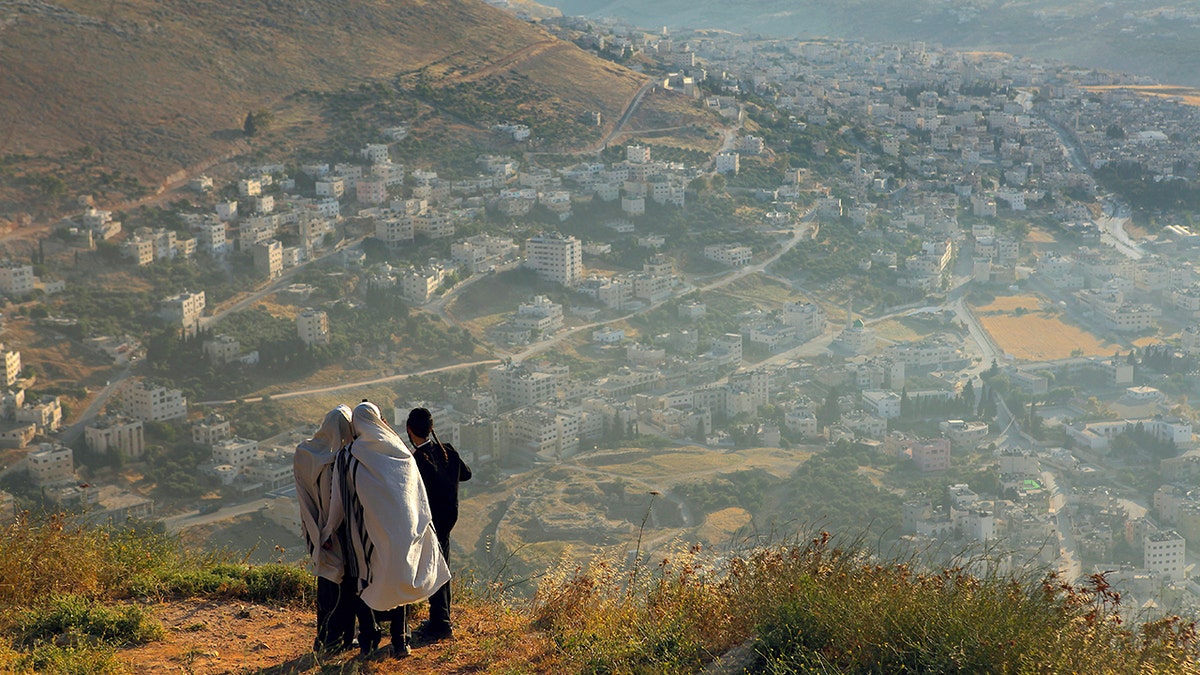
Orthodox Jewish worshippers pray on Mount Gerizim, overlooking Joseph’s Tomb, considered one of their holiest sites, in the West Bank city of Nablus on May 28, 2009. (Menahem Kahana/AFP via Getty Images)
An Emmy Award-winning documentary filmmaker and host of the television program “Focus on Israel,” Cardoza-Moore is also president of Proclaiming Justice to the Nations, or PJTN. She serves as a member of the Tennessee Textbook and Instructional Materials Quality Commission.
Her personal search began in 2002, after the Sept. 11 terrorist attacks, when she decided to introduce a resolution in the Tennessee state legislature supporting Israel in its fight against terrorism.
A year later, the Jewish Federation of Nashville invited her to join a mission to Israel. While visiting the Diaspora Museum at Tel Aviv University—now called the ANU Museum of the Jewish People—Cardoza-Moore discovered that surnames on both her mother’s and father’s sides had Jewish origins.
During the trip, the group spent a Sabbath with a Nashville family that had immigrated to Israel. As the family recited the traditional blessing over challah, Cardoza-Moore remembered her grandfather baking the same type of bread. As a child, she had eaten it on Friday nights and called it “sweet bread.”
The memory triggered others, including a conversation with her grandmother when Cardoza-Moore was about four or five years old. She remembered admiring an anniversary ring her grandfather had given her grandmother.

Large groups of Jews were marched to and from an auto-da-fé during the Spanish Inquisition. At far right, convicted Jews are shown being burned at the stake. (ullstein bild/ullstein bild via Getty Images)
“I remember saying, ‘Nana, that ring looks fit for a princess,’ and she said, ‘Well, you know we have a Jewish princess in our family,’” she told News Outlet.
After collecting clues during the 2003 visit, Cardoza-Moore asked her father to speak with her great-aunt and confirm the family’s Jewish heritage. She learned that her ancestors were Portuguese Jews who had been forced to convert to Christianity centuries earlier.
“It was a tradition to conceal the identity of our family’s ancestors, and it was the responsibility of the patriarch or matriarch, whichever lived the longest, to reveal it to the next generation on their deathbed,” she told News Outlet.
“As a student of the Bible, I knew that one day Israel would be restored, that Hashem would bring all 12 tribes back to the land to inhabit the land of their forefathers. I knew this prophetic history would unfold, but discovering that my family was part of this group of people transformed my life,” she said.
With her documentary, Cardoza-Moore hopes to carry that message beyond Spain and Portugal to places where Anussim descendants fled, including Brazil, Argentina and Mexico.
She is continuing to travel through Southern Europe and South America to record interviews for the film, which is expected to premiere in Israel by fall 2027.
IN CASE YOU MISSED IT: Woman Drugged and Raped by Husband Says: ‘I Can’t Believe It’s True’
Cardoza-Moore said the return of the Anussim carries special meaning as antisemitism rises sharply around the world. Even five centuries after the Inquisition, however, some people remain afraid to disclose their Jewish ancestry, she said.

Children stand near the El Transito synagogue and Sephardic Museum in Toledo on Feb. 27, 2014. Samuel Halevi Abulafia, an adviser and treasurer to King Pedro of Castile, also known as Pedro the Cruel, founded the synagogue in 1357. It was later converted into a church after Jews were expelled from Spain in 1492. (Gerard Julien/AFP via Getty Images)
“This is a disturbing trend. There are groups within Israel working to bridge the gap and help the Anussim return to the land of Israel. That is the purpose of this documentary: to reach those who don’t know their ancestry, as well as those who know but keep it hidden, and help them understand that it is safe to come back and that Israel is waiting for them,” she said.
Cardoza-Moore recalled speaking at a convention when a woman approached her with her family and young children. After learning the woman’s last name, Cardoza-Moore asked whether she was Jewish.
“She said they were Catholic, and I told her that her last name was Sephardic. Her face lit up. She was excited by the possibility that she might be descended from the Anussim and said she planned to look into her family history,” Cardoza-Moore said.
According to Cardoza-Moore, surnames such as Nunez and Lopez may provide clues of Sephardic Jewish ancestry. She said that in Spain, the “Z” in some surnames was originally an “S,” but Jews who fled to Portugal changed it to a “Z” as a marker of their Zionist identity, enabling them to recognize one another.
“There are so many Hispanic and Latino surnames. In fact, one of the people I’m investigating is a country’s leader. I believe he may also be a descendant of the Anussim,” she said.
“This is a very exciting journey, one that I get to share with others as they begin to realize that this is their family’s story, too. They start recalling things like, ‘I remember when family members would die, we would cover mirrors during the mourning period,’” she said.
Cardoza-Moore said she also created the documentary to teach Christians about the Inquisition and the Catholic Church’s treatment of Jews during that era.

Laurie Cardoza Moore interviews Oded Revivi, CEO of the ANU Museum of the Jewish People in Tel Aviv, on Nov. 16, 2026. (PJTN)
“There are many Christians, particularly evangelical Christians, who would be equally appalled by what was done to the Jewish people in the name of their God. As they learn what was done to the Jews in the name of Jesus, they will wake up and realize that this is unacceptable,” she said.
Cardoza-Moore said she has observed a growing movement among Christians turning away from Israel and the Jewish people, which she believes is partly the result of inadequate biblical education.
“We at PJTN have to change that. That is why we use the Bible and the Scriptures and refer to the prophets to remind Christians of their teachings, because Christians believe the prophets spoke the truth,” she said.
As an evangelical leader, Cardoza-Moore said she once considered keeping her Jewish heritage private. Ultimately, she decided that answering her calling mattered more.
“If my ancestors were persecuted and forced into silence because of who they were, that is unacceptable. I will go to my grave fighting insidious hatred and holding the church and Christians accountable, because we are seeing antisemitism rise again and hearing the same blood libels from Christians that were spread in the past,” she told News Outlet.
“We can’t be silent. We have to speak up and alert the church, because judgment will come. Genesis 12:3 says, ‘I will bless those who bless you, and whoever curses you, I will curse; and all peoples on earth will be blessed through you,’” she added.