
For older Americans anxious about giving up their independence, a vehicle that appears to handle much of the driving may seem like an ideal solution.
Tesla’s increasingly prominent appeal to senior drivers, however, is prompting safety concerns. Specialists warn that the company’s heavily promoted technology could leave some older motorists unable to respond safely in an emergency.
The electric vehicle maker is marketing its $99-a-month Full Self-Driving (FSD) subscription as a way for older adults to remain mobile as vision, reflexes and physical capability change with age.
Chief Executive Elon Musk has endorsed that message, writing in July that ‘Tesla self-driving enables safer mobility for senior citizens’.
Tesla has also released videos featuring older customers, including 93-year-old Lois of San Diego, who reportedly resumed taking long-distance trips with the technology.
In a post on X, the company wrote: ‘When a 93-year-old woman noticed how tired she was on her daily drives, she started going out less.
‘But with FSD Supervised, she’s now able to drive herself to appointments, run errands and even take road trips to visit her family on her own.’
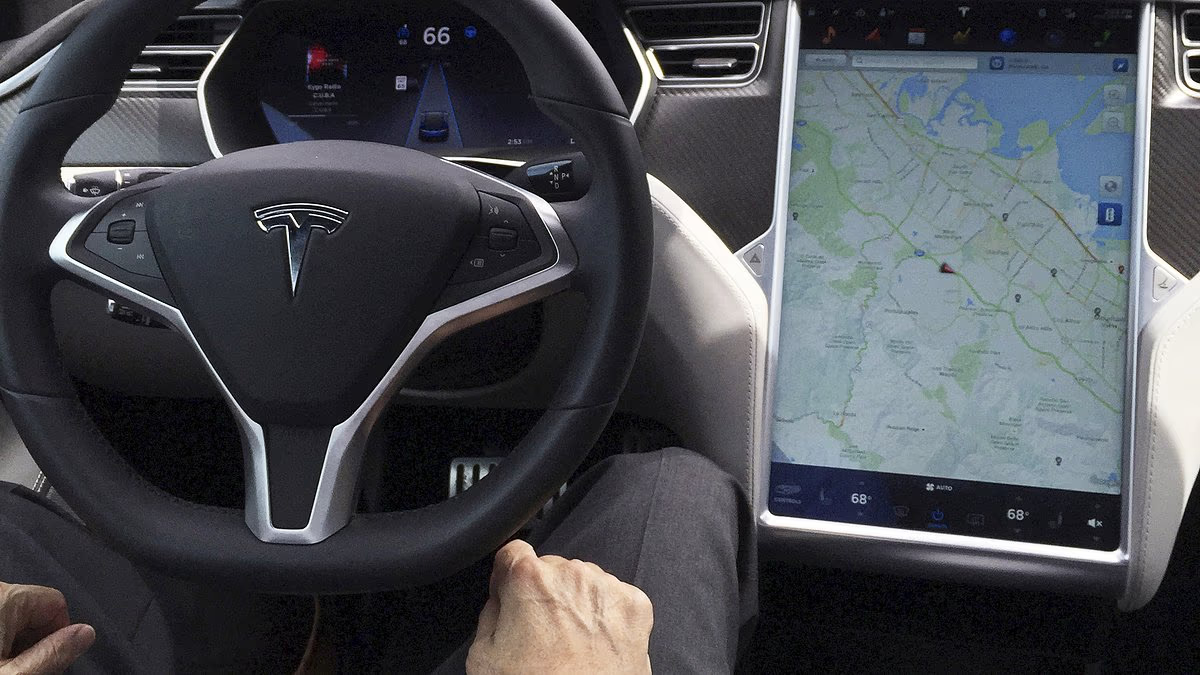
The crucial limitation is that, despite its name, Tesla’s FSD system is not fully autonomous and still depends on constant human oversight.

Tesla is promoting its $99-a-month Full Self-Driving (FSD) subscription as a way for older adults to preserve their independence as eyesight, reflexes and physical abilities decline

Motorists must stay focused, watch the road and be prepared to take over instantly if the system fails, a demand that may be especially challenging for some older drivers
Drivers must continue watching the road, remain attentive and be ready to take control immediately if the software makes an error. For older motorists experiencing reduced vision, concentration or reaction speed, that demand could prove especially difficult.
Doug Burnetti, a transportation injury attorney and founding attorney of Tampa-based Burnetti P.A., told Our News Outlet: ‘Even with Full Self-Driving turned on, you still have to watch the road and be ready to hit the brakes or grab the wheel right away.’
He said drivers whose eyesight is deteriorating may struggle to identify dangers even when they are relying on the vehicle’s assistance systems.
‘If you’re having trouble seeing well enough to drive, you’re going to have that same trouble seeing when the car gets something wrong,’ he said.
Burnetti said Tesla must clearly explain to older buyers that the technology does not remove their responsibility to stay alert or intervene when required.
Neha Sabharwal, a California physical therapist and Director of Rehabilitation who specializes in geriatric rehabilitation and neurological recovery, said Tesla’s messaging could persuade some seniors to resume driving despite medical or physical limitations.
‘If someone has stopped driving because of delayed reaction time, impaired judgment or difficulty processing visual information, automation does not reverse those impairments,’ she told Our News Outlet.
FIND OUT MORE: Sophie Kinsella Left £25m Fortune to Husband After Her Death
Sabharwal agreed that the greatest danger may arise when the system encounters a situation it cannot handle. The driver must then detect the problem, assess the danger and physically take over, possibly within only a few seconds.

Tesla has featured older users such as 93-year-old Lois from San Diego, who reportedly began taking road trips again after using the technology

A specialist cautioned that Tesla’s advertising could encourage people who are no longer fit to drive to return to the road
‘A car that can do most of the driving is not necessarily a safer car for someone who cannot reliably take over when needed,’ she added.
The potential danger is not merely theoretical. Tesla has reported nearly 2,400 crashes involving its advanced driver-assistance systems since June 2025.
At least 24 of those crashes involved a fatality, while injury-severity information was listed as unknown in nearly 2,300 cases submitted to the National Highway Traffic Safety Administration.
The data does not reveal the ages of the drivers, and no complete national figures show how many older motorists have been involved in collisions while using automated-driving features.
Even so, a number of recent deadly crashes have intensified questions about the technology’s risks.
In May, an 87-year-old Florida man died when his Model Y reportedly veered off the road, hit an electrical box and landed in a pond while Autopilot was engaged.
Two months later, an 89-year-old California man was killed after his Tesla reportedly drove through a red light and struck a light pole. A driver-assistance feature was believed to have been operating at the time.
Tesla did not respond to requests for comment.
The company also has a clear commercial reason to attract more older buyers. Approximately 1.7 million vehicles have activated FSD.
Gene Munster, an analyst at Deepwater Asset Management, estimates that aging consumers could represent about 50,000 Tesla deliveries each year, making older drivers a valuable market segment.
The debate online has been sharply divided. Some Reddit users have called Tesla’s approach irresponsible, while others say families urgently need alternatives to simply taking away an elderly relative’s keys.
One commenter said truly autonomous vehicles could eventually revolutionize transportation for seniors. But presenting current systems as though they have already reached that stage could create a dangerous and misplaced sense of confidence.
For now, experts offer a simple warning: if a person can no longer drive a standard vehicle safely, a system that still expects them to seize control without warning may not be a suitable solution.