Just before Jensen Huang was restored as CEO of Nvidia on Monday, he reportedly told the board of the $3.7 trillion artificial-intelligence powerhouse that he had “additional affairs beyond the two that had already been widely reported.”
More revelations may still be on the way.
A size-12 Timberland could be among them.
For President Donald Trump, the bigger question is whether his extraordinary intervention in a private company’s leadership will ultimately benefit America and his own political standing—or leave him spending the final two years of his presidency trying to avoid one crisis after another. Both outcomes are possible.
The implications of the Nvidia saga for Trump’s successors and the Republican Party are an entirely separate matter.
We now know that Trump sent his Silicon Valley point man, Vice President JD Vance, to help persuade Nvidia’s board to reverse course last weekend—just days after directors had reaffirmed that Huang, who acknowledged an affair with a woman allegedly linked to Chinese intelligence, would not return to his post. Trump then stepped in to seal the deal and, apparently, knew exactly which argument would work.
“I spoke to them,” Trump boasted Monday on CNBC as he described how he convinced Nvidia’s board to reinstate Huang. “Let me just put it that way. And I convinced them.”
So much for a conventional executive search. The successful candidate had a powerful reference: the president of the United States, who is helping shape how the company operates in China.

“I spoke to them,” President Trump said Monday on CNBC while recounting how he persuaded Nvidia’s board to restore Huang as CEO

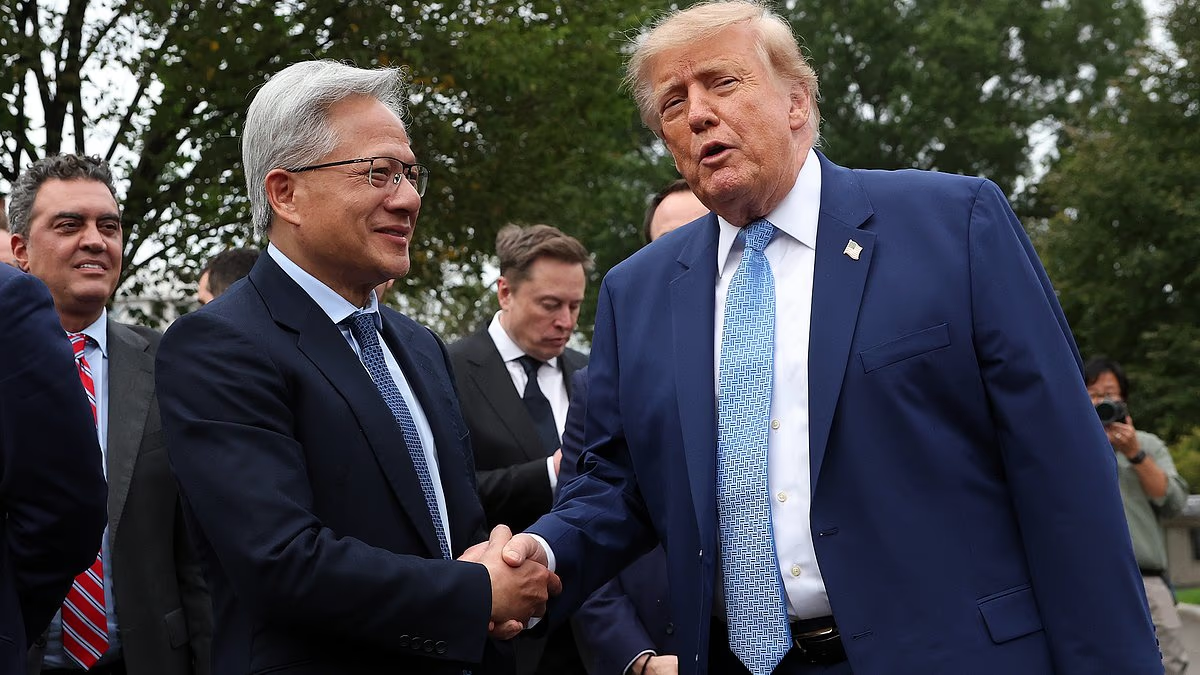
Before returning as Nvidia CEO on Monday, Jensen Huang reportedly told the board he had “additional affairs beyond the two that had already been widely reported” (Pictured: Jensen Huang with Alice Huang)
Elon Musk also backed Huang, as did venture capitalist and White House adviser David Sacks. The four men involved—Trump, Vance, Musk and Sacks, only two of whom hold elected office—appear to have exercised extraordinary influence over the decision. Their names are likely to remain linked in future news reports and perhaps even in the history books. It would also be unsurprising if all four were eventually asked to explain their roles, with Musk and Sacks potentially required to testify under oath.
Trump’s risk is clear: Huang’s return could prove excellent for Nvidia and the United States while creating a serious political liability for the White House and congressional Republicans.
As Huang returns to running the company, several investigations continue. The Justice Department is reportedly examining whether Nvidia’s advanced AI chips were improperly routed to China through the company’s customers. Reuters has reported that the Securities and Exchange Commission is investigating Nvidia’s accounting, while California’s attorney general has subpoenaed the company.
Huang is also scheduled to appear before House investigators on December 1 and the Senate Banking Committee on December 3. Tom Cotton, the Republican chairman of the Senate Intelligence Committee, has voiced concerns, as have Republican power broker Newt Gingrich and other Trump allies.
Democrats, meanwhile, are set to take control of Congress in January. They will have their own questions about whether the White House offered Nvidia’s directors anything in exchange for bringing Huang back.
Still unresolved is the precise nature of Huang’s relationship with Alice Huang, the former chief executive of Singapore-based data company Megaspeed. She has allegedly been connected to Chinese intelligence agencies, allegations Beijing has denied.
Trump and the White House have assured Nvidia that Huang has not violated any laws. “We gave them assurances, at least with everything we know,” the president told CNBC. “We believe he’s fine. He’s absolutely fine.”
But who exactly does “we” mean?
Secretary of State Marco Rubio, who reportedly warned government officials earlier this year that Huang was involved in a compromising relationship, has not expressed the same level of confidence in Nvidia’s chief executive.
“Mr. Secretary, is Jensen Huang’s reinstatement a national security risk?” a reporter asked Rubio on Monday. He smiled, turned and walked away without answering.
Treasury Secretary Scott Bessent also appears to have changed his position. He had previously urged Nvidia to choose an executive from “outside” the company as its next leader. Yet during a Sunday appearance on Face the Nation, Bessent dismissed the controversy surrounding Huang’s affair as a “canard”—a sign of the direction events were heading.
As I noted last week, Bessent appeared to take a shot in what looked like “Cabinet warfare” against Commerce Secretary Howard Lutnick. He effectively blamed Lutnick’s department for failing to act more quickly to prevent Megaspeed from acquiring sensitive Nvidia technology.
“Commerce has the pen,” Bessent said. “You will have to ask them about their internal processes.”
Trump, however, has shown little interest in publicly rebuking his Commerce secretary. Huang’s reinstatement may suggest that the president prefers Lutnick’s approach to regulating AI-related trade.
Indeed, both critics and defenders of Bessent and Rubio say Monday’s decision highlights two broader realities.

Elon Musk joined David Sacks, the venture capitalist and White House adviser, in supporting Huang

Critics and supporters of Bessent and Rubio alike say the decision exposes two important realities
First, the administration’s hard-line strategy in the competition with China over AI remains unsettled.
There is a strong argument that returning Huang to Nvidia serves American interests. If, as Trump clearly believes, U.S. leadership in artificial intelligence is both a national-security imperative and the economy’s greatest opportunity, then allowing the person who built Nvidia to disappear from the company would carry significant risks—particularly while China sought to capitalize on his absence.
Second, even the most powerful Cabinet secretaries in Trump’s orbit ultimately answer to the “Decider-in-Chief.”
And then there is Alice “No Relation” Huang. What happens if she decides to tell her own story?
So far, nearly everyone connected to the controversy has spoken more than she has. That could change quickly—and if it does, her account could alter the entire course of the Nvidia saga.