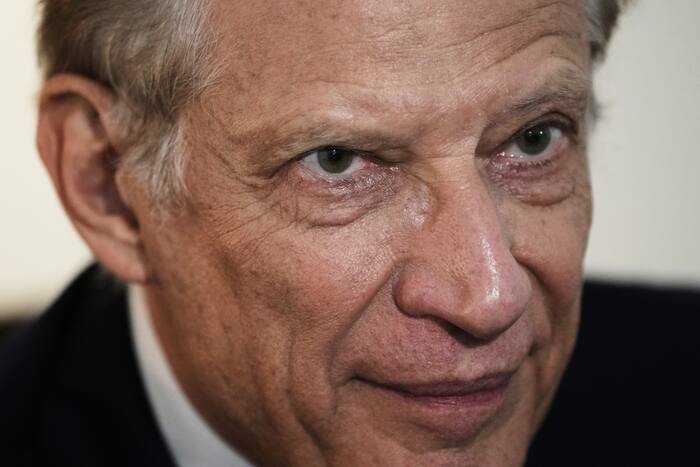

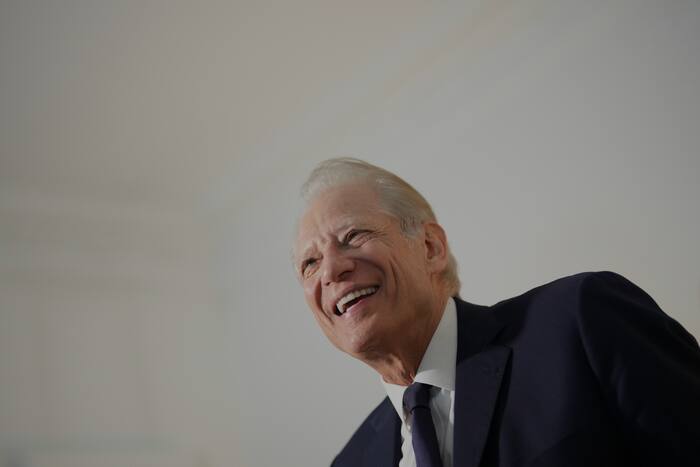
PARIS – Dominique de Villepin, the former conservative prime minister who gained global recognition as France’s leading voice against the U.S.-led invasion of Iraq in 2003, is campaigning once again — this time to keep the far right from taking power in France.
In an interview with The Associated Press, the 73-year-old former ally of late President Jacques Chirac said his central motivation for entering next year’s election is preventing Marine Le Pen from succeeding Emmanuel Macron.
With France facing deep political divisions and mounting social tensions, de Villepin is presenting reconciliation as the best defense against the far right and a safeguard against national turmoil.
“It’s a huge danger for our republic. It’s a huge danger for democracy,” he said during an extended interview at his campaign headquarters. “I think the way the far right singles out parts of the population, and the way it can open the door to xenophobia, racism and antisemitism, justifies the major fight we are preparing for. I believe that if France falls into the hands of the far right, all of Europe will fall.”
De Villepin’s profile rose sharply after his forceful 2003 speech at the United Nations opposing President George W. Bush’s planned invasion of Iraq. As foreign minister, his opposition to the war reflected France’s longstanding emphasis on strategic independence.
France argued that military action in Iraq would violate international law and threatened to veto a U.N. Security Council resolution authorizing the invasion. De Villepin’s position did not stop the war and contributed to strained relations between France and the United States.
Now, his focus is on a threat much closer to home.
French republic at a crossroads
For months, opinion polls have placed Le Pen at the front of the presidential race. They suggest she could reach the May 2 runoff as the leading first-round candidate, ahead of hard-left leader Jean-Luc Mélenchon.
De Villepin cautioned that a Le Pen presidency could produce an illiberal transformation and weaken republican principles. He said proposals to give French citizens preference over foreign nationals in areas such as social benefits, housing and employment would require constitutional amendments.
“France is facing the risk of a regime change,” he said. “Even the idea of a republic would be at stake.”
A veteran of France’s traditional right, de Villepin does not have the support of a major political party. Still, he believes he can overcome the odds and reach the second round by attracting voters worried about the far right’s uncompromising approach.
He enters a crowded contest that includes judo champion Teddy Riner and two former prime ministers who served under Macron. Whether de Villepin — or any of his challengers — can qualify for the presidential runoff remains one of the campaign’s defining questions as candidates compete to consolidate the center.
De Villepin has also adopted themes with appeal beyond the right, presenting culture and environmental protection as national priorities. His vision for France emphasizes compromise and a stronger public role in decision-making, including through referendums.
A push for greater social justice
“We need to understand that without a degree of minority consent, there can be no peace in a democracy,” de Villepin said, while calling for broader social justice.
He maintains that inherited privilege, limited social mobility and an uneven tax system have eroded public trust and weakened social cohesion. As a result, many voters feel the political system no longer represents their interests.
“We are a society of heirs, with people inheriting their position,” he said.
Internationally, de Villepin wants Europe to adopt a more forceful stance. He is urging the European Union to resist President Donald Trump’s tariffs and play a more active diplomatic role in Ukraine and the Middle East.
“We have to explain to Donald Trump that he is not the king of the world,” he said.
Yet despite his resolve, it is still uncertain whether de Villepin will qualify for the ballot. He must obtain endorsements from 500 elected officials, a threshold he failed to reach when he sought to run in the 2012 presidential election.
“It’s tough,” he said of the effort to secure endorsements.
___
Nicholas Garriga contributed to this report


