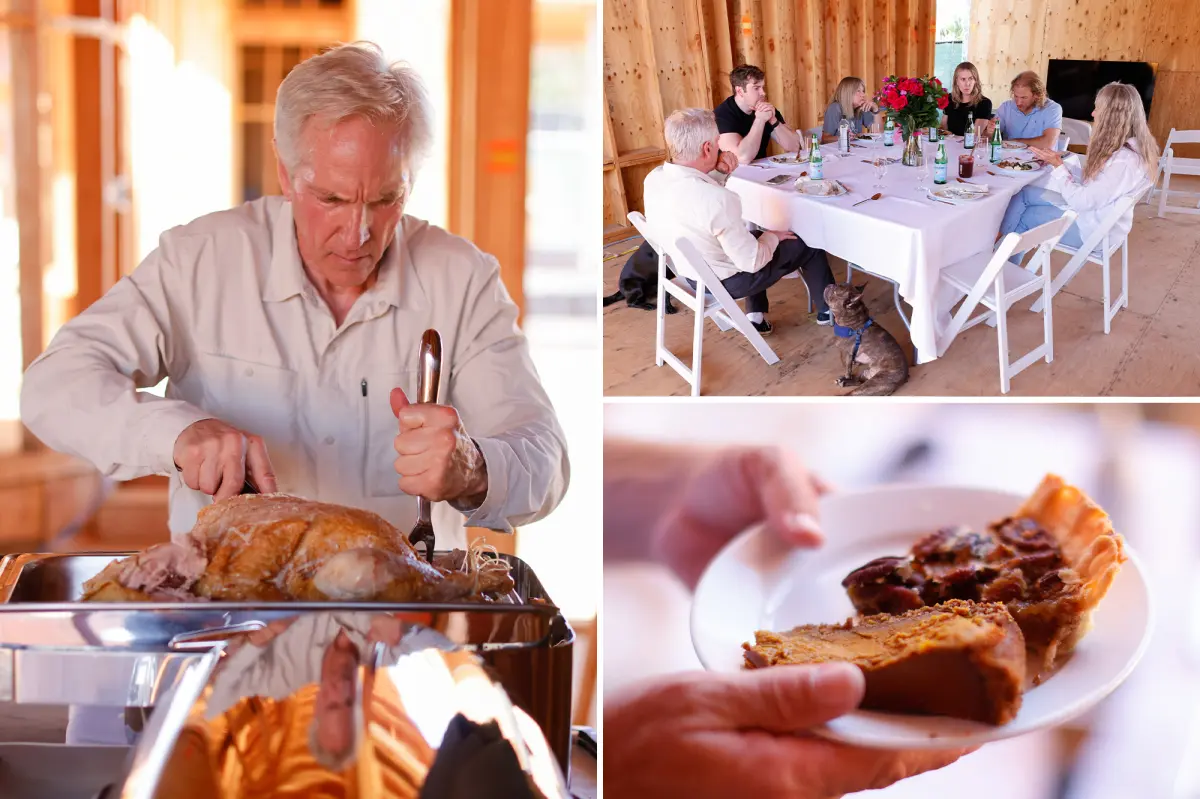

The Pacific Palisades’ long road back was visible on Thanksgiving, when one family gathered for a holiday meal inside the exposed wooden frame of its fire-damaged home. The Pascoes refused to let the slow pace of rebuilding interrupt a tradition that began 32 years ago.
There were no windows, finished walls or completed plumbing. Still, the Pascoes were determined not to spend another Thanksgiving anywhere else.
After growing tired of waiting, the family turned the unfinished structure of their partially rebuilt Pacific Palisades house into a makeshift dining room. The goal was simple: protect a cherished holiday tradition from the community’s painfully delayed recovery.
“The big thing is, it is our home,” Sue Pascoe told the California Post. “This is our home even though it’s not there yet.”
The family had marked Thanksgiving at the same property every year since 1994, until the Jan. 7, 2025, wildfire swept through the coastal community. The blaze killed 12 people, burned more than 23,000 acres and destroyed 6,845 structures.
More than 5,000 single-family houses and 361 mobile homes were among the buildings lost.
“Every Thanksgiving, we would go eat on the patio of this house, which was lovely, and we would send photos of us eating outside to everyone in the Midwest who was in the snow,” Pascoe said.
The photographs may be gone, but the traditions they captured remain.
For years, the Pascoes’ Thanksgiving table has welcomed friends, visitors from out of town and anyone without another place to celebrate.
“The holidays are hard for the thousands who are still displaced, but it’s incredible to see so many families returning to the Palisades, in new homes, making new memories and carrying on old traditions,” Councilwoman Traci Park said.
This year followed the same spirit. Despite the construction debris and unfinished rooms, the family invited a friend and welcomed The Post’s photographer to dinner.
“Every year there would be someone new that might have been out of town who was there or someone who didn’t have someplace to go,” Pascoe said. “It just was a grounding place is what it was on Thanksgiving.”
With her adult children returning for the holiday and little space to host them in the family’s temporary apartment, Pascoe recognized an unlikely advantage in the unfinished house: room to gather.
Her husband, John, supported the plan and arranged rental tables and chairs for the celebration.
The menu featured turkey, dressing, Brussels sprouts, pecan pie and, naturally, ugly cake.
That unusual dessert also carries a story of resilience.
“It looks ugly, but when people eat it, they love it,” Pascoe said.
During the COVID-19 pandemic, Pascoe began trying desserts from across the country and found a recipe for “ugly cake” in a Lutheran church cookbook.
Made with apples, raisins and butter, the dessert quickly became a family favorite, regardless of its unappealing name.
The wildfire destroyed Pascoe’s entire cookbook collection. She remembered the recipe, however, and has since printed copies to share with others.
Pascoe, a longtime journalist who publishes the local outlet Circling the News, has spent much of the past 22 months documenting the disaster that also destroyed her own home.
Even after losing everything, she continued reporting on disaster aid, insurance disputes and the painfully slow recovery of residents trying to rebuild.
Behind those stories, she was also fighting to return to her own property.
Pascoe obtained rebuilding permits in July 2025, only six months after the fire. But securing approval to rebuild turned out to be much easier than securing the money needed for construction.
“At the beginning you have nothing. You really have nothing,” Pascoe said.
For months, the family disputed its insurance payments with State Farm, assembling detailed inventories of the belongings destroyed in the blaze, along with receipts, photographs and replacement estimates.
“They started stalling and stalling, and then they told us we didn’t have the possessions that we had,” Pascoe told The Post.
“We went through seven adjusters,” Pascoe said.
As the delays mounted, Pascoe sought assistance from state Sen. Ben Allen and California insurance regulators.
The family ultimately received its full insurance payment in April 2026 — nine months after obtaining its permits and 15 months after the house burned.
Even a complete payout, however, could not restore everything that was lost.
“You lose your wedding dress. You lose your kids’ baby books. You lose the cedar chest your dad made you,” she said.
“The most devastating thing is the memories you lose.”
The Pascoes’ dispute came as State Farm faced mounting scrutiny over its handling of wildfire claims.
In May, the California Department of Insurance launched legal action against the insurer after identifying 398 alleged violations in 114 of the 220 wildfire claims it reviewed.
State Farm has denied systematically mishandling claims. In May, the company said it had paid more than $5.7 billion on roughly 13,700 fire-related claims.
At the same time, the wide gap between issued rebuilding permits and completed homes highlights the scale of the work still ahead.
Los Angeles has issued more than 2,100 residential rebuilding permits, but only 61 certificates of occupancy, according to the state’s wildfire rebuilding dashboard.
For Maryam Zar, founder and president of the Palisades Recovery Coalition and CEO of the Malibu Pacific Palisades Chamber of Commerce, Thanksgiving underscored both the progress made and the many families still waiting to come back.
“I set my Thanksgiving table today with joy in my heart at being home, mindful of all the people who aren’t,” Zar told The Post.
Zar cited the reopening of Palisades Village and the return of local businesses as encouraging signs of recovery.
“We’ll keep working to make sure every family that wants to come home has a real path back,” she said.
For the Pascoes, the holiday was an opportunity to recognize their progress instead of focusing solely on everything still unfinished.
Pascoe’s daughter Shelby helped remove debris and salvage plants after the fire. Seeing recognizable parts of her childhood home emerge again brought her comfort.
“It’s cool to see how much progress has gotten done,” Shelby said, pointing to familiar features such as the kitchen nook and the three children’s bedrooms.
“There’s different elements that have that home feel, which is really nice.”
As the family shared what they were thankful for around the Thanksgiving table, Shelby’s brother Sawyer gave an answer that captured the moment.
“I’m thankful we’re together and have a roof over our head. A construction roof, but we had a roof over our head,” Sawyer said.
Pascoe’s deepest gratitude, meanwhile, was for the person who helped make the gathering at home possible.
“I am very thankful for my husband, who went through all the effort to get the rentals and everything set up so we could celebrate here,” she said.