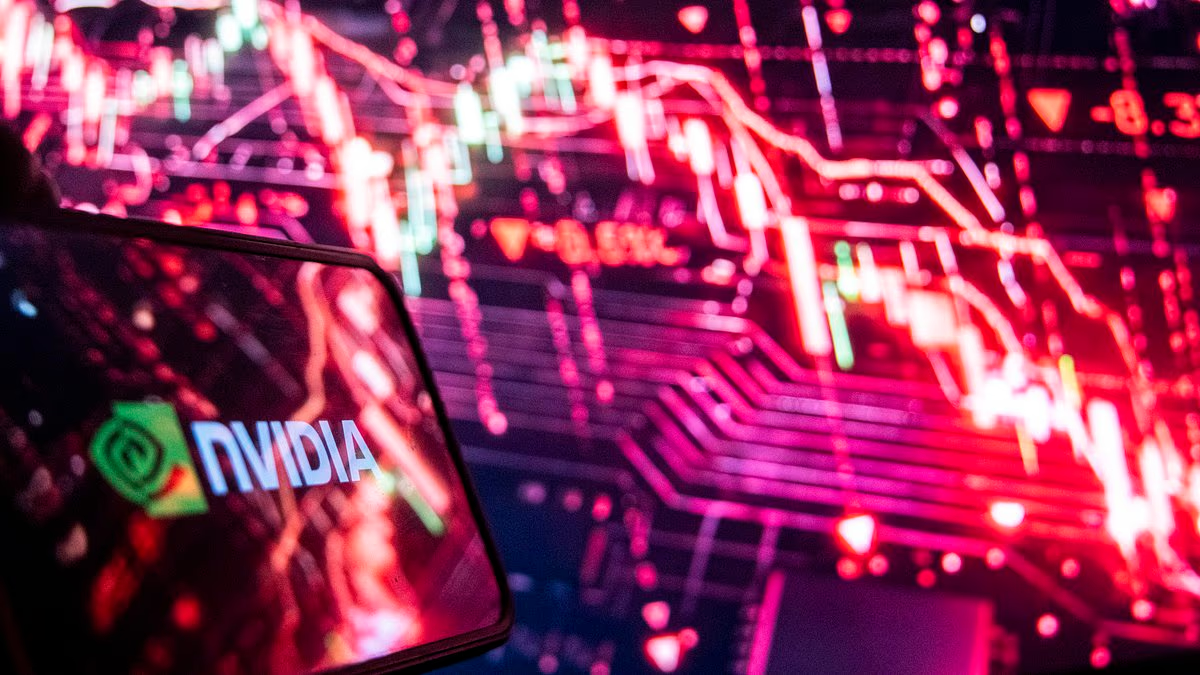
“Carnage” is how one veteran City insider describes the past month.
Anyone reviewing their investments during the latest global market rout is unlikely to disagree.
Technology shares have suffered the heaviest losses. America’s tech-focused Nasdaq 100 has fallen 15 per cent from its peak last month.
Other leading indices have also retreated, although the FTSE 100 – dominated by comparatively defensive banks and industrial companies – remains more than 7 per cent higher this year.
Markets staged a modest recovery towards the end of last week, but leading investors remain concerned that the worst may not yet be over.
The Cboe Volatility Index, Wall Street’s closely watched “fear gauge”, recently climbed to its highest level since President Trump’s “liberation day” tariffs triggered a market sell-off.
“Volatility events often arrive in clusters, but this episode appears particularly manic,” says Chris Beauchamp, chief market analyst at City trading firm IG.

Turmoil: Jensen Huang, Nvidia’s embattled chief executive, has found himself under intense scrutiny
“Once the snowball begins gathering momentum in one direction, it can be extremely difficult to stop.”
A Mayfair hedge fund manager, highlighting the tech shares that have fallen by 20 per cent or more from their recent highs, says bluntly: “We’re already in a stealth bear market.”
For many observers, the focus has fallen on Nvidia chief executive Jensen Huang.
Nvidia’s stock was already under pressure when reports about Huang’s alleged affairs – including one involving an alleged Chinese spy – sent shares in the chipmaker he co-founded into another steep decline. Since their peak in early October, the company has lost $2.8 trillion (£2.15 trillion) in market value.
That figure is roughly equivalent to the annual economic output of Italy or Brazil.
The controversy surrounding Huang’s removal by Nvidia’s board, followed by his return after intervention from Trump, even overshadowed the blockbuster flotation of Anthropic, the developer of Claude.
The listing had been billed as the biggest ever, but its impact was quickly diluted as Anthropic shares fell below their offer price.
For many professional investors, the troubles facing these two artificial intelligence giants point to an uncomfortable conclusion: the technology bubble may be bursting.
They see major challenges beyond the Nvidia controversy, including doubts about AI financing and profitability, as well as growing opposition to data-centre construction that could bring the technology boom to a halt.
Those concerns follow a period of exceptionally high stock-market valuations. Combined with rising interest rates, Trump’s tariffs and geopolitical uncertainty, the result has been a toxic mix for investors.
“Jensen’s return does not resolve the fundamental questions investors were already asking,” says James St Aubin, chief investment officer at California-based Ocean Park Asset Management.
The controversy has also drawn attention to the technology sector’s powerful billionaire founders, whose positions increasingly appear linked to their relationship with the President.
Investors are therefore facing what some describe as a “Washington discount” – lower share valuations intended to reflect heightened political risk.
“If Democrats take control of both chambers of Congress in January, scrutiny could intensify,” says Charu Chanana, chief strategist at Saxo investment bank in Singapore. “The circumstances surrounding his reinstatement also raise wider questions about corporate governance and the rule of law.”
Historian Niall Ferguson is equally sceptical. “The end of the AI boom will not be prevented by the Jensen restoration,” he warns. “Like all major turning points in economic history, it is an event in which great men play only modest roles.
“What matters is not Mr Huang’s libido. What matters is that the artificial-intelligence revolution is facing powerful structural headwinds: higher short- and long-term interest rates, a significant political backlash and an intensifying Cold War II.”
Before Anthropic’s record-breaking listing, investors were asking whether it could revive the AI trade and restore confidence in a faltering stock market.
The answer was an emphatic no.
“It’s grim,” says a respected City fund manager responsible for hundreds of millions of pounds in savings. “People have poured money into the US without properly considering valuations. An adjustment is coming. We will have to see how long it lasts and how severe it becomes.”
Two of America’s most prominent investors – Ray Dalio, founder of Bridgewater, the world’s largest hedge fund, and Ken Griffin of rival Citadel – believe the market is in a bubble that is destined to burst.
CONTINUE READING: Michael Scripps Wikipedia And Age: Is He Still In Jail?

Dalio says: “Almost every technology boom eventually produces a bubble and a bust, whether it involves railways, the Industrial Revolution or the late 1920s.”
Some investors have already reduced their exposure. Berkshire Hathaway, led by Warren Buffett for six decades before he stepped down in September, now holds a remarkable $377 billion in cash.
That does not necessarily mean Buffett expects a crash, but it does suggest he believes many shares are overpriced at current levels.
Owen Lamont, once a fund-management optimist and now with Boston-based Acadian Asset Management, says: “There is a 70 per cent chance that, by November 2026, the US stock market will be in an AI bubble. Smart money is selling.”
In London, the head of market strategy at one of the City’s leading investment banks is even more convinced that the bubble is close to bursting. He has gone as far as selling his personal stake in shares.
“We have warned consistently of an AI bubble since May and have become more bearish,” says Joachim Klement of Panmure Liberum. “We believe the AI bubble is about to burst.”
Gary Channon, a fund manager at London-based Phoenix Asset Management, takes a similar view. “The bubble has nearly run its course,” he says. “It has been a great ride, but the building is on fire. Save yourselves.”
A leading London fund manager adds: “Many people have already been badly burned. During the first half of this year there was intense ‘Fomo’, or fear of missing out, as inexperienced investors rushed into AI. The past few months have been extremely painful for them.”
A market crash would be particularly painful for millions of British savers whose pensions and stocks and shares Isas are invested in equities. Yet London, with relatively few technology companies, could prove a defensive refuge.
“UK shares are the best place to hide,” says Klement, pointing to pharmaceutical groups GSK and AstraZeneca, as well as pub chain
JD Wetherspoon. He adds: “After all, if the market crashes, what else can you do but go to a pub?”
DIY INVESTING PLATFORMS

AJ Bell
AJ Bell
Simple investing with ready-made portfolios

Hargreaves Lansdown
Hargreaves Lansdown
Free fund dealing and investment ideas

interactive investor
interactive investor
Flat-fee investing from £4.99 a month

Freetrade
Freetrade
Stocks and shares Isa free on the basic plan

Trading 212
Trading 212
Commission-free share dealing with no account fee
Affiliate links: If you take out a product This is Money may earn a commission. These offers are selected by our editorial team because we believe they are worth highlighting. This does not affect our editorial independence.


