
Initial laboratory testing found no increase in lead contamination in southeastern Iowa’s drinking water or lakes after the Army carried out a controlled detonation of 5 tons of unstable lead azide, federal environmental officials said Saturday.
The Environmental Protection Agency said results from 38 public drinking-water samples and 26 recreational-water samples collected after Wednesday’s explosion at the Iowa Army Ammunition Plant in Middletown showed no lead linked to the blast.
However, the agency has not yet published results from most of the 1,616 post-detonation samples collected from air, tap water, soil and dust. The delay has prompted skepticism among environmentalists, who say the testing remains incomplete.

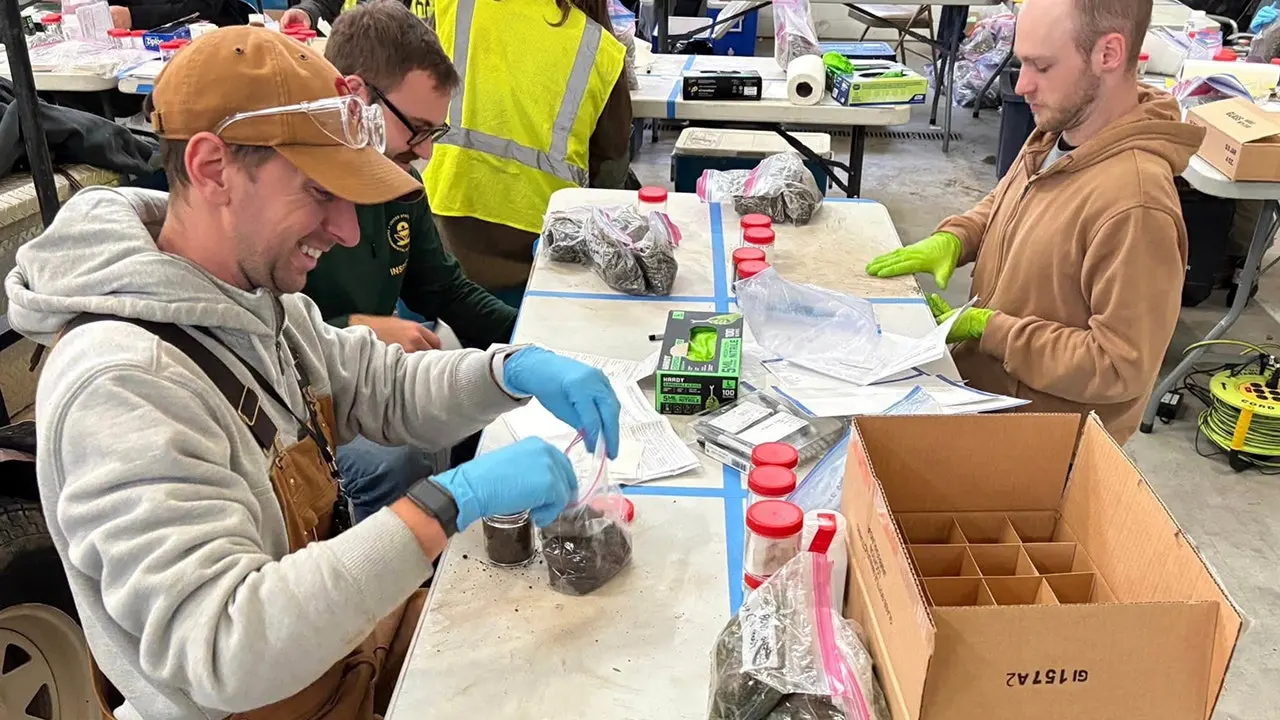
This image provided by the U.S. Environmental Protection Agency (EPA) shows workers in Middletown, Iowa, preparing soil samples for shipment to laboratories on Thursday, Nov. 26, 2026. (EPA via AP)
The drinking-water testing covered both untreated intake water and treated water, while recreational samples were collected from lakes, ponds and other sources not used for drinking, the EPA said. The agency also reported no airborne lead detections during the 30 consecutive hours following the detonation.
“Our priority remains the health and safety of our residents,” Muscatine Mayor Brad Bark said in an emailed statement to The Associated Press. He described the early findings as “reassurance for communities” in his city, located about 50 miles north of Middletown. “We will continue to follow the recommendations and stay in close coordination with the EPA, the Army, state and county partners.”

Environmental Protection Agency On-Scene Coordinator Sharon Kennedy, left, catalogs soil samples collected by contractors in Augusta, Iowa, on Wednesday, Nov. 25, 2026. Augusta lies along the perimeter of the Iowa Army Ammunition Plant, where the U.S. Army detonated a stockpile of lead azide earlier that day. (AP Photo/Austin Johnson).
Agriculture Secretary Brooke Rollins said on X that the U.S. Department of Agriculture continues to work in Iowa with state and federal partners to assist farmers, ranchers and rural communities.
But some residents and environmental advocates remain unconvinced that the region is out of danger.
CHECK THIS OUT: Hunters Race to Stop Burmese Pythons Moving North in Florida
Wally Taylor, legal chair of the Sierra Club Iowa Chapter, told The Associated Press that he lacks confidence in the EPA’s preliminary findings and believes it is still “too early to make any firm conclusions.”

A plume rises after the U.S. Army detonated a stockpile of lead azide at the Iowa Army Ammunition Plant in Middletown, Iowa, on Wednesday, Nov. 25, 2026. (AP Photo/Austin Johnson)
“The lead had to go somewhere,” Taylor said, arguing that contaminants may still have spread around the blast site. He said he is awaiting results from the University of Iowa and other research organizations. The Sierra Club chapter was among the environmental groups that petitioned to halt the permit authorizing Wednesday’s detonation.
Lead is a heavy metal that presents particular dangers to children and pregnant women. The Army has said immediate detonation was the safest option because the aging material was deteriorating and could have triggered an uncontrolled explosion as colder weather approached.

The U.S. Army detonates a deteriorating stockpile of lead azide at the Iowa Army Ammunition Plant in Middletown, Iowa, on Nov. 25, 2026. (Reuters/Jim Urquhart)
The explosion has also drawn criticism from residents and some lawmakers over the government’s handling of public warnings. Although Middletown residents were aware of the plan, many elected officials and members of the broader public did not learn about the risks until just days before the scheduled detonation.
EPA teams and approximately 300 personnel collected more than 3,200 samples before and after the blast. The sites included 27 public parks with playgrounds, schools, daycares and churches, along with farms and locations throughout the Mississippi watershed.
More laboratory findings are expected in the coming days and will be posted at epa.gov/IowaData as officials validate the results.