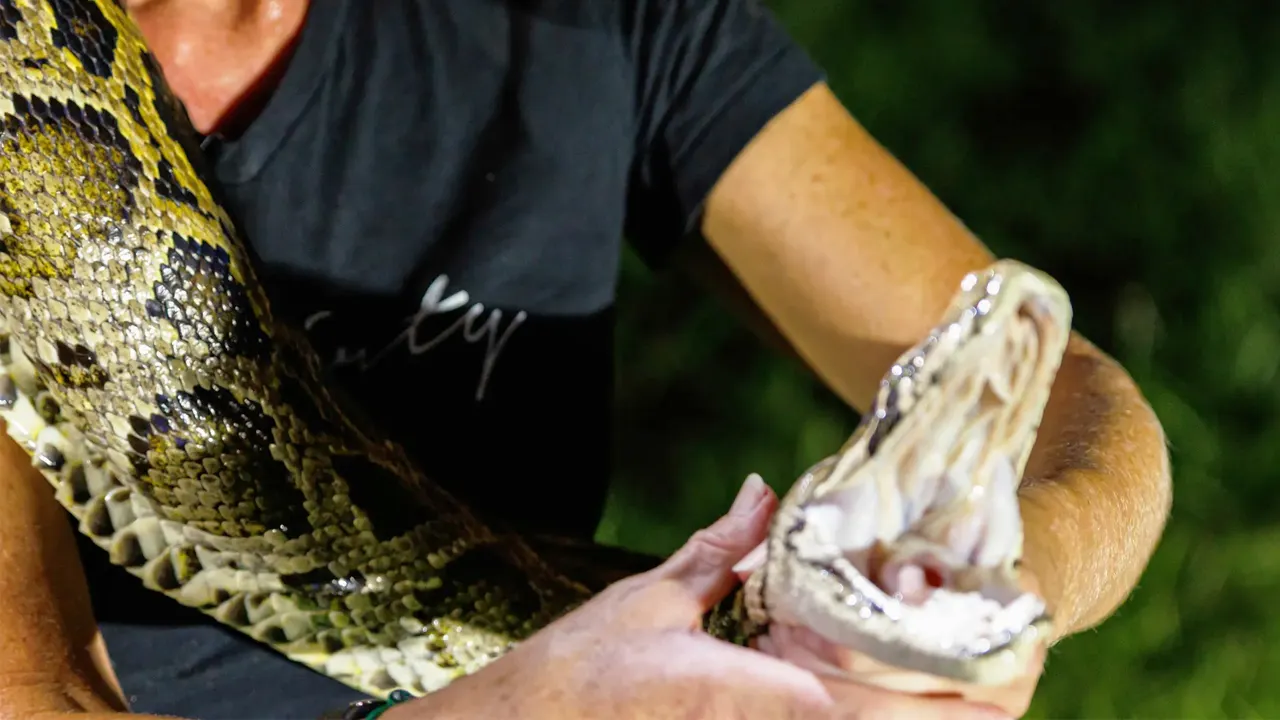

COLLIER COUNTY, Fla. – For more than two decades, Burmese pythons have disrupted the Florida Everglades. Now, wildlife experts caution that the invasive snakes may be expanding their range northward.
Scientists once believed periodic hard freezes would keep Burmese pythons confined to South Florida. But recent observations show the snakes can survive cold spells by retreating into burrows—and in some cases, reproducing there.
“They’re following the food, first of all,” said Amy Siewe, a professional python hunter and guide. “But they’re also taking over gopher tortoise and armadillo burrows. Those shelters help them get through the colder Florida nights they normally wouldn’t survive.”
Siewe, known as the “Python Huntress,” has made the search for Burmese pythons her full-time career. In 2019, she left a 13-year real estate career after learning more about Florida’s invasive snake crisis and transformed her lifelong interest in reptiles into a mission to protect native wildlife.
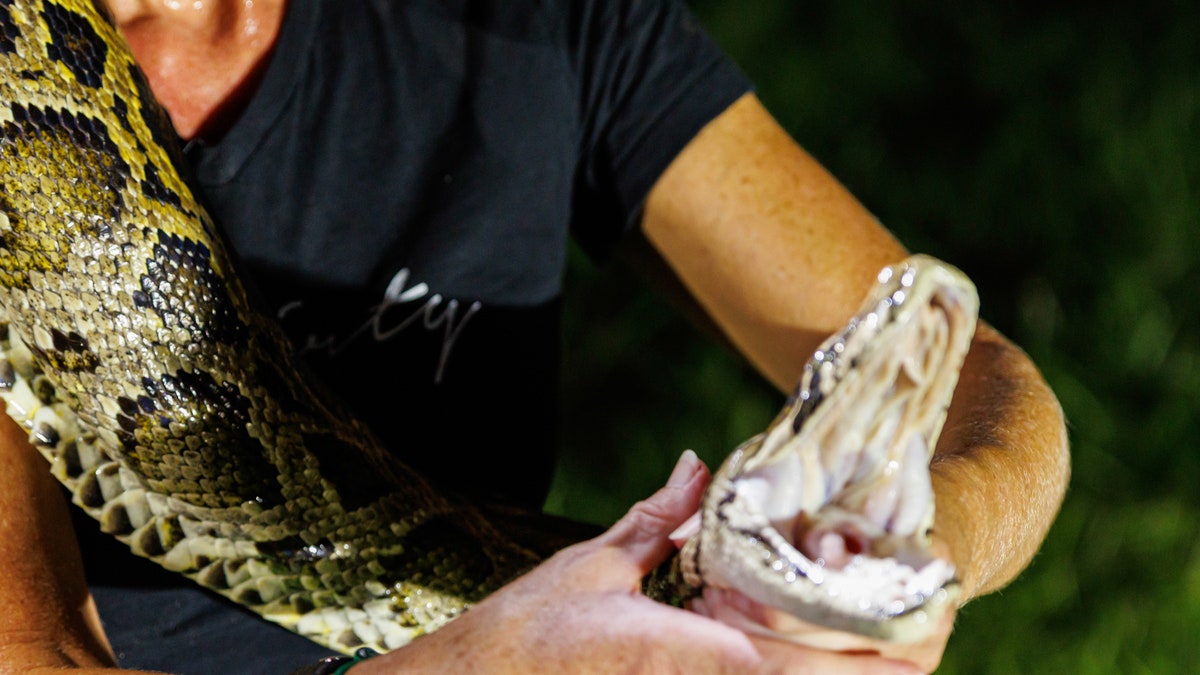
Amy Siewe holds an invasive Burmese python. (Amy Siewe / pythonhuntress.com)
“They consume 98% of the mammals in some parts of the Everglades,” Siewe said. “They are causing tremendous damage to the ecosystem, so we have to do everything possible to remove them and protect native wildlife. We still don’t know the full extent of the harm they could cause in the years ahead.”
Siewe’s husband, Dave, and their puppy, Dixie, often join the search. Fox News Multimedia Reporter Amy Galo accompanied the team on a hunt in Collier County, offering a firsthand view of how difficult it can be to locate the well-camouflaged snakes.

Python hunter Amy Siewe scans the Everglades from her truck’s snake deck. (Amy Galo)
“Dixie is essentially showing us where the snakes are,” Siewe said as the dog worked through the brush. “When she detects one, she gives us her signal. Once she sits, Dave calls her back, and I go in to confirm that a python is there.”
Siewe heads into the Everglades several times each week and also leads guided python-hunting expeditions.
“This is our snake deck,” she said. “It’s a platform mounted on the truck that gives us extra height, making it easier to spot pythons in the grass, water and surrounding vegetation.”
CHECK THIS OUT: Wife of Alexander Brother Breaks Down in Tears on Street Following Guilty Verdict

Amy Siewe’s dog, Dixie, is trained to locate invasive Burmese pythons. (Amy Galo)
Conservative estimates suggest that tens of thousands of Burmese pythons inhabit the Greater Everglades. Determining the exact population is nearly impossible because the snakes blend so effectively into their surroundings.
Siewe said the snakes remain motionless for approximately 85% of their lives, often in places people cannot easily reach.
“We’re always excited when we catch one—we’re always hoping to find another,” Siewe said. “But many trips end without a single snake. That’s simply part of hunting pythons.”
The Florida Fish and Wildlife Conservation Commission says more than 23,000 Burmese pythons have been removed from the state. In recent years, however, sightings have emerged farther north.

Amy Siewe and Dixie search the tall grass of the Florida Everglades. (Amy Galo)
“There are two separate populations—one in Brevard County and another in Charlotte County,” Siewe said. “Based on current scientific knowledge, researchers believe they resulted from separate events rather than being an expansion of the long-established Everglades population.”
Once Burmese pythons establish a breeding population, removing them completely becomes extraordinarily challenging.
“The trouble is that you may not realize they’re there until the situation is far beyond your control,” Siewe said. “They spend about 85% of their time without moving. Finding one python could mean there are as many as a thousand more that remain undetected.”
She noted that the snakes typically lay between 20 and 40 eggs annually, while particularly large females can produce more than 100. “It becomes a cycle that never seems to end,” she said.
For that reason, researchers say spotting new populations early—and educating the public about the risks of releasing captive snakes—will be critical to stopping the invasive Burmese python from spreading farther.


