
Share this @internewscast.com
In recent days, North America has been shaken by two devastating shooting incidents.
On Monday afternoon, a high school ice hockey tournament in Rhode Island was abruptly disrupted by gunfire. As the shots echoed through the arena, a livestream captured the chaos, showing spectators diving for safety and players hastily exiting the ice.
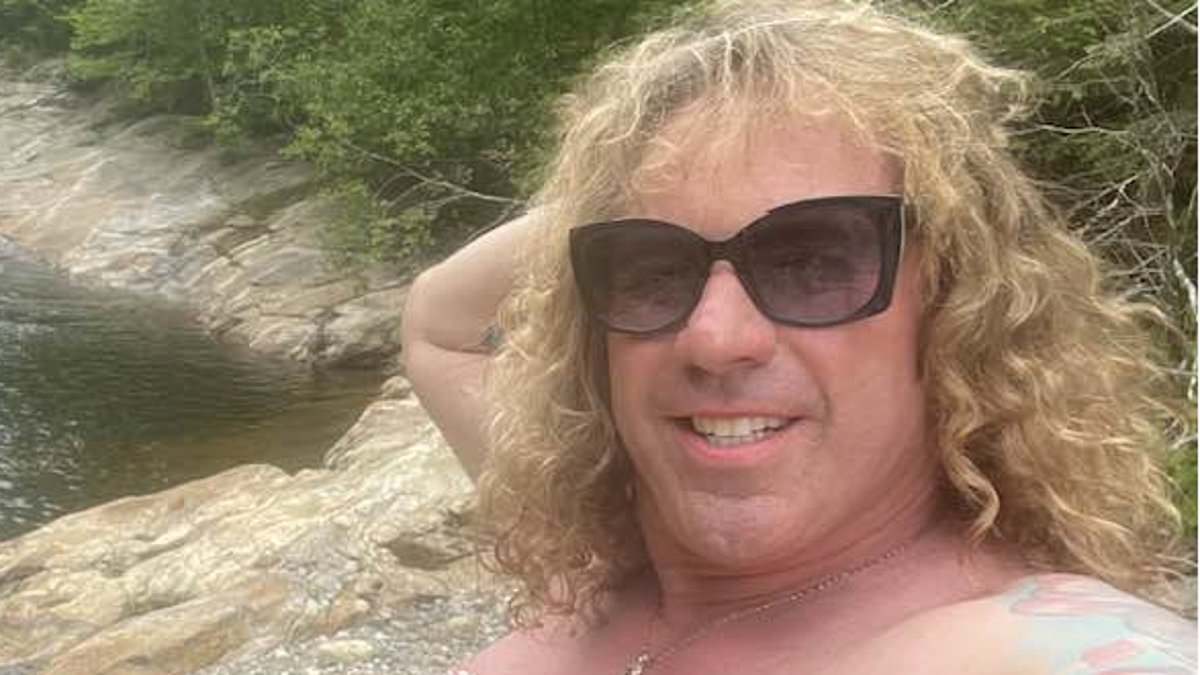
The shooter, positioned at the front of the stands, claimed the lives of two individuals and left three others critically injured. Authorities have identified the gunman as 56-year-old Robert Dorgan, also known as ‘Roberta Esposito,’ who ultimately died from a self-inflicted gunshot wound.
Reports have since revealed that Dorgan, a biological male living as a woman, targeted his own wife, three children, and a family friend at the event before taking his own life.
This tragedy follows another horrific event just a week earlier in Canada, marking one of the deadliest school shootings in the country’s history. Six students and teachers lost their lives, and dozens more were wounded, at the hands of another shooter identifying as transgender.
Further investigation disclosed that the alleged gunman, 18-year-old Jesse Van Rootselaar, had killed his mother and stepbrother at their home before launching the attack on the school.
Bizarre initial reports from police described Van Rootselaar – who died at the school apparently from self-inflicted injuries – as a ‘gunperson’ and a ‘woman wearing a dress’. Van Rootselaar had begun ‘transitioning’ about six years ago before dropping out of school, and was understood to have taken his mother’s surname, Strang, at school.
These two recent atrocities are just the latest in a string of incidents that have raised the troubling question over whether there is a statistically significant link between trans people and mass shootings, which some on the American Right have blamed on the drugs prescribed to trans people as part of their gender reassignment treatment. In September, it emerged that senior officials within the US Department of Justice (DOJ) were in the early stages of evaluating proposals to restrict transgender people from owning guns.

Robert Dorgan, a biological male who was living as a woman, opened fire on his own wife, three children and a family friend at the match, before turning the gun on himself

Initial reports from police described Jesse Van Rootselaar – who died apparently from self-inflicted injuries – as a ‘gunperson’ and a ‘woman wearing a dress’
That news came just days before the murder of Right-wing American activist Charlie Kirk at Utah Valley University. While his alleged shooter, Tyler Robinson, isn’t trans himself, he was a passionate advocate of trans rights and had a trans-identifying boyfriend.
Kirk’s murder, meanwhile, came just weeks after two children died and 19 others were injured in a horrific church shooting in Charlotte, North Carolina, in which the 23-year-old suspect, Robin Westman, was found to be trans, having legally changed his name in 2019 on the grounds that he ‘identifies as a female and wants her [sic] name to reflect that identification’. Investigators looking for a motive for the killings said Westman was in possession of a notebook that contained images of a trans pride flag and guns.
Needless to say, mass shootings are rarer in Canada than in the US. But it is striking that two in a single week in North America have apparently been committed by trans-identifying individuals. Indeed, members of Donald Trump’s inner circle have compiled a list of seven other US mass shootings in recent years said to have been carried out by trans people or those ‘confused in their gender’.
They go back as far as 2018, when 26-year-old Snochia Moseley shot and killed four people at a pharmacy in Maryland, before killing herself. A close friend of Moseley’s claimed the killer identified as transgender.
In 2019, then-16-year-old Maya ‘Alec’ McKinney and a fellow student opened fire inside a school in Colorado, killing one person and injuring eight. McKinney, a female, identifies as male.
Lee Aldrich, a 22-year-old male who identified as ‘non-binary’, attacked a gay night club in Colorado in 2022, killing five and injuring at least 20 others. (Some critics believe he only later claimed to be non-binary to avoid hate-crime charges).
Audrey Hale, 28, shot dead three children and three adults in 2023 at a Christian primary school in Nashville, Tennessee, before being shot dead by police. Female-born Hale, who was under medical care for ‘emotional disorder’, had asked to be referred to by a new male name as well as by male pronouns.
Also in 2023, Kimbrady Carriker, 40, a cross-dressing man who didn’t identify as trans, carried out a mass shooting in Philadelphia, killing five.
Then in January 2024, 17-year-old Dylan Butler opened fire at his school in Perry, Iowa. He killed a student and the school’s principal, injuring six more people before he shot himself. Butler’s TikTok profile used ‘he/they’ pronouns and he called himself ‘genderfluid’ on the social media platform, although he didn’t appear to identify as a woman.
And, although they don’t count as mass shooters so have been left out of this particular row, the so-called Zizians, a ‘transgender, radical vegan death cult’ accused of being involved in at least six killings across the US, boast a membership almost entirely made up of trans people.
Does this all constitute a significant trend? Yes, according to a swathe of prominent US conservatives in politics and the media. ‘This is happening a lot. Something is deeply wrong,’ said Elon Musk on X after last year’s Iowa school shooting. Musk has an estranged transgender daughter – whom he claims has succumbed to the ‘woke mind virus’.
Donald Trump Jr has said: ‘Seems like per capita the radical transgender movement has to be the most violent movement anywhere in the world.’

Audrey Hale, 28, shot dead three children and three adults in 2023 at a Christian primary school in Nashville, Tennessee, before being shot dead by police. Female-born Hale, who was under medical care for ‘emotional disorder’, had asked to be referred to by a new male name as well as by male pronouns

Two children died and 19 others were injured in a horrific church shooting in Charlotte, North Carolina, in which the 23-year-old suspect, Robin Westman (pictured), was found to be trans

In 2023, Kimbrady Carriker, 40, a cross-dressing man who didn’t identify as trans, carried out a mass shooting in Philadelphia, killing five
However, academics counter that the data says otherwise and that, statistically, trans people are not more prone to committing gun violence. Fact-checking organisation PolitiFact examined data collected by the Gun Violence Archive and determined that just seven out of 4,147, or 0.17 per cent, of mass shootings since 2018 were committed by people with a trans or nonbinary identity. Around 0.95 per cent of the US adult population (and 3 per cent of younger Americans) reportedly identify as transgender.
University of Alabama criminologist Adam Lankford said it was statistically too early to say whether the recent spate of trans mass shootings ‘is an aberration or a new trend’.
Both sides in this fraught argument have accused each other of cherry-picking facts to suit their arguments and have disagreed over what constitutes a ‘mass shooting’, and which shooters were definitely trans.
Meanwhile, those who argue that there is an increase in trans and ‘gender-confused’ people turning to violence have largely not addressed why it might be happening.
There’s no research available on whether trans people are more prone to violence (and some experts believe the opposite is true) but studies have shown that young trans people are far more likely to have mental health issues, including depression and suicidal urges.
Other research has suggested that around 70 per cent of mass shooters have some mental health history, and approximately a quarter have evidence of a serious mental illness.
Van Rootselaar, the latest Canadian shooter, wrote online about having mental health issues. Some claim that trans people are becoming violent due to the cocktail of sex hormones they are prescribed.
Health experts have claimed that, while there is evidence ‘masculising’ therapy can increase the risk of psychotic symptoms in patients, there is less research into the effects of high-dose oestrogen in males. However, it is claimed that such medication, taken by trans women, can cause cognitive decline.
Studies also indicate there is a higher rate of suicide among trans people compared to the general population.
But the more popular explanation among those on the American Right campaigning against trans-related violence is that it’s a symptom of how viciously radicalised the pro-trans movement has become in recent years. They believe the issue has become so ideologically extreme that activists now openly advocate violence, even murder, against their enemies.
It seems clear that without proper research into the link between transgenderism and violence neither side can draw definite conclusions.
But one thing’s certain: the toxicity of the debate means many researchers want to steer clear of the topic entirely – so the controversial question is unlikely to yield answers any time soon.