
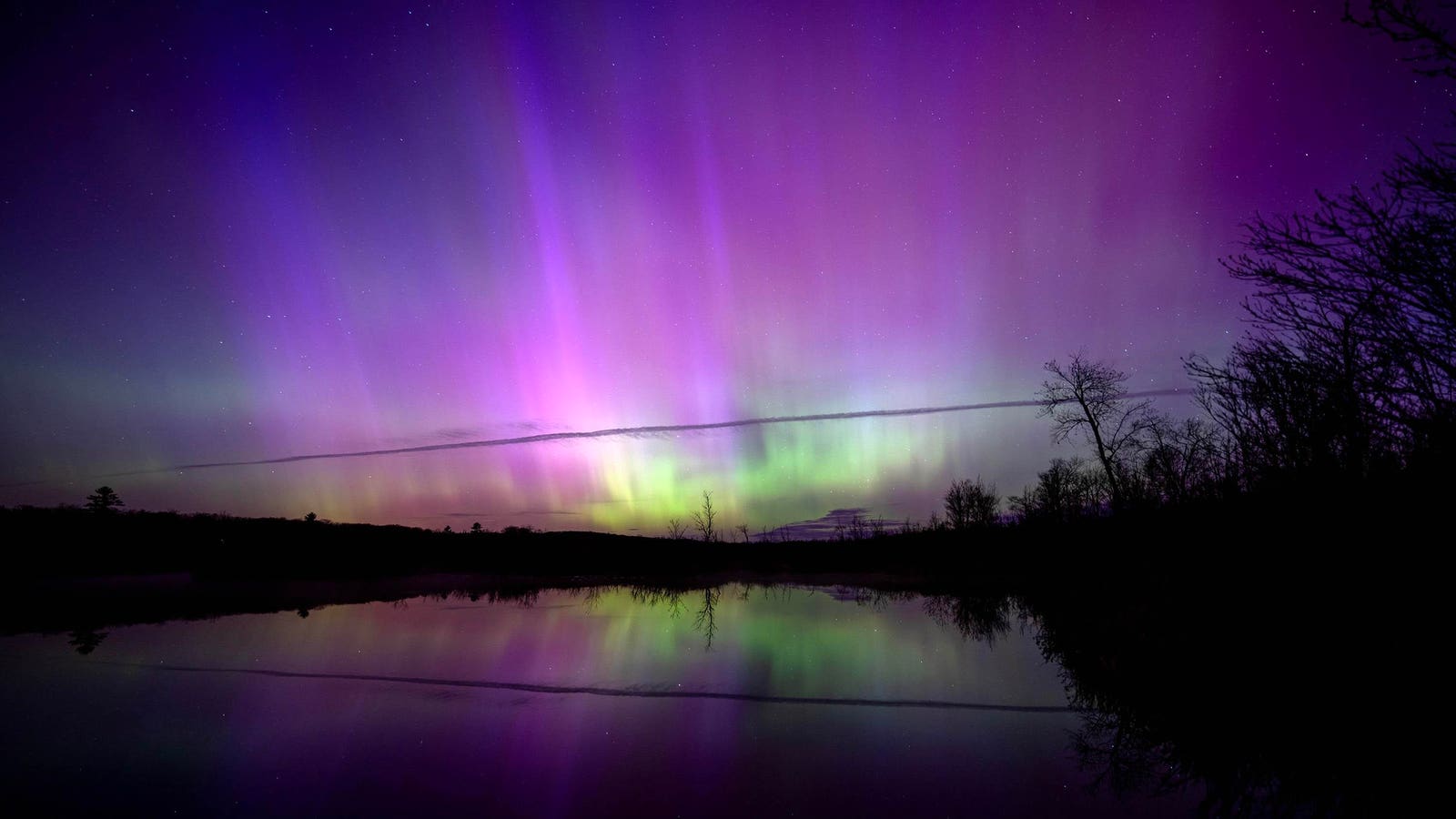
Several states in the northern U.S. may have an opportunity to view the northern lights Tuesday night as geomagnetic storm conditions could pull the phenomenon farther south, according to the National Oceanic and Atmospheric Administration.
Key Facts
NOAA forecast a Kp index of five on a scale of nine for Tuesday, suggesting the northern lights will be brighter and more active farther from the poles.
Tuesday’s auroral forecast comes as some “minor” geomagnetic storm levels are likely late Tuesday and early Wednesday morning, as NOAA cited effects of winds from a cooler, less dense spot on the sun’s surface.
Similar auroral activity is expected Wednesday night with a maximum Kp index of four, followed by a projected Kp index of three for Thursday, though NOAA has not forecast geomagnetic storm conditions for either night.
Where Will The Northern Lights Be Visible?
The highest chance of seeing the northern lights is forecast across northern Canada and Alaska, once the sun sets in the state. A lesser chance is forecast for parts of Washington, Idaho, Montana, North Dakota, Minnesota, Wisconsin and Michigan, with a lower, yet still possible opportunity projected in areas of Wyoming, South Dakota, Iowa, New York, New Hampshire, Vermont and Maine. (See map below.)

What’s The Best Way To See The Northern Lights?
NOAA recommends traveling to a north-facing, high vantage point away from light pollution between 10 p.m. and 2 a.m. local time.
What’s The Best Way To Photograph The Northern Lights?
A wide-angle lens, an aperture or F-stop of four or less and a focus set to the furthest possible setting are recommended to capture the northern lights, photography experts told National Geographic. With a smartphone, NOAA said it’s best to disable flash and enable night mode.
Key Background
Solar events like solar flares and coronal mass ejections are responsible for disrupting Earth’s geomagnetic field and creating the northern lights. More of these events are expected through early 2026, after NOAA and NASA said a “solar maximum” was achieved during the sun’s 11-year cycle late last year. This peak will likely coincide with stronger auroral displays, the agencies said, noting a 500-year peak was hit in 2024.