
Share this @internewscast.com
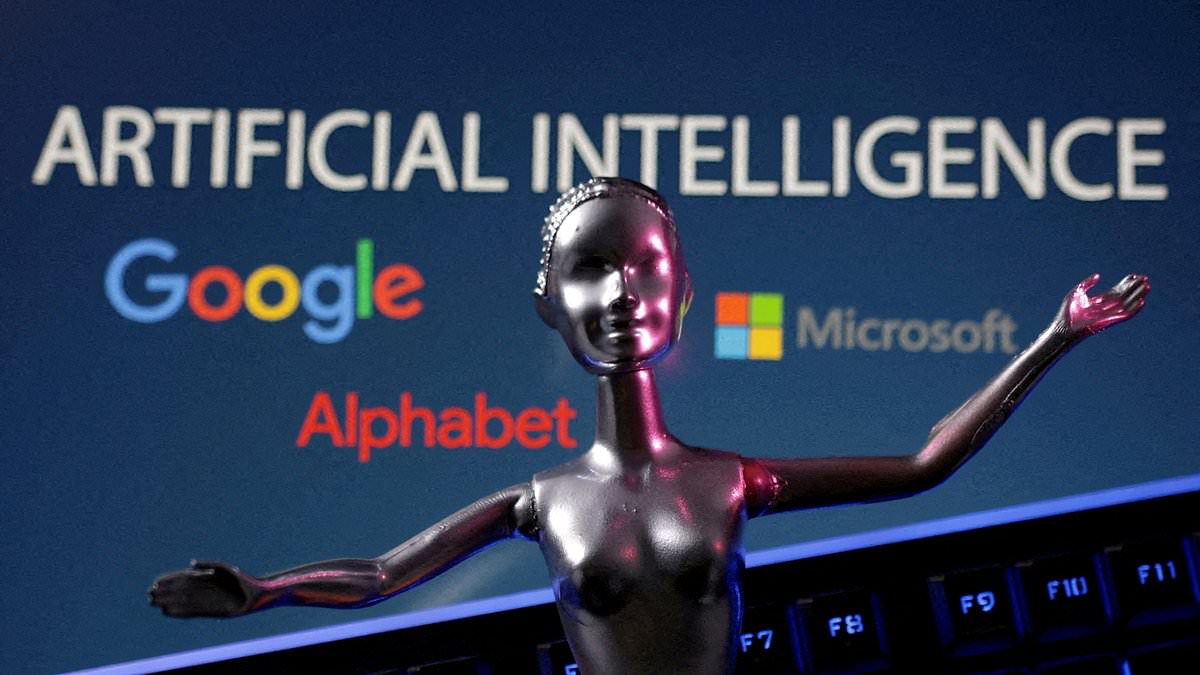
This week, investors with stakes in the “Magnificent Seven” — a group of leading U.S. tech companies including Alphabet, Amazon, Apple, Meta, Microsoft, Nvidia, and Tesla — are being urged to stay vigilant as these giants vie for dominance in the realm of artificial intelligence (AI).
Microsoft’s shares took a significant hit after Wednesday’s earnings report fell short of expectations, resulting in a staggering $357 billion (£260 billion) loss in the company’s market value. This decline serves as a stark reminder that the stock market is poised to react harshly to any perceived shortcomings.
The tech sector’s landscape appears increasingly unstable, with Microsoft’s struggle to convincingly demonstrate the profitable use of its capital fueling concerns about a broader, more painful correction in tech stock prices.
Following Microsoft’s downturn, the remaining members of the Magnificent Seven are under intensified scrutiny to prove that their AI investments are yielding returns, lest they face similar stock market repercussions.
Collectively, these tech behemoths are anticipated to spend a whopping $505 billion (£366 billion) this year, a significant increase from the projected $366 billion (£266 billion) by 2025. A substantial portion of this investment is directed towards constructing and outfitting data centers, or “AI factories,” as Nvidia’s CEO Jensen Huang describes them. Nvidia, valued at $4.3 trillion (£3.1 trillion), is among those wagering heavily on securing a win in the AI race.

Companies are under greater pressure to demonstrate payback from their AI expenditure

Chuck Robbins, CEO of Cisco, warns that the market in Magnificent Seven shares may be in a bubble and that there could be ‘carnage’
The growing sense of unease has been further amplified by recent comments from Chuck Robbins, the influential CEO of Cisco, adding to the industry’s tense atmosphere.
Robbins suspects that AI may be bigger than the internet. But he also warns that the market in Magnificent Seven shares may be in a bubble, and that there could be ‘carnage’. Some companies ‘will not make it’. Cisco was itself one of the most high-profile victims of the dot-com collapse in 2000 but has staged a remarkable comeback – thanks to AI.
Three years ago, when Alphabet and the rest were dubbed the Magnificent Seven in honour of the classic Western, their kingdoms were not in competition. Today their rivalries have been likened to the battles between the separate realms of the fantasy drama Game of Thrones.
The impact of these hostilities may spread beyond the financial markets. Microsoft boss Satya Nadella contends that AI must bring a tangible improvement to ‘education and health outcomes, public sector efficiency and private sector competitiveness’. Or there could be a popular uprising against the tech sector’s huge AI energy consumption.
These conditions are an alert to assess your portfolio. Lauren Hyslop of fund manager Mattioli Woods commented: ‘The monolithic unity of Big Tech’s finest is fracturing. Selectivity, not sentiment, must now guide the discerning investor.’
If you are that kind of investor, this is what you need to know now.
Alphabet

The tensor processing unit (TPU) – a smaller, cheaper type of microchip – is one reason for the new perception of Alphabet whose empire includes Google, YouTube and Deep Mind. Thanks to the TPU innovation, the $4trillion group is now seen as a star chip designer as well as a search engine specialist.
Next Wednesday’s results should reveal the level of demand for TPUs, and whether the upgrades to Gemini – Microsoft’s AI system – continue to be well-received.
Alphabet is now valued at 30 times earnings, following a 75pc rise in its shares over the past six months. This makes it one of the more expensive ‘Mag 7’ members. Yet analysts rate shares in the $4trillion business a ‘buy’.
Amazon

Amazon’s smaller chip – the Trainium – is also in demand, aiding Amazon to implement its strategy for AI dominance.
The $2.6trillion company, which is the world’s largest retailer and the number one cloud computing business, is lavishing supersized amounts on data centres.
Alarm over this largesse means that the shares have only edged up by 4pc over the past six months ago to $241.
But ahead of next Thursday’s results, analysts rate the shares a ‘buy’, apparently convinced that Amazon will contrive to dispel doubts over its strategy. But this week’s reaction to Microsoft’s results indicate that the markets will take some convincing.
Apple

Apple’s shares are up by 23pc to $258 over the past months, thanks to best-ever sales of its phones. The company scored a record of $144bn in revenue for the final quarter.
Some investors approve of Apple’s reluctance to commit vast sums to AI. The company is trusting that the enhanced AI capability of the iPhone 17 and the models set to follow will encourage consumers to upgrade rather than remain faithful to their old devices.
Goldman Sachs now considers Apple a ‘buy’. But the majority of analysts rate the shares a ‘hold’, hinting at the suspicion AI creativity could bring forth new gadgets that draw users away from their phones – which would spell tragedy for Apple.
Meta

The $1.7trillion Meta empire, which encompasses Instagram and WhatsApp, produced such bumper fourth quarter revenues that its shares leapt by 14pc following the figures.
Meta, led by Mark Zuckerberg, appeared to comfortably allay investors’ fears over the billions it is laying out on AI to augment advertising revenues on its platforms. It is also building other AI-based operations.
Hyslop argues that Meta offers genuine value. She commented: ‘In a market where leadership is fragmenting, the company’s diversification helps investors avoid a binary outcome tied to any single storyline.’
Analysts rate the shares a ‘buy’ at the current price of $668.
Microsoft

Not to be outdone by its foes, Microsoft has created its own chip – the Maia 200. But this was overlooked in the shock over the disclosure in the results of a 66pc leap in AI spending by this $3.5trillion group. The performance of the Azure cloud computing division was also seen as disappointing.
Analysts may still rate Microsoft shares to be a ‘buy’ at the current $481, with one broker setting a target of $730.
But, as this week’s results show, such a trajectory could be derailed if Microsoft cannot start to show that it is making money from AI. Ben Barringer from Quilter Cheviot commented: ‘For now, the long‑term opportunity remains compelling, but in the near term, the numbers didn’t quite live up to elevated expectations.’
Nvidia
Nvidia, the sector’s $4.5trillion behemoth, is the name behind the GPU (graphic processing unit) chips that power the smash hit AI system ChatGPT.
Nevertheless it has been in the news more lately over its ‘circular deals’ in which the corporation invests in its customers’ companies. This week, for example, it committed $2bn to CoreWeave a data centre supplier.
Nvidia shares have risen by 11pc to $191 over the past six months.
They remain a ‘buy’ ahead of results next month on the basis that, as Hyslop puts it, Nvidia is the undisputed key protagonist in AI, thanks to its dominance of its chips and its Cuda software platform.
But Dan Boardman-Weston of BRI Wealth Management argues that the shares’ strong run ‘is likely to cap near-term upside’. After all, the price has soared by 26,500pc over the past decade.
Tesla

No company anywhere divides opinion like Tesla. Fans of its mercurial boss Elon Musk are persuaded of the company’s infinite potential. Others are much more dubious, a stance likely to have been confirmed by reports this week that Tesla may merge with Musk’s SpaceX. The rocket company could also get together with xAi, another Musk venture.
Tesla’s results suggested that the $1.4trillion company does not much care that it has been displaced by the Chinese BYD as the top global maker of electric vehicles. It sees robotaxis and its Optimus humanoid robots as the future, a venture that’s set to be supported by a massive surge in AI investment. The aim is to turn Optimus into ‘the greatest product of all time’.
Over the past six months, Tesla shares have leapt by 30 pc to $416. After the results, brokers RBC, who are enthusiasts for the stock, set a target price of $500. But the consensus view is that Tesla is a ‘hold’, reinforcing the message: AI costs can be steep but must also demonstrably effective.
THE NEW TECH NAMES
Other tech names from the US, Europe and the Far East are set to come to the forefront this year. This week’s bumper results from the Dutch microchip machine manufacturer ASML may have propelled its share price to a record €1,281, but it remains a ‘buy’.
The AI boom is creating demand for memory systems. One beneficiary is the Korean company SK Hynix whose shares are 201pc higher than six months ago, but are also still a ‘buy’.
Seagate Technology, a US company, makes hard disk drives for data centre kit. Its shares, which have leapt by 194pc to $439 over the past six months, are considered another ‘buy’.
But anyone investing now in this or any other tech share should be aware of the risks of painful reverse. There will be winners in the AI arms war, but it is not yet clear who they will be.