
Share this @internewscast.com
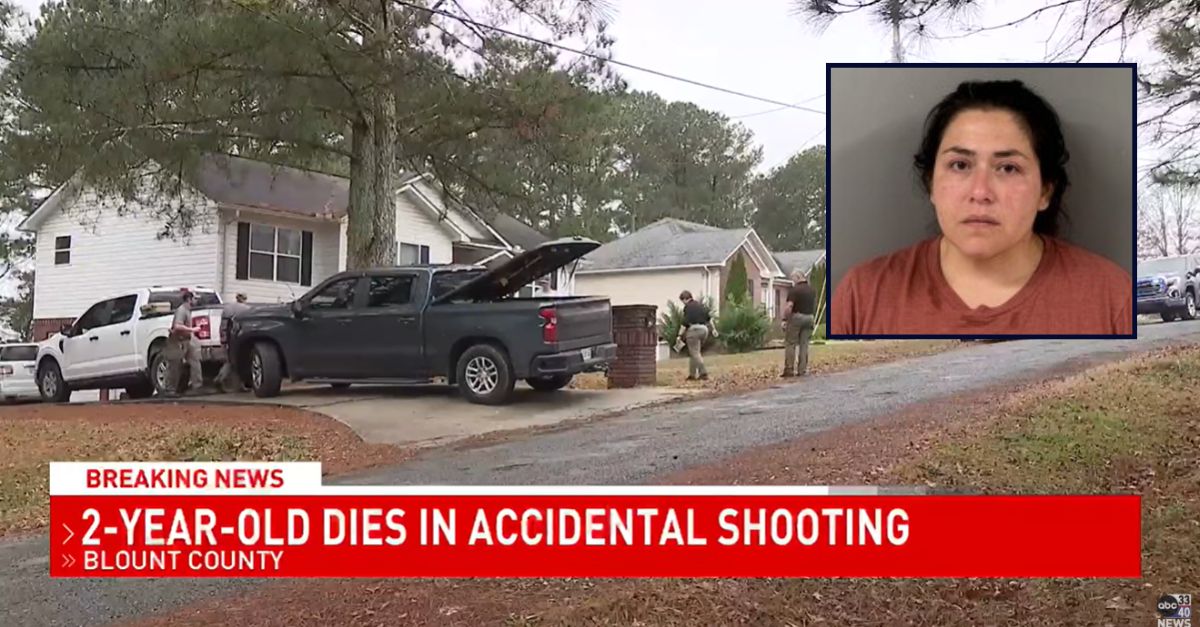
Inset: Evelyn Etress (Blount County Sheriff”s Office). Background: Cops investigate after Etress’ 2-year-old son was accidentally shot and killed in Hayden, Alabama (WBMA/YouTube).
An Alabama woman has been charged after a tragic incident where one of her young children accessed an unsecured, loaded firearm, resulting in the fatal shooting of a 2-year-old boy, authorities reported.
Evelyn Etress, aged 40, is facing charges of manslaughter, aggravated child abuse, and drug-related offenses following the death of her son, Noah, on Wednesday in their Hayden residence, located about 30 miles northeast of Birmingham.
Blount County Sheriff Mark Moon shared with the media during a press briefing that deputies were dispatched around 10 a.m. to a shooting incident at a home on Orchard Circle. Upon arrival, they discovered Noah with a gunshot wound to his head. Emergency medical personnel transported him to the hospital, where he was later pronounced dead by doctors.
Subsequent investigations revealed that Etress was present in the house with her children. While the kids were playing in the master bedroom, Etress was elsewhere in the home. She heard a loud noise and rushed to find her son with a gunshot wound and a .380 caliber handgun in a closet. At the time of the shooting, three children were inside the closet.
During a news conference, Blount County District Attorney Pamela Casey stated there were six children in the house at the time: two 4-year-old girls, an 8-year-old girl, a 9-year-old girl, a 13-year-old boy, and Noah. Etress was the only adult present, Casey noted.
While Casey refrained from identifying who fired the weapon, she clarified that the gunshot wound was “not self-inflicted.”
“Crime scene investigators determined that the projectile had gone through the 2-year-old’s skull, through the wall, hit the ceiling and then landed on the couch,” Casey said.
No other children were injured.
Cops allegedly found at least four firearms that were easily accessible by the children.
Casey said it’s imperative that parents keep firearms secure and away from children.
“They’re children,” she said. “A firearm is not a toy, and it’s not a teaching moment for a toddler, and in this case, as we see, that teaching moment came too late.”
Young kids often don’t know the difference between a toy gun and a real firearm, the prosecutor said.
“When a gun’s left out, a child doesn’t see danger, they see something familiar,” said Casey. “If you think about it, our children play with water guns and with Nerf guns and things of that nature, and these young children just don’t know and as a result a misunderstanding can turn into tragedy in seconds.”
Etress has since posted a $90,000 bond.