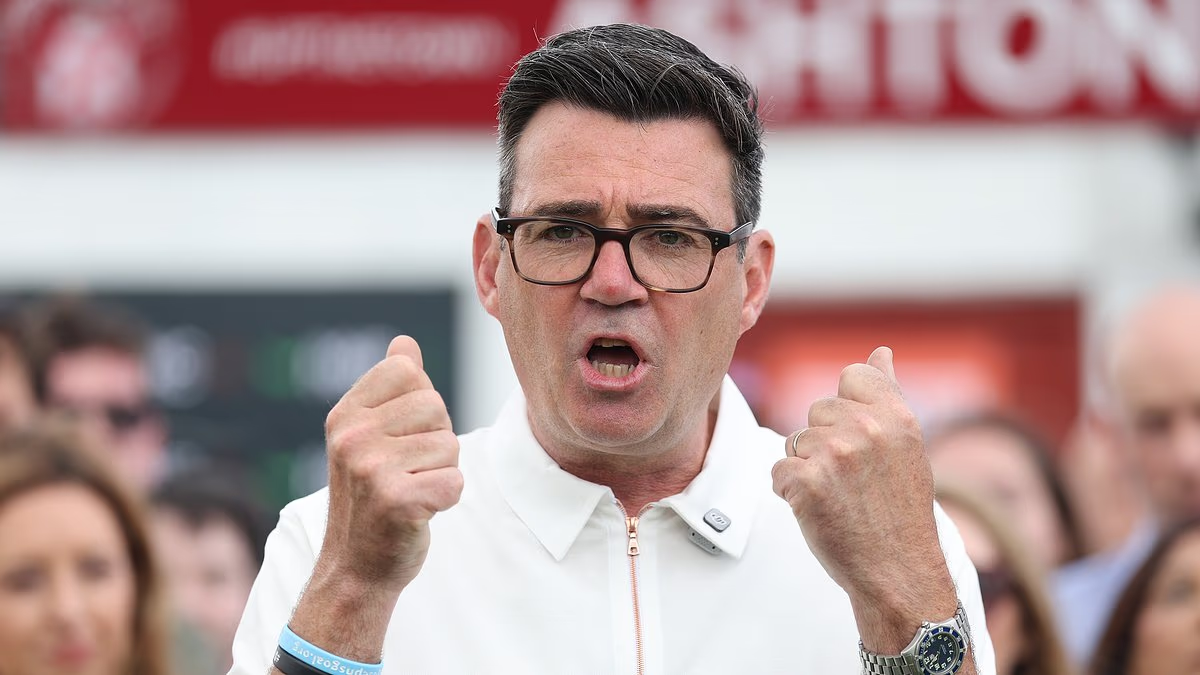

Andy Burnham has been cautioned that a struggling Britain, described by critics as a “basket case,” has little capacity to absorb further tax increases after two difficult years for the economy under Labour.
The newly elected MP for Makerfield appears poised to enter Downing Street this summer, following Keir Starmer’s announcement on Monday that he will step down as Prime Minister.
Some fear his arrival could mark a shift further to the left, bringing renewed tax rises to support ambitious spending commitments and a rapidly expanding welfare budget.
However, the overall tax burden is already at a record level after Chancellor Rachel Reeves introduced £75billion in increases since taking office less than two years ago.
Those measures have weighed heavily on companies and families, while the wider economy has struggled, leaving what some describe as a “lost generation” of young people facing poor job prospects and long-term reliance on benefits.
Mohit Kumar, an economist at investment bank Jefferies, said: “It is not obvious where the money for any additional spending will come from. Taxes have reached a stage where further rise in taxes would be counterproductive.”

Andy Burnham is heading toward Downing Street after securing victory in the Makerfield by-election
Bond markets are now watching closely for any indication that a Burnham-led administration would open the spending taps.
Gilt yields seesawed on Monday before edging lower on hopes a prolonged leadership contest – and the uncertainty that would bring – can be avoided. The pound also crawled higher against the dollar but fell against the euro.
But at close to 4.8 per cent, the yield on the UK’s ten-year gilts are the highest in the G7 and among the highest in the developed world.
Mike Bell, head of market strategy at RBC Bluebay, said: ‘It wouldn’t be surprising at all if we saw ten-year gilt yields trade back up to 5 per cent with the market starting to question the credibility of Burnham and the fiscal trajectory for the UK.’
Matthew Ryan, head of market strategy at Ebury, added: ‘Sterling and gilts are holding up for now, but we view this as an unambiguously negative development for UK assets.
‘Burnham sits firmly to the left of the Labour Party, and his record as mayor points to a significant step-up in public spending, a higher tax burden and greater gilt issuance. This is an experiment that the UK can ill-afford.
‘The critical near-term question is who becomes Chancellor. Any indication that a new Chancellor intends to loosen or abandon the existing fiscal rules could trigger fresh selling in UK assets.’
Higher bond yields would push up the cost of borrowing for the government, businesses and households – as was the case after the Liz Truss mini-Budget in 2022.
Adam French, head of consumer finance at Moneyfactscompare.co.uk, said: ‘Episodes of political volatility tend to push up borrowing costs as investors demand a greater premium for perceived risk.
‘The lessons of the 2022 mini-Budget remain fresh. Fiscal headroom is tight and money markets will be watching the UK closely.
‘If plans don’t add up, the subsequent loss of confidence can quickly drive up borrowing costs. Once again, it is households which risk picking up the tab if market confidence is undermined.’
Rain Newton-Smith, chief executive of the Confederation of British Industry, said business needs ‘stability, confidence and a clear path to growth’.
Neil Carberry, boss of the Recruitment and Employment Confederation, urged whoever takes over from Starmer to back business ‘rather than imposing solutions that sound good to Westminster think-tanks and more radical union leaders’.
He added: ‘What firms really need is a government that will back them to deliver growth, rather than making trading more difficult by heaping up ever more regulatory and taxation costs.’
Scott Dawson, chief executive of payments firm Decta, said: ‘The resignation of Keir Starmer underlines what the UK’s business community has been saying for some time – the country needs stability, and a major part of that comes from having a steady hand at the rudder.
‘We don’t have that and the world knows it – six Prime Ministers, soon to be seven, in the past ten years doesn’t show the kind of stability that overseas investors need.
‘That perception filters down into a general view that the UK is a basket case in general.’
DIY INVESTING PLATFORMS
AJ Bell
AJ Bell
Easy investing and ready-made portfolios
Hargreaves Lansdown
Hargreaves Lansdown
Free fund dealing and investment ideas

interactive investor
interactive investor
Flat-fee investing from £4.99 per month

Freetrade
Freetrade
Investing Isa now free on basic plan

Trading 212
Trading 212
Free share dealing and no account fee
Affiliate links: If you take out a product This is Money may earn a commission. These deals are chosen by our editorial team, as we think they are worth highlighting. This does not affect our editorial independence.
Compare the best investing account for you


