The Bank of England governor has issued a stark pre-Budget warning: the Chancellor must keep the nation’s finances under control or risk triggering another bond market crisis.
With the cost of long-term UK government borrowing reaching a new 28-year high yesterday, Andrew Bailey cautioned that conditions could deteriorate further if investors “begin to doubt the fiscal trajectory”.
Another surge in bond yields would push mortgage rates higher, increasing the financial strain on homeowners whose fixed-rate deals are due to expire.
The average five-year fixed mortgage rate rose above 6 per cent this week. Borrowers who secured rates below 1.5 per cent during the pandemic-era property boom could see their monthly repayments increase by hundreds of pounds.
Speaking in Istanbul three weeks before John Healey presents his first Budget, Mr Bailey said that, in such circumstances, “bond yields can rise further”.
That would bring “tightening monetary and financial conditions” – effectively meaning higher interest rates and a squeeze on lending from commercial banks.
Mr Bailey said the Government’s tax and spending plans had to be regarded as “credible” by financial markets, while emphasising the need to follow established fiscal rules.

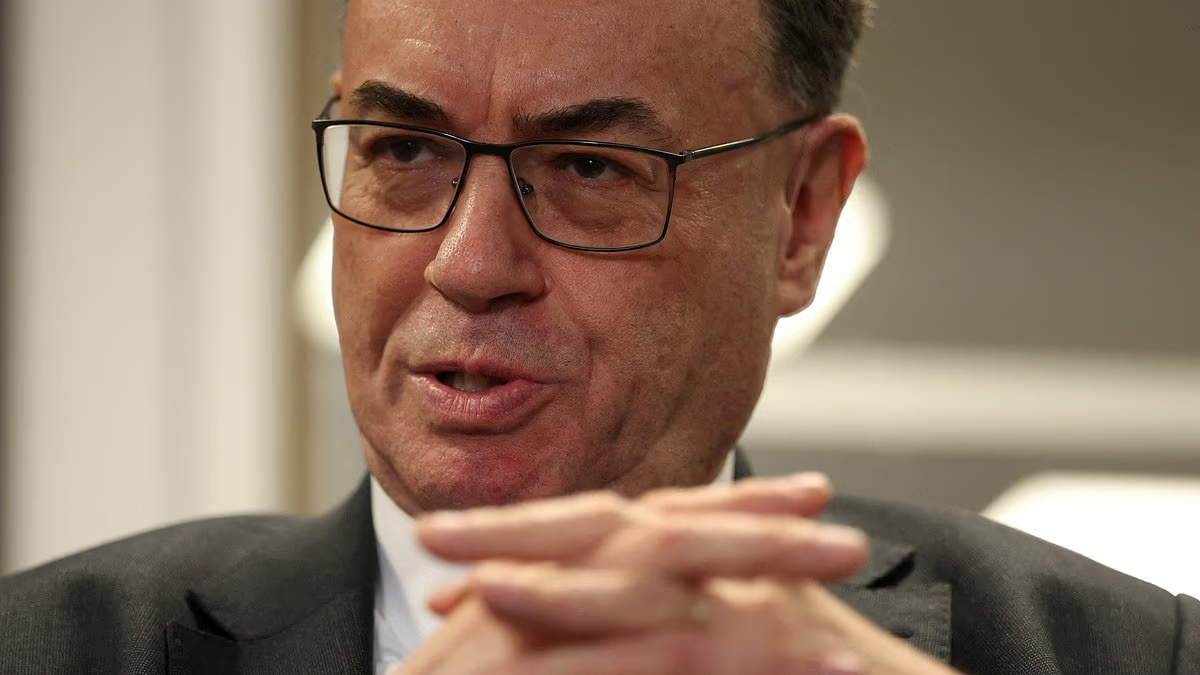
Andrew Bailey said governments must deliver “credible” fiscal policy
His speech focused primarily on “financial resilience” amid uncertainty linked to the war in Iran and the rapid expansion of artificial intelligence (AI).
However, his comments on fiscal policy – the way governments raise taxes and allocate public spending – are certain to be considered in the context of Mr Healey’s Budget on 28 October.
Tory shadow Chancellor Andrew Griffith said: “In central banker speak this is a clear warning to the government to get a grip on their debt-fuelled spending binge.”
The warning follows comments earlier this week from Andy Haldane, a former Bank of England chief economist and one-time adviser to the Prime Minister, who said the UK was “skating on thin ice”.
Investors are becoming increasingly concerned about how the Chancellor will pay for cost-of-living support, increased defence spending, a major council housebuilding programme and an overhaul of social care – all priorities identified by the Prime Minister.
There are fears that Mr Healey could resort to tax increases that weaken economic growth, adding to the £75 billion already piled onto the economy by Rachel Reeves. Investors also question whether he is willing to reduce Britain’s rapidly rising benefits bill to balance the books.
Those concerns have intensified pressure on UK government bonds, known as gilts. Like bonds in other major economies, gilts have been sold heavily since the Middle East war began, driving up oil prices and fuelling renewed inflation worries.
When gilt prices fall, their yields rise, increasing the Government’s borrowing costs. Mr Burnham’s repeated insistence that he does not want to be “in hock” to bond markets has done little to calm investors.
The market turmoil has sharply reduced the Budget headroom available to Mr Healey. Experts estimate that it has fallen by more than half from the £24 billion available in the spring.
An EY report published earlier this week warned that the shortfall could become a £7 billion black hole if the conflict continues into next year.
As oil prices climbed above $105 yesterday, the yield on 10-year gilts rose beyond 5.52 per cent – its highest level since 2007. The yield had been below 5 per cent shortly before Mr Burnham became Prime Minister.
Meanwhile, the yield on 30-year gilts surged above 6.04 per cent, reaching its highest level since 1998.
Mr Bailey warned that lower growth and repeated global shocks weakened public finances even as governments come under pressure to provide cost of living support, while higher borrowing costs add to the debt pile.
‘If markets begin to doubt the fiscal trajectory, bond yields can rise further, tightening monetary and financial conditions,’ he said.
And while governments can ordinarily splash out in times of crisis – and pay for it later – this becomes ‘much harder to sustain’ when ‘shocks become more frequent’, Mr Bailey added.
The remarks come days after Mr Haldane warned: ‘We are skating on pretty thin ice in fiscal terms, and nothing would be worse both economically and politically, than if the ice were to crack beneath our feet.’
He said the ‘single most effective way’ of stopping that and appeasing financial markets ‘is for this government to show that it’s able and willing to take the knife to public spending’.
Protect Your Money – sign-up to our six-week plan
The Budget is coming – but are you prepared? Sign up to our six-week plan and Simon Lambert and his team of financial experts will reveal how to Protect Your Money. If you’re a subscriber, it’s completely FREE
> Sign-up to Protect Your Money


