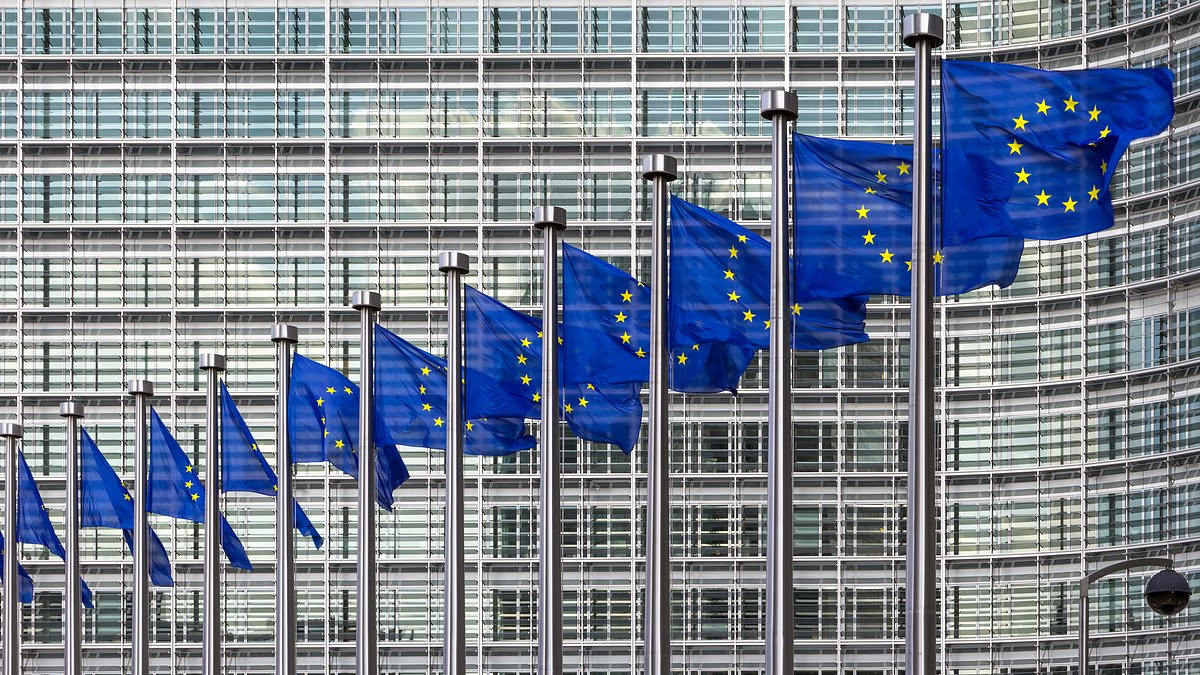
Labour’s eagerness to strengthen ties with Brussels shows no sign of fading.
But if Prime Minister Andy Burnham looked across the Channel, he would find the eurozone preparing for its most serious test since the Greek fiscal crisis of 2009-10.
This time, the source of the alarm is France, one of the European Union’s largest and most influential economies.
Political paralysis in Paris has triggered pressure on the euro and pushed the gap between French government borrowing costs and German bund yields to levels not witnessed since the turmoil of 2010-12.
The timing makes the crisis especially dangerous. Germany’s industrial powerhouse is losing momentum, riots have erupted in France and Spain, and voters across the continent are proving increasingly unpredictable.
Adding to the uncertainty, speculation is mounting in Frankfurt that Christine Lagarde could leave the European Central Bank before her term expires in a year’s time.

Political paralysis in Paris has triggered pressure on the euro and pushed the gap between French government borrowing costs and German bund yields to levels not witnessed since the turmoil of 2010-12
A change at the top of the ECB could hardly come at a more awkward moment.
France’s failure to bring its public finances under control lies at the heart of the latest eurozone upheaval.
Andy Haldane, the former Bank of England chief economist, has warned that Britain is also on ‘thin ice’ unless it makes deep reductions in public spending.
Across the Channel, however, the borrowing and debt picture is even more severe. The euro has fallen to a 17-month low against the dollar, trading at $1.12.
The French government is struggling to secure approval for its 2027 budget. Without a substantial reduction in the annual deficit, which is being driven partly by an accelerating interest bill, borrowing could reach 6.5 per cent of national output, while public debt could climb to 120 per cent of GDP.
Yields on French bonds are now about 1.5 percentage points higher than those on German bunds — the widest spread in 15 years.
Pressure from financial markets may ultimately force France to confront the scale of its deteriorating budget position.
Attention has already turned to what the ECB might do if the fiscal contagion spreads. Its unused Transmission Protection Instrument allows it to purchase bonds on the secondary market. But deploying it to support struggling governments could amount to monetising deficits, bringing significant inflationary risks.
A crisis spanning Europe is now a real possibility, raising fears that the shock could finally burst the bubble surrounding global equity and debt markets.
Real people
Meanwhile, Britain’s live-events industry has staged a powerful recovery since Covid-19. During the pandemic, I fielded calls from trade bodies seeking Government backing for a vital part of the services economy.
Stephen Carter, the former Ofcom chief and an adviser to ex-prime minister Gordon Brown, deserves credit for remaining focused on the sector for 13 years and transforming Informa into an £11billion business.
Investors have good reason to believe in his decision-making. That is why Informa’s £2.2billion acquisition of exhibitions group Clarion, funded in part through an equity raising, is unlikely to cause serious concern.
The transaction will bring a series of high-profile events into Informa’s portfolio, including Berlin’s IFA electronics show and a major gaming conference.
Nevertheless, there needs to be caution, given Clarion has been hanging around in Blackstone’s vast vault. Private equity is not known for bearing gifts.
A victim of the stronger focus on live, people events will be Informa’s ownership of Taylor & Francis.
The academic publisher and research powerhouse has roots back to 1852.
In an AI age, with a thirst for data, there should be no problem finding a buyer.
Better it goes to a British player, such as Relx, rather than end up on the cutting room floor among digital giants.
Bank raid
One doesn’t envy John Healey. Within government and on Labour’s backbenches there is baying for taxes on the banks.
Yet, every pound confiscated by government means less capacity for mortgage and business lending, and growth.
It places the City as a banking metropolis in danger. Barclays and HSBC, with global operations, are mobile.
Just as seriously, Jamie Dimon’s JP Morgan could well decide to cut and run from the bank’s £3billion commitment to Canary Wharf. Be careful what you wish for.
DIY INVESTING PLATFORMS
AJ Bell
AJ Bell
Easy investing and ready-made portfolios
Hargreaves Lansdown
Hargreaves Lansdown
Free fund dealing and investment ideas

interactive investor
interactive investor
Flat-fee investing from £4.99 per month

Freetrade
Freetrade
Investing Isa now free on basic plan

Trading 212
Trading 212
Free share dealing and no account fee
Affiliate links: If you take out a product This is Money may earn a commission. These deals are chosen by our editorial team, as we think they are worth highlighting. This does not affect our editorial independence.
Compare the best investing account for you


