
By the standards of stock market launches, it was every bit as spectacular as investors had hoped.
Shares in Anthropic surged almost 40 per cent within minutes of opening in New York last Thursday, briefly lifting the artificial intelligence company’s valuation above $2trillion.
The company’s seven founders, all aged between their 30s and 40s and including Brighton-born Jack Clark, were each sitting on paper fortunes of about $26billion. Thousands of employees had also become multi-millionaires.
But could the blockbuster flotation provide Wall Street with the lift it needed after weeks of market upheaval?
The short answer was no.
Anthropic, best known for its Claude chatbot, quickly surrendered its early gains, although it still finished its first trading session 17 per cent higher. The following day, the stock fell back to its $83 listing price before closing at $88.91, a drop of 8.5 per cent.
It slipped again on Monday, even as Nvidia’s controversial boss Jensen Huang made a dramatic return and helped send markets around the world higher.
Until then, trading screens from Asia to the US had been awash with red. The MSCI All Country World Index, a widely followed measure of global equities, had endured its longest losing run in three years.
Technology shares once again bore the brunt of the selling. New York’s blue-chip Nasdaq 100 had fallen more than 18 per cent from its peak just over a month earlier, before Huang’s comeback provided some relief.

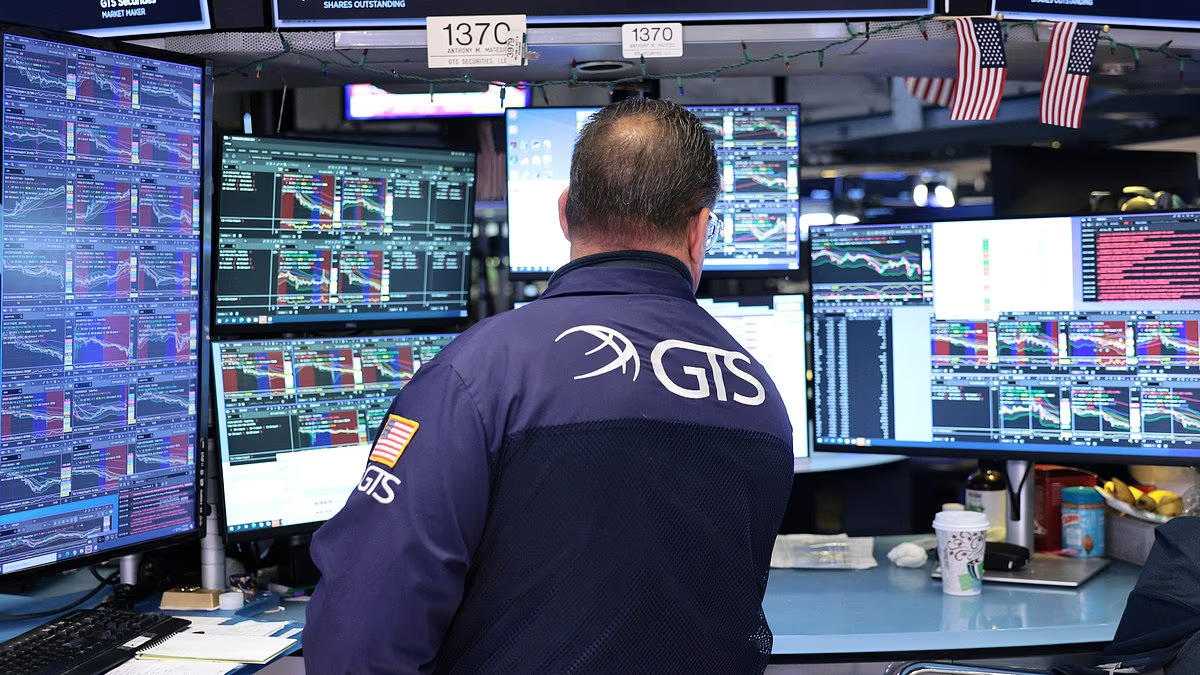
Traders work on the New York Stock Exchange floor on Friday morning after AI developer Anthropic made its market debut. The shares dropped back to the $83 listing price before ending at $88.91, down 8.5 per cent
The AI pioneers that had powered the market’s earlier rally – including hyperscalers, neocloud companies and data-centre developers – were hit particularly hard.
After reaching record levels in recent months, CoreWeave, SanDisk and Nebius had each fallen by roughly 70 per cent before the rebound. Intel and Oracle had lost about 60 per cent. The damage extended far beyond those names.
Nvidia, the flagship company of the AI boom, was down more than 40 per cent after the sudden departure of its star chief Huang, reportedly amid a series of affairs, sent investors into a panic. The sell-off erased around $2.5trillion from the value of the company, once the world’s most valuable.
Monday’s recovery, which followed Donald Trump’s praise for Huang’s return – saying, ‘we have one of our great stars back in play’ – has eased investor anxiety for the moment. The underlying concerns, however, remain.
‘We’re already in a stealth bear market,’ says one Mayfair-based hedge fund manager. The phrase describes a situation in which a particular sector has fallen at least 20 per cent from its peak.
The question is when, not whether, the bubble bursts
Ahead of Anthropic’s record-setting initial public offering, investors were asking whether the listing could rescue the AI trade and restore confidence in a faltering stock market.
The answer was an emphatic no. Many of the world’s leading investors are now bracing for further turbulence.
The warning signs are widespread. Wall Street’s so-called fear gauge, the Cboe Volatility Index, or VIX, recently reached its highest point since March, when markets were rattled by Donald Trump’s conflict with Iran.
Russ Mould, investment director at AJ Bell, described the previous week as ‘a week from hell’.
‘It’s gritty out there,’ says a respected City fund manager responsible for hundreds of millions of pounds in savings. ‘People have poured money into the US without considering valuations. There is an adjustment ahead, and we will have to see how long it lasts and how severe it becomes.’
Two of America’s best-known investors, Bridgewater Associates founder Ray Dalio and Citadel chief Ken Griffin, believe markets are caught in a bubble that will eventually burst.
‘Almost every technology boom creates a bubble, then a bust, whether it’s railroads, the Industrial Revolution or the late 1920s,’ Dalio says.
Berkshire Hathaway, the investment company associated with the ‘Oracle of Omaha’, Warren Buffett, has built a cash reserve of $377.4billion. Buffett stepped down as chairman in September after six decades at the helm.
That cash pile is not proof that Buffett expects a crash. At the very least, though, it suggests that he does not regard many shares as attractively priced at present.
Owen Lamont, a fund manager at Boston-based Acadian Asset Management and a former finance professor at the University of Chicago, points out that he wrote an article as recently as January titled ‘We are not in an AI bubble’.
‘Today, I would no longer write those words,’ he says. ‘I think there is a 70 per cent chance that, by November 2026, we are already in an AI bubble in the US stock market. The smart money is selling.’
In London, the market strategy chief at one of the City’s leading investment banks is even more convinced that the bubble is close to bursting. He has sold his own privately held shares.
‘We have consistently warned of an AI bubble since May and have become more bearish,’ says Joachim Klement of Panmure Liberum. ‘We think the AI bubble is about to burst. Market dynamics have turned decisively bearish.’
He decided to sell and shift money into government bonds after the S&P 500 fell below a closely watched technical level: its 200-day moving average.
‘I know I will be out of stocks when the AI bubble bursts,’ he says.

‘Almost every technology boom creates a bubble, then a bust, whether it’s railroads, the Industrial Revolution or the late 1920s,’ says Ray Dalio, founder of Bridgewater Associates, the world’s largest hedge fund
Gary Channon, a fund manager at London-based Phoenix Asset Management, is no less downbeat. ‘The current bubble has almost run its course,’ he says. ‘It has been a great ride, but the building is on fire. Save yourselves.’
Whether or not a full-scale crash arrives, one of London’s leading fund managers says there is no doubt that ‘a lot of people have already been very badly burned’.
He adds: ‘There was considerable FOMO – fear of missing out – during the first half of this year, with many inexperienced investors piling into AI. The past few months have been extremely painful for them.’
A market crash would be deeply damaging for millions of British savers whose pensions, stocks and shares Isas and other investments are linked to equities.
The London market, dominated by banks, oil majors and pharmaceutical companies rather than technology stocks, has performed better than its US counterparts during the recent sell-off.
On November 16, the FTSE 100 came within touching distance of a record closing high. Sentiment has deteriorated since then, however, as concerns spread across the Atlantic. The index lost 5 per cent in just five trading days last week.
Klement at Panmure believes UK shares are ‘the best hiding place’ during the turmoil, pointing to businesses including GSK, AstraZeneca, Greggs and Wetherspoon.
‘After all, if the market crashes, what else can you do but go to a pub?’ he says ruefully, before adding that ‘the best positions to take are cash and the foetal position’.
Major banks and regulators raise the alarm
Given the scale of America’s technology sector, a collapse in AI valuations could pull markets around the world lower.
The strain is already being felt well beyond Wall Street.
Asian equities suffered their worst week since 2020. Japan’s Nikkei 225 and South Korea’s Kospi each fell 5 per cent on Friday, while Taiwan’s market dropped 17 per cent over the week – its sharpest weekly decline since 1990.
Regulators worldwide have issued repeated warnings. Almost every major financial authority, from the International Monetary Fund to central bank leaders, has highlighted the risks.
Bank of England governor Andrew Bailey has cautioned that the enormous sums borrowed by the AI sector to finance its expansion could become a threat to financial stability.
Boris Vujcic, vice-president of the European Central Bank, has warned of an ‘abrupt repricing and significant valuation losses’ if enthusiasm for AI suddenly fades – language that sounds remarkably close to a crash warning.
The timing could scarcely be worse.
The global economy is already absorbing an energy-price shock, first triggered by Vladimir Putin’s invasion of Ukraine and then intensified by Trump’s war in Iran. Households and businesses are feeling the squeeze.
Public debt is climbing while interest rates rise. Turbulence in bond markets is pushing up borrowing costs, Europe is facing social unrest and France is heading towards an election expected to be among its most divisive in years.
The world appears poorly prepared for the consequences of an AI crisis or a stock market crash – much less both at the same time.
Trump’s warm exchanges with Vladimir Putin and Chinese President Xi Jinping last week have done little to reassure investors.
There are plenty of reasons for concern about AI.
Anthropic itself listed a series of risks in the documents prepared for investors before its flotation.

Before Anthropic’s record-breaking IPO, investors wondered whether the listing could revive the AI trade and restore confidence in a troubled stock market
Its 400-page prospectus described AI as ‘one of the most consequential technologies in human history’. It said the technology could help cure diseases that have afflicted humanity for thousands of years, including cancer, Alzheimer’s, heart disease, rare genetic conditions and major infectious illnesses.
Yet the document also warned about AI’s ‘potential adverse societal impacts’, including job displacement, misuse, harmful applications and risks that could be catastrophic or existential for humanity.
That raises another question: does Anthropic really justify the $2trillion valuation it briefly achieved?
Aswath Damodaran, a finance professor at New York University’s Stern School of Business and one of the world’s leading authorities on valuation, said the company could be worth anywhere from $400billion to $4trillion. The outcome depends on how quickly its revenues grow and how much it must spend to achieve that growth.
These concerns have unsettled markets in recent weeks. Even experienced investors are questioning whether debt-funded spending on AI infrastructure will generate the returns needed to support such extreme valuations.
The Quantum Strategy & Geonomics think-tank estimates that $3.1trillion has been spent on AI infrastructure since 2013. That, it says, is more than the combined cost of the Vietnam War, the US Interstate Highway System, the Apollo programme, the post-war Marshall Plan and the eradication of polio.
Goldman Sachs expects a further $1trillion to be invested in 2026. Morgan Stanley estimates that AI-related companies will borrow $500billion to fund projects such as data centres.
And the spending may only be getting started.
Gartner, the business and technology research group, forecasts that global expenditure on AI infrastructure will reach $2.4trillion in 2027.
Debt is not the sector’s only vulnerability. Increasing attention is being paid to circular financing structures.
These arrangements create a complex network of transactions linking AI firms, chipmakers, cloud providers and investors. They have raised concerns about how much growth is being supported by money moving around within the same ecosystem – and what could happen when that flow stops.
Sweeping Democratic victories in the US midterm elections, together with fears that the party could slow the construction of the data centres needed for AI, have added another source of uncertainty.
SAVE MONEY, MAKE MONEY

Up to £300 cashback
Up to £300 cashback
£25-£300 cashback on at least £300

4.90% cash Isa
4.90% cash Isa
Trading 212: 1.05% fixed 12-month bonus

£5,000 cashback
£5,000 cashback
£100-£5,000 cashback when opening Sipp

Up to £150 cashback
Up to £150 cashback
Open a savings account with at least £5,000

Welcome bonus
Welcome bonus
Get up to £200 when you invest £100
Affiliate links: If you take out a product This is Money may earn a commission. These deals are chosen by our editorial team, as we think they are worth highlighting. This does not affect our editorial independence. Terms and conditions apply on all offers.
So how are the financial world’s biggest players responding?
Michael Burry, the investor made famous by The Big Short after Michael Lewis chronicled his successful bet against the US subprime mortgage market before the 2008 financial crisis, has long been sceptical of circular financing in the AI sector.
In late 2025, he placed bets that Nvidia and Palantir, the data analytics company, would suffer sharp falls within two years. Both trades are now moving in his favour, with Palantir down about 25 per cent from its peak. He has also raised concerns about cloud-computing companies including CoreWeave and Nebius.
As shares plunged last week, Burry told his 2.1million followers on X: ‘I tried to warn you all. I didn’t say short. But I provided the information one would need to sell.’
Dmitry Solomakhin, a fund manager at Fidelity International, has also been betting against technology shares. He argues that the exuberance driving markets earlier in the year lifted some AI stocks regardless of whether their businesses were ‘good, bad or terrible’.
That, he says, created opportunities to short companies whose valuations had become excessive.
Billionaire investor Bill Ackman, head of Pershing Square, has reduced some of his exposure. He sold roughly one-third of the firm’s Microsoft holding and more than 10 per cent of its position in Meta, the owner of Facebook and Instagram.
Ackman is not predicting disaster, however. He still owns substantial stakes in both companies and has increased his holding in Netflix. Although he is unlikely to invest in Anthropic, he calls it ‘perhaps the greatest business story I’ve ever seen… an amazing company’.
Berkshire Hathaway’s cash holdings have more than doubled since the end of 2023, but Buffett’s faith in shares continues under new chief Greg Abel. The company held $336billion in equities at the end of September, according to its latest filings.
Back in London, Stephen Yiu, manager of the Blue Whale Growth Fund and an investor in AI stocks, believes there are still opportunities to be found.
‘Is the AI trade over? Is it a bubble? Some shares are clearly overvalued, but that does not mean the entire AI ecosystem is,’ he says.
‘Some of the froth has disappeared, and that can make the market healthier. But we do not believe there will be a very severe crash because AI is real and here to stay. It is growing exponentially as we speak.
‘Nothing rises in a straight line. Technological revolutions never ensure that every company survives. Some will disappear, but AI is not going away.’
That may prove correct.
Even so, the tone of the market has clearly shifted – and the consequences could be severe.
‘To say investor sentiment has started to sour is an understatement,’ says David Morrison, senior market analyst at Trade Nation.
Paul Singer, the hedge fund billionaire and one of the world’s most closely watched investors, has compared the current mood with the Roaring Twenties, the period of speculation that preceded the Wall Street crash and the Great Depression.
FOMO, he says, could soon be replaced by FOGO – the ‘fear of getting obliterated’.
For many investors, that fear has already arrived.


