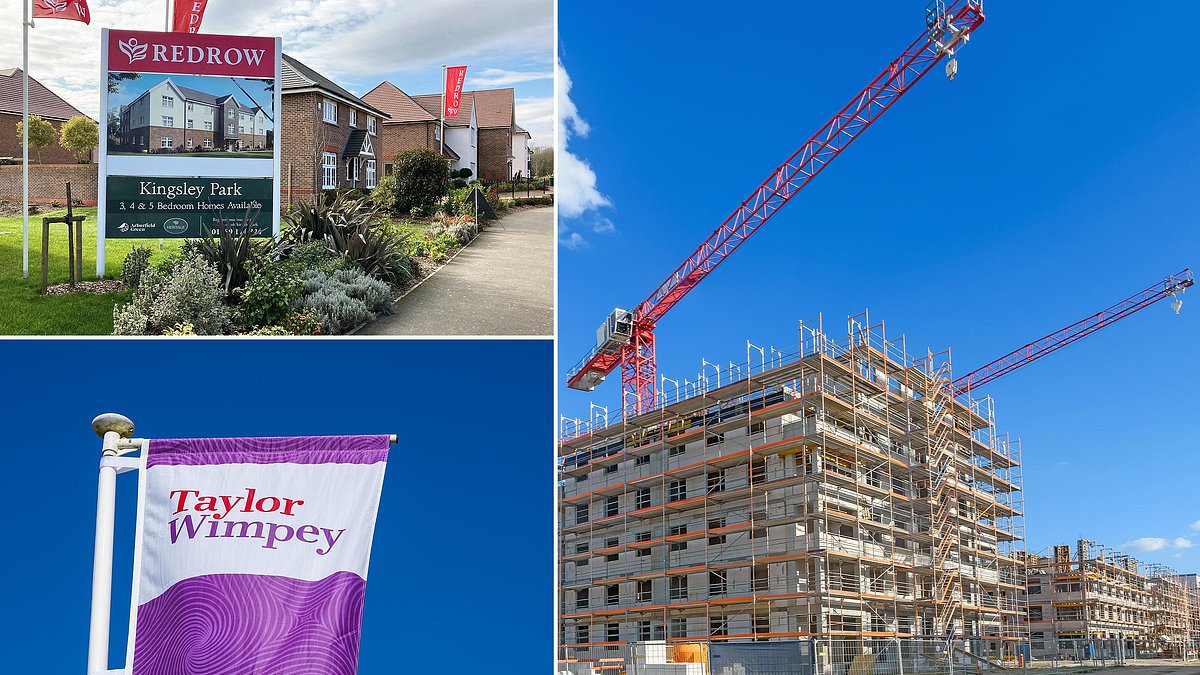

In recent years, while the housing market itself has experienced stagnation with minimal changes in house prices, the stock market tells a contrasting tale for major housebuilders. The plummeting share prices of leading developers reflect a grim scenario reminiscent of the post-2008 financial crisis era.
One of the most striking examples is Persimmon, whose shares have seen a sharp decrease of about 33% over the past three months, settling at £10.27. This marks a significant drop from its peak of £32.86 back in 2020.
Taylor Wimpey is facing a similar downturn. Its shares have fallen by 34% in the same period, with the price declining from a 2020 high of £2.23 to just £0.76.
Meanwhile, Barratt Developments has not been spared from this trend. The company’s share price has tumbled 40% since February, plummeting from a high of £8.76 in 2021 to a current value of £2.37.
Vistry Group, known formerly as Bovis Homes, is experiencing an even more severe descent. The company’s shares have dramatically declined by 64% since February, crashing from £7.37 to £2.65, a far cry from its previous high of £14.76.
These figures underscore a turbulent period for housebuilders, highlighting a stark contrast between the relatively stable housing market and the volatile performance of developer shares.
Anthony Codling, of RBC Capital Markets says the dismal performance is due to higher mortgage rates, planning issues and higher build costs – all of which are squeezing margins.
Falling: While house prices have held up, the share prices of housebuilders have crashed to levels last seen in the aftermath of the 2008 financial crisis
‘The war in Iran has led to higher mortgage rates and fuel prices, sparking concerns about the cost of living,’ says Codling. ‘This has reduced the level of demand from first-time buyers.
‘Secondly, build cost inflation since the mini-Budget in September 2022 has been higher than house price inflation. This has reduced housebuilders’ profits making them less attractive to investors.
‘Third, continued planning delays mean that housebuilders have not been able to open more [development] sites, therefore they are physically unable to build and sell as many homes as they would like.’
The Government promised to build 1.5 million homes by 2029, a target that is looking less achievable with every passing month.
Housebuilders are struggling to sell the homes they do build, and are therefore reining in plans to develop more.
The share of new-build homes being sold before they are completed dropped to a 12-year low last year, according to analysis by estate agent Hamptons.
Meanwhile, just 26,959 new homes were registered in the first three months of 2026, according to the new home warranty provider, the National House Building Council. This was down 6 per cent on the previous year.
Angeline Ong, senior investments analyst at IG suggests steering clear of housebuilders
Last month, Berkeley Group said it will reduce investment and halt new land acquisitions as it battles higher costs and geopolitical volatility.
Other housebuilders are also scaling back on land buying, including Barratt Redrow, while Taylor Wimpey says it is cutting back on development.
Short sellers are betting on further bad news for the sector.
Short selling is a trading strategy that aims to benefit from the fall in the price of a share by ‘borrowing’ it from a broker, selling it on the open market and then buying it back at a lower price and pocketing the difference.
Vistry Group, Taylor Wimpey and Barratt Redrow are among the 20 most-shorted UK companies at present.
Angeline Ong, senior investments analyst at IG sees things getting worse for housebuilders if the Middle East conflict continues. ‘I don’t see any case to be optimistic about the sector as long as conflict in the Middle East remains in play,’ she says.
‘The market is heavily discounting the sector for a reason. Prior to the Middle East conflict markets had been pricing in interest rate cuts, but now central banks are being forced to stay tighter for longer as inflation proves sticky. That’s a toxic mix for housing demand and builder margins.’
Could cheap housebuilder shares be a good investment?
Jack Fletcher-Price, equity analyst at Morningstar says that housebuilder stocks will be tempting to some value investors.
‘Fundamentally these names are very cheap – both in historic and absolute terms,’ he says. ‘There is huge demand for new homes in the UK and the large PLC homebuilders are best placed to deliver this.
‘They have sizable land banks and planning reform will enable them to monetise this quicker.’
Analyst Anthony Codling also thinks there is upside potential for those able to stomach the short-term volatility and risk.
‘Valuations are at close to 20 year lows, which, if you are a glass half full investor, provides an attractive entry price,’ he says.
‘We also believe that if the measures already taken by the Government don’t lead to a significant increase in housebuilding the Government will look to stimulate the market through some form of first-time buyer assistance – something similar to Help to Buy.’
Property insiders argue that if the Government really wants to see an increase in housing supply it will need to come up with a plan to spark housebuilders into action.
This could come in the form of something similar to the Help to Buy scheme, which ran between 2013 and 2021.
The scheme helped tens of thousands on to the housing ladder, most of them buying new-build flats.
It enabled first-time buyers to purchase a new build with a 5 per cent deposit, with the Government lending between five and 40 per cent of the cost of a new-build home as an equity loan which was interest-free for the first five years.
This drove demand for new-build flats and pushed prices higher over a sustained period, but it also incentivised developers to build.
‘In our view to help the housing market the Government needs to help those aspiring homeowners who do not have access to the Bank of Mum and Dad to get on the housing ladder,’ says Codling.
‘There are ways to do this with or without spending taxpayers’ money, therefore if the Government is serious and committed to seeing more homes built and more people buying their own home we would expect them to offer first time buyers help in the near future.’
Best of a bad bunch? Two of out analysts said Persimmon would be their housebuilder stock pick if they had to choose
Which one housebuilder should you buy… if any?
Analyst Anthony Codling likes three of the housebuilders.
First is Berkeley Group, because ‘It has very good visibility of earnings and is trading at levels much lower than it was during the global financial crisis.’
Second is Crest Nicholson, which Codling says ‘Offers an attractive turnaround story and would be, in our view, the major beneficiary of any Government led first time buyer stimulus package.’
And finally there is Taylor Wimpey, which he says ‘Has a high dividend yield and should benefit the most from the changes in the planning system, because it owns or controls a significant amount of land that has yet to get planning permission.’
Since the party was elected, Labour has said it will increase the number of homes built by cutting planning application delays, helping first-time buyers and building on ‘ugly’ green belt.
Anthony Codling, investment analyst at RBC Capital Markets says there is cause for some optimism in the sector
Angeline Ong says that, while she wouldn’t be buying any housebuilder stocks right now, Persimmon is one to watch.
‘It’s guiding for higher volumes and profits and appears to have a tighter grip on costs, which puts it in a stronger position than many of its peers when conditions eventually improve,’ she says.
Morningstar’s Fletcher-Price also says Persimmon would be his pick.
‘Persimmon is particularly exposed to lower-value housing and first-time buyers, representing some 50 per cent of its sales,’ he says.
‘Owing to ongoing housing affordability concerns and a government targeting increasing homeownership rates, we think Persimmon is best placed to capitalise on this opportunity.
‘It also has minimal exposure to the challenged London and South East markets.’
Which housebuilder shares should you sell?
Vistry Group and Gleeson Homes are two that analyst Anthony Codling is wary of at the moment.
He says: ‘Vistry seems to be consuming cash rather than generating cash, and is cutting prices aggressively to stimulate sales.
‘It has very recently appointed a new chief executive to tackle the performance issues, but we have yet to hear what his vision for Vistry is and how he is planning to improve the company’s performance.’
On Gleeson, he says: ‘The group suspended financial guidance in February and therefore we do not know what targets it is trying to hit. This makes it very difficult, in our view, to assess whether the shares are expensive or offer good value.’
Equity analyst Jack Fletcher-Price, has a final word of caution for investors who think share prices can’t get any lower.
‘These names are so sensitive to factors beyond their control, and it is now a case of “once bitten, twice shy,”‘ he says.
‘While affordability is improving, it is still stretched in London and the South East. Ever-increasing building standards drive up the cost of developing land, and house price growth in the UK is forecasted to slow.’
DIY INVESTING PLATFORMS
AJ Bell
AJ Bell
Easy investing and ready-made portfolios
Hargreaves Lansdown
Hargreaves Lansdown
Free fund dealing and investment ideas
interactive investor
interactive investor
Flat-fee investing from £4.99 per month
Freetrade
Freetrade
Investing Isa now free on basic plan
Trading 212

Trading 212
Free share dealing and no account fee
Affiliate links: If you take out a product This is Money may earn a commission. These deals are chosen by our editorial team, as we think they are worth highlighting. This does not affect our editorial independence.
Compare the best investing account for you


