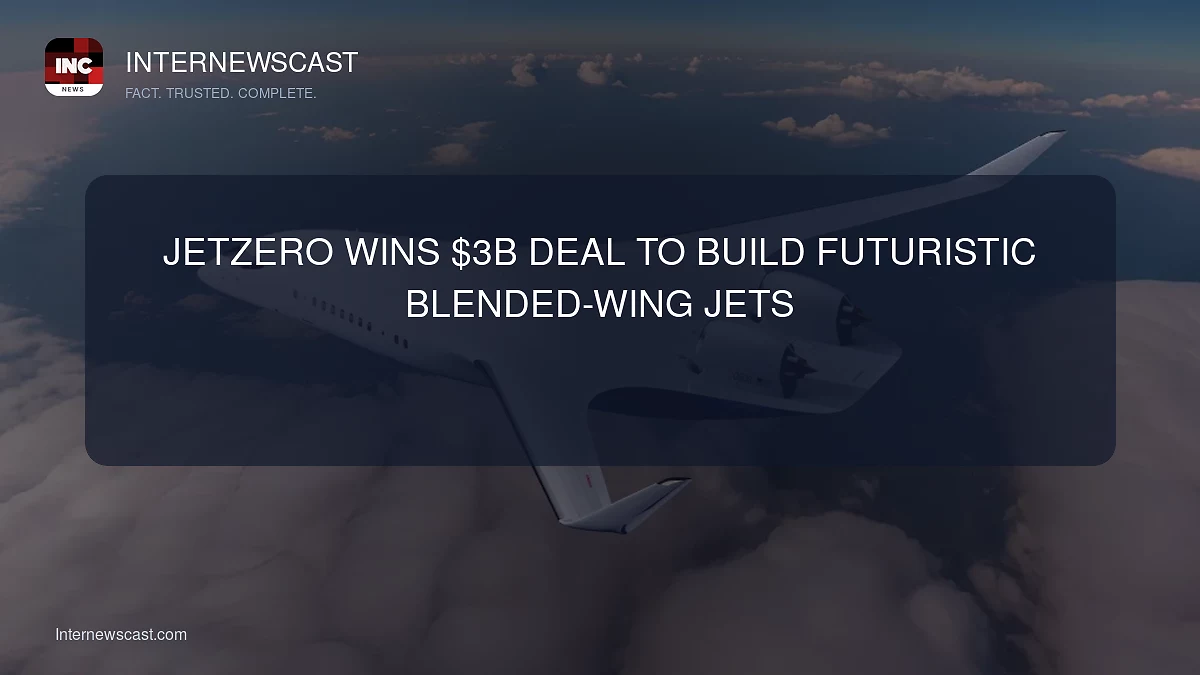

The commercial jetliner has looked largely the same for generations: a narrow fuselage, two wings and rows of window seats stretching from nose to tail. JetZero is now pushing a far more radical vision. The company has secured a preliminary $3 billion agreement with the U.S. government to advance a blended-wing aircraft, a manta ray-like plane with four aisles, no traditional passenger windows and a wide, aerodynamic body that JetZero says could reduce fuel burn by 30% compared with modern aircraft such as Boeing’s 787, according to the Wall Street Journal.
Blended-wing aircraft are not a brand-new idea, but they have never broken into commercial aviation. NASA and Boeing spent more than $1 billion studying the design decades ago, while Airbus also explored a similar concept before deciding it was too difficult to bring to market. Doubters still point to major challenges: travelers sitting farther out in the wing structure may experience more noticeable G-forces in turns, a windowless cabin could intensify motion sickness for some passengers, and a four-aisle interior raises complicated questions about how quickly people could evacuate in an emergency.
Money has long been the biggest obstacle between the futuristic aircraft and an actual runway. JetZero CEO Tom O’Leary acknowledged the doubts, saying, “The question’s a good one, is it real?” The company’s answer is that it intends to make the plane real soon, with a first prototype flight targeted for the end of 2027. The $3 billion arrangement with the U.S. Export-Import Bank is tied to JetZero building its first factory in the United States. Alongside earlier support totaling $235 million from the Air Force, Northrop Grumman, RTX and about 20 airlines, JetZero says it is ready to confront the skepticism. Now it has to prove the design can fly.
For most passengers, the image of an airliner is fixed: a long metal tube, wings on either side and windows running down the cabin. JetZero wants to replace that familiar silhouette with a blended-wing jet that looks closer to a sea creature than a conventional airplane. Backed by a preliminary $3 billion U.S. government deal, the company is developing a four-aisle, windowless aircraft whose broad body is designed to deliver major efficiency gains, including up to 30% lower fuel consumption than newer jets like the 787, the Wall Street Journal reports.
Aviation engineers have been intrigued by the blended-wing concept for years, but turning it into a passenger plane has proved elusive. NASA previously partnered with Boeing on research that cost more than $1 billion, and Airbus later examined the approach before setting it aside as impractical. Critics argue that the unusual cabin layout could create passenger comfort and safety concerns, from stronger turning sensations for those seated in the wing areas to possible motion sickness in a cabin without windows. The aircraft’s four-aisle design also leaves open questions about meeting emergency evacuation standards.
JetZero’s biggest challenge has been securing the financial firepower needed to move beyond drawings and demonstrations. O’Leary has openly addressed the central question — whether the project is truly viable — and the company says the answer should come in the next few years. With its first prototype flight planned by late 2027, JetZero is relying on the U.S. Export-Import Bank agreement, which requires the company to establish its first factory in the U.S. Add in previous backing from the Air Force, Northrop Grumman, RTX and roughly 20 airlines, and JetZero believes it has built a serious case. The next test is the one that matters most: getting the aircraft into the sky.


