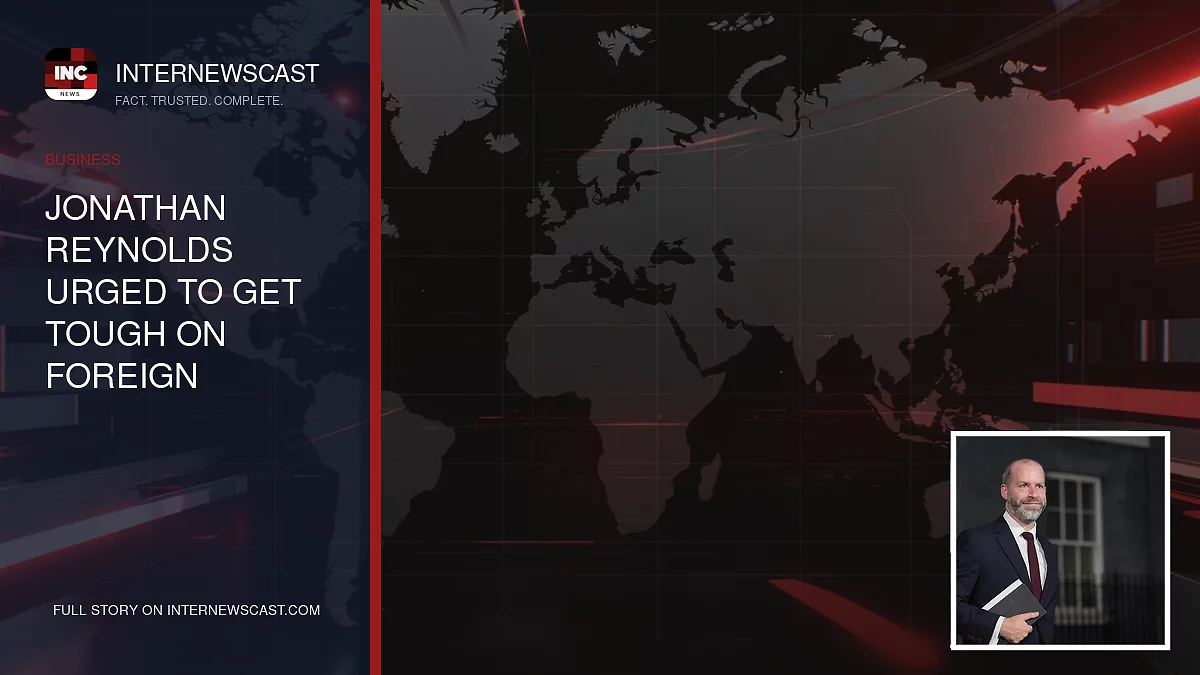

Among Andy Burnham’s cabinet appointments, the most troubling is the return of Jonathan Reynolds — the minister associated with the Royal Mail sale — to the role of Business Secretary.
Reynolds’ previous claims about being a Manchester-based solicitor were concerning in themselves. Far more serious, however, are the policy judgments that now carry consequences for the whole country.
With key FTSE 350 companies, many of them central to the national interest, increasingly being snapped up by private equity groups and debt-backed overseas bidders, Britain needs a Business Secretary prepared to defend British commerce with conviction.
In his Bloomberg speech, Chancellor John Healey acknowledged the crucial part business plays in generating jobs and unlocking investment. Yet that aspiration rings hollow when control of so many important companies is disappearing into the opaque world of financially driven ownership.

Jonathan Reynolds’ reinstatement as Business Secretary will have consequences
The turmoil at Thames Water and British Steel stands as a stark warning of how badly these takeovers and ownership structures can unravel.
The rapid transfer of critical British assets into the hands of private capital should not be happening quietly. It demands serious public scrutiny and a far more robust national debate.
That is why the potential £14billion sale of Segro, Britain’s leading data centre player, to San Francisco-based Prologis looks profoundly misguided.
The flaccid response of Segro chairman Andy Harrison and his nodding-dog board, which unanimously rejected the approach and then changed its mind for more cash, is pitiful. Segro and Prologis investor Matthew Norris, of VT Gravis UK Listed Property Fund, questions why British pension funds cannot see value when overseas private equity players can.
If Labour is serious about being part of the AI revolution, then allowing Segro to fall into American hands could turn out to be an Arm Holdings-style blunder.
Peter Kyle, who briefly replaced Reynolds as Business Secretary, recognised the technology loss of selling UK smart-chip designer Arm and AI pioneer DeepMind to the Americans. He would have sought to block both deals.
Segro, as the UK’s data centre champion, clearly justifies a reference under the National Security and Investment Act.
Others under siege, such as Intertek – sold to Swedish vultures EQT – and easyJet – in the sights of hedge fund Apollo – are obvious candidates for intervention.
Pledges by overseas marauder Prologis and the buyer of Unilever’s food arm McCormick to seek secondary listings in London don’t cut it.
Such devices are investment banker-inspired wheezes to get deals over the line.
As for easyJet, we must hope that the EU, which is more combative on unsafe takeovers, tells Apollo to take a hike.
Britain’s role as an airline, travel and vacation hub is at stake. All that financial buyers see is easyJet’s lien on 157 new short-haul Airbus jets that the carrier has on order and the value of slots.
Services to passengers and the impact of higher energy prices are deadweight.
No one should forget how Jonathan Reynolds betrayed International Distribution Services, owner of the Royal Mail.
He designated ‘Czech sphinx’ Daniel Kretinsky a ‘legitimate’ business figure despite a fortune being built on Russian energy pipelines. Kretinsky’s ownership of the Royal Mail has fallen flat.
Regulator Ofcom revised the Universal Service Obligation to reflect a steep decline in letter volumes and help restore profitability. Yet last month, Ofcom revealed appalling service provision in the year to March 2026.
Just 75.6 per cent of first-class letters were delivered on time, against a target of 93pc.
Second-class deliveries came in at 90.2 per cent, against a requirement of 98.5 per cent.
In response to an ‘unacceptable performance’, Ofcom launched a probe following fines of £37million levied for past failures.
The idea that a debt-funded deal for the Royal Mail could ever result in better service, despite promises of £500million of investment, was cloud-cuckoo-land.
Yet Reynolds signed it off.
It would be wonderful, but unlikely, if the Business Secretary in a restored role were to take a tougher line on overseas ownership and technology transfer.
Thus far, £70billion of listed assets have been sold this year, many to unaccountable financial players. Flipping and exploitation of assets is their mantra. Such buyers rarely let investment needs and public and consumer interest intrude.
DIY INVESTING PLATFORMS

AJ Bell
AJ Bell
Easy investing and ready-made portfolios

Hargreaves Lansdown
Hargreaves Lansdown
Free fund dealing and investment ideas

interactive investor
interactive investor
Flat-fee investing from £4.99 per month

Freetrade
Freetrade
Investing Isa now free on basic plan

Trading 212
Trading 212
Free share dealing and no account fee
Affiliate links: If you take out a product This is Money may earn a commission. These deals are chosen by our editorial team, as we think they are worth highlighting. This does not affect our editorial independence.
Compare the best investing account for you