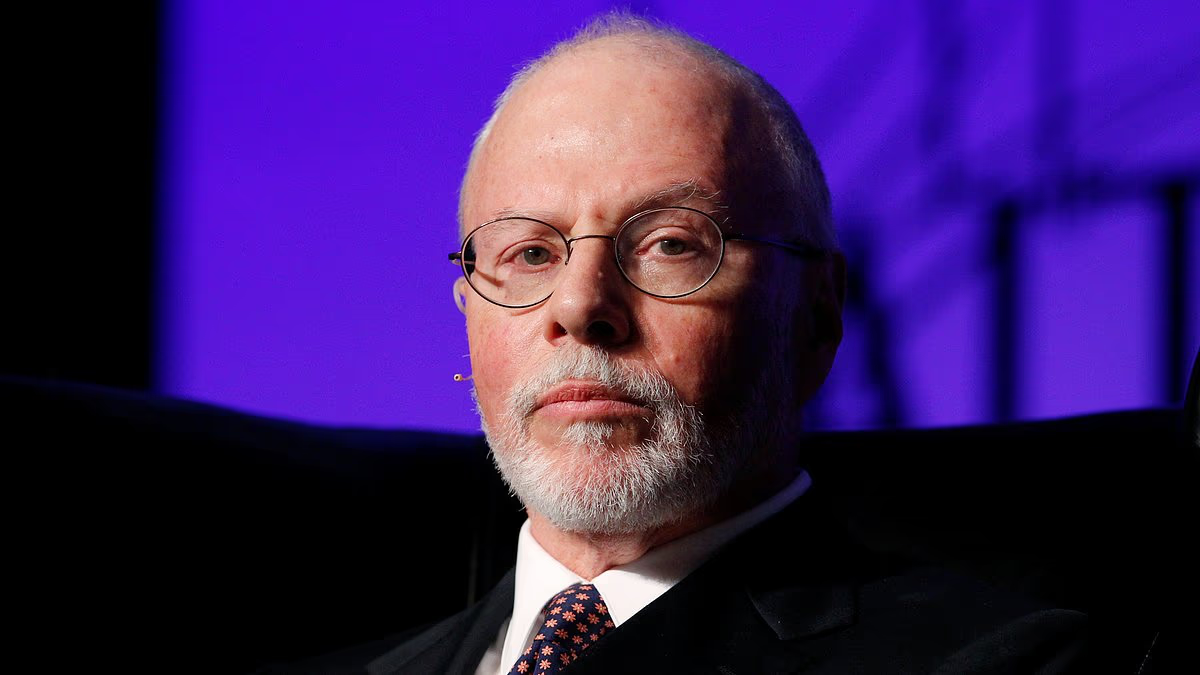

Paul Elliott Singer ranks among Wall Street’s most formidable money managers, overseeing Elliott Investment Management, one of the world’s most successful hedge funds, with about £60bn in assets.
To supporters, the firm’s founder and joint chief executive is something of an investor superhero: a relentless activist who pushes companies to unlock value for shareholders.
His usual approach is to build stakes in businesses he believes are undervalued, such as BP or PepsiCo, then apply pressure until directors reconsider their strategy and take steps to improve performance.
Critics take a much harsher view, labelling the 82-year-old a ‘vulture capitalist’ who has forced companies — and countries including Argentina and Peru — into restructurings after purchasing their distressed debt.
Whatever the verdict, Singer is undeniably a sharp investor with an exceptional ability to identify emerging trends in financial markets.
That is why investors should pay close attention when he and co-chief executive Jonathan Pollock sound the alarm over the current market boom.

Elliott Investment Management founder Paul Elliott Singer has likened today’s debt-driven, technology-led markets to the Roaring ’20s that preceded the Great Depression
In their latest investor newsletter, Singer and Pollock draw a striking comparison between today’s debt-heavy, technology-led markets and the ‘Roaring 20s’ that came before the Great Depression.
They suggest that the current fear of missing out — or FOMO — could quickly give way to FOGO: the fear of being wiped out.
Their warning is unusually direct: ‘At present, virtually every alarm bell warning of a substantial bear market ahead is ringing.’
Among the threats they identify are growing US budget deficits, stubborn inflation, capital investment funded by borrowing, unseen weaknesses in private credit and the enormous enthusiasm surrounding artificial intelligence and data-centre spending.
Elliott is especially focused on three developments: the circular flow of investment between AI model developers and infrastructure suppliers, the resulting dependence between the two groups, the use of debt to finance capital expansion and the rise of an increasingly vocal anti-AI movement.
The firm is right to question whether the technology giants’ huge spending on AI infrastructure will eventually produce enough revenue — and, more importantly, profits — to justify the investment.
If the AI expansion fails to deliver the earnings investors expect, markets could face a sharp sell-off followed by a prolonged bear market.
Singer and Pollock conclude that ‘so many factors have lined up to cause this great boom that it might take disruption in only one or two of them to shift this momentum into reverse’. They also warn of ‘a cascading, self-reinforcing unwind of this bull market’.
Elliott’s recent results underline some of those concerns. Its funds returned less than 2 per cent, compared with a 13 per cent gain for the S&P 500.
For the moment, the firm says it intends to concentrate on preserving capital while remaining ready to act if markets turn lower and new opportunities emerge.
Singer and Pollock are generally cautious in their quarterly updates, but the particularly gloomy tone of this latest letter highlights their anxiety over how vulnerable markets have become to both domestic and international shocks — from energy prices at home to the war in Iran.
That uncertainty could intensify further once the outcome of the US midterm elections becomes clear.
The expected excitement around Anthropic, which could list on the Nasdaq as soon as next week, adds another layer of exuberance to an already overheated market.
Analysts have suggested that Anthropic could achieve a remarkable $2 trillion valuation. The company has also indicated that it expects to spend more than $1 trillion on computing capacity in the years ahead. The obvious question is how Anthropic — or its competitors — will ultimately turn such vast spending into profits.
That may be a question for Claude.

Former Morrisons chief David Potts has been appointed to lead Asda
David Potts is a major coup for Asda
Asda has made an excellent appointment in bringing David Potts on board.
Recruiting Potts to take charge of the troubled supermarket group represents a significant coup.
The former senior Tesco executive is widely regarded as an outstanding retailer. He led Morrisons for almost ten years before the chain was acquired by US private-equity investors.
Potts, who turns 70 next year, will begin immediately, enabling 73-year-old Allan Leighton to reduce his involvement in the supermarket’s daily operations.
As my grandmother would have put it: wear out the old ones first.
DIY INVESTING PLATFORMS

AJ Bell
AJ Bell
Simple investing with ready-made portfolios

Hargreaves Lansdown
Hargreaves Lansdown
Free fund dealing plus investment inspiration

interactive investor
interactive investor
Flat-fee investing starting at £4.99 a month

Freetrade
Freetrade
Stocks and shares Isa free on the basic plan

Trading 212
Trading 212
Commission-free dealing with no account charge
Affiliate links: If you take out a product This is Money may earn a commission. These offers are selected by our editorial team because we believe they are worth considering. This does not compromise our editorial independence.
Find the best investing account for your needs


