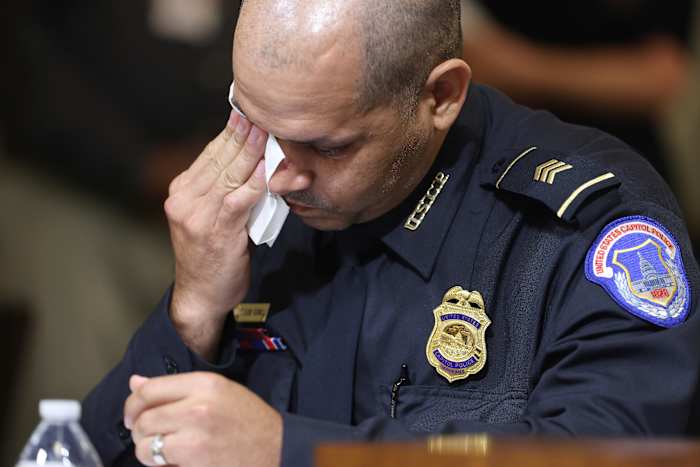


WASHINGTON – On January 20, 2025, as Donald Trump was sworn in for his second term, former Capitol Police Sgt. Aquilino Gonell decided to disconnect from the day’s events. He set his phone to “do not disturb” and left it on his nightstand, seeking a respite from the news cycle.
Later that day, after enjoying some quality time with his family and a leisurely walk with his dog, Gonell’s phone began to light up with notifications. He received a series of calls and messages from federal prosecutors, FBI agents, and the Bureau of Prisons. They informed him that the newly inaugurated president had issued pardons to approximately 1,500 individuals convicted for their roles in the January 6, 2021, Capitol riot. Among those pardoned were individuals who had physically harmed Gonell while he and his fellow officers defended the Capitol.
“They informed me that those I had testified against were being released,” Gonell recounted. “And they advised me to stay vigilant.”
Gonell was one of the brave officers at the Capitol’s West Front entrance on that fateful day, as Congress was in the process of certifying Joe Biden’s presidential victory. Hundreds of Trump supporters, fueled by unfounded claims of election fraud, stormed the building. Gonell was dragged into the crowd by his shoulder straps, nearly suffocating in the chaos. In court, he detailed the enduring pain from injuries to his shoulder and foot.
“These pardons, along with other efforts to downplay the attack, feel like an attempt to erase my sacrifices,” Gonell expressed. “I’ve lost my career, my health, and I’ve been struggling to rebuild my life.”
Five years after the Capitol siege, Gonell and his fellow officers who faced the rioters continue to grapple with the aftermath. Their challenges have been exacerbated by Trump’s return to power and his pardoning of the perpetrators. Adding to their distress, statements from the Republican president and some GOP lawmakers have sought to minimize the violence experienced by the officers that day.
“It’s been a difficult year,” said Officer Daniel Hodges, a Metropolitan Police Department officer who was also injured as he fought near Gonell in a tunnel on the West Front. Hodges was attacked several times, crushed by the rioters between heavy doors and beaten in the head as he screamed for help.
“A lot of things are getting worse,” Hodges said.
An evolving narrative
More than 140 police officers were injured during the fighting on Jan. 6, which turned increasingly brutal as the hours wore on.
Former Capitol Police Chief Thomas Manger took over the department six months after the riot. He said in a recent interview that many of his officers were angry when he first arrived, not only because of injuries they suffered but also “they resented the fact that they didn’t have the equipment they needed, the training they needed ” to deal with the unexpectedly violent crowd.
Several officers who fought the rioters told The Associated Press that the hardest thing to deal with has been the effort by many to play down the violence, despite a massive trove of video and photographic evidence documenting the carnage.
Trump has called the rioters he pardoned, including those who were most violent toward the police, “patriots” and “hostages.” He called their convictions for harming the officers and breaking into the building “a grave national injustice.”
“I think that was wrong,” Adam Eveland, a former District of Columbia police officer, said of Trump’s pardons. If there were to be pardons, Eveland said, Trump’s administration should have reviewed every case.
“I’ve had a hard time processing that,” said Eveland, who fought the rioters and helped to push them off the Capitol grounds.
The pardons “erased what little justice there was,” said former Capitol Police Officer Winston Pingeon, who was part of the force’s Civil Disturbance Unit on Jan. 6. He left the force several months afterward.
Pushback from lawmakers and the public
Hodges and Gonell have been speaking out about their experiences since July 2021, when they testified before the Democratic-led House committee that investigated Jan 6. Since then, they have received support but also backlash.
At a Republican-led Senate hearing in October on political violence, Hodges testified again as a witness called by Democrats. After Hodges spoke about his experience on Jan. 6, Sen. Peter Welch, D-Vt., asked the other witnesses whether they supported Trump’s pardons of the rioters, including for those who injured Hodges. Three of the witnesses, all called by Republicans, raised their hands.
“I don’t know how you would say it wasn’t violent,” says Hodges, who is still a Washington police officer.
It has not just been politicians or the rioters who have doubted the police. It also is friends and family.
“My biggest struggle through the years has been the public perception of it,” Eveland said, and navigating conversations with people close to him, including some fellow police officers, who do not think it was a big deal.
“It’s hard for me to wrap my head around that, but ideology is a pretty powerful thing,” he said.
Improvements in safety and support
As police officers struggled in the aftermath, Manger, the former Capitol Police chief, said the department had to figure out how to better support them. There were no wellness or counseling services when he arrived, he said, and they were put in to place.
“The officers who were there and were in the fight — we needed to make sure that they got the help that they needed,” Manger said.
Manger, who retired in May, also oversaw major improvements to the department’s training, equipment, operational planning and intelligence. He said the Capitol is now “a great deal safer” than it was when he arrived.
“If that exact same thing happened again, they would have never breached the building, they would have never gotten inside, they would have never disrupted the electoral count,” Manger said.
Pingeon, the former Capitol Police officer, said he believes the department is in many ways “unrecognizable” from what it was on Jan. 6 and when he left several months later.
“It was a wake-up call,” he said.
Pressing on
Pingeon, who was attacked and knocked to the ground as he tried to prevent people from entering the Capitol, said Jan. 6 was part of the reason he left the department and moved home to Massachusetts. He has dealt with his experience by painting images of the Capitol and his time there, as well as advocating for nonviolence. He said he now feels ready to forgive.
“The real trauma and heartache and everything I endured because of these events, I want to move past it,” he said.
Gonell left the Capitol Police because of his injuries. He has not returned to service, though he hopes to work again. He wrote a book about his experience, and he said he still has post-traumatic stress disorder related to the attack.
While many of the officers who were there have stayed quiet about their experiences, Eveland said he decided that it was important to talk publicly about Jan. 6 to try to reach people and “come at it from a logical standpoint.”
Still, he said, “I’ve had to come to terms with the fact that just because something happened to me and was a major part of my world doesn’t mean that everyone else has to understand that or even be sympathetic to that.”
He added: “The only thing I can do is tell my story, and hopefully the people who respect me will eventually listen.”
Copyright 2026 The Associated Press. All rights reserved. This material may not be published, broadcast, rewritten or redistributed without permission.