
Rachel Reeves may be apprehensive that her attempts to stabilize the British economy are destined for setbacks. Unpredictable events often have a way of disrupting even the most carefully crafted strategies.
As the Chancellor makes her way to Washington DC on Tuesday for the spring assembly of economic leaders, she will encounter a downgraded forecast for UK growth and the looming threat of rising inflation.
Additionally, the International Monetary Fund (IMF) is expected to urge the UK to resist political pressure for spending hikes or tax reductions in response to the escalating energy costs driven by the conflict in Iran.
Reeves, who previously held a junior position as the second economic secretary at Britain’s embassy in the US, is clearly enthusiastic about her role as Chancellor and the opportunity to return to the American capital.
However, she is troubled by the unpredictable conduct of Donald Trump’s White House, among other issues. Just last year, she faced chaos due to tariffs and was accompanied at meetings by Peter Mandelson, who has since faced disgrace.
During the IMF and World Bank’s annual meeting in October, Reeves and others were concerned about a potential artificial intelligence bubble and the looming risk of a collapse in private credit markets—an uncertainty that persists.
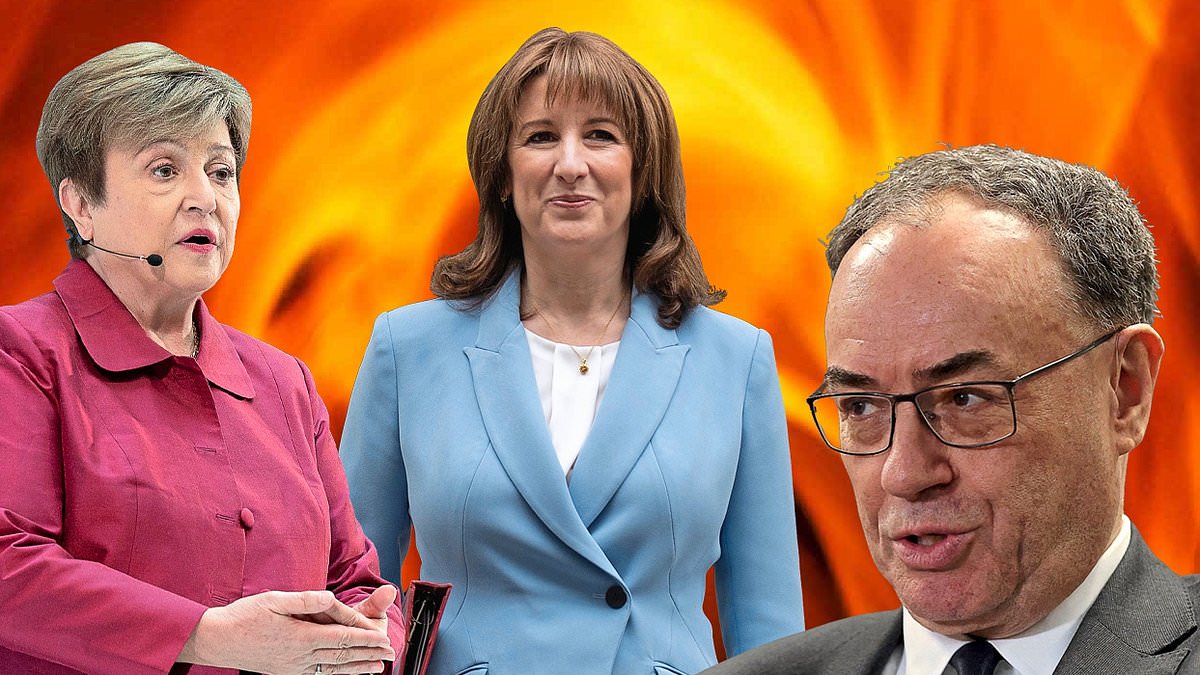
Three-way split: IMF boss Kristalina Georgieva, Chancellor Rachel Reeves and Bank of England governor Andrew Bailey
The Chancellor’s decision to hold a late November Budget in 2025 cast a huge, confidence-sapping cloud of uncertainty over business, consumers, and the prospects for Britain’s recovery.
But as serious as these shocks have been, none are as potentially catastrophic as the fallout from the US-Israeli assault on Iran, which has all but closed the Strait of Hormuz to Western shipping. The current ceasefire may provide temporary relief to financial markets but the scale of damage to the global economy is terrifying.
Research by the IMF shows wars lead to longer-lasting damage than financial shocks, such as those in sovereign debt, banking or currency markets. And the after-effects are felt well beyond nations directly affected by conflict.
Much of the world is still suffering the effects of the ongoing war in Ukraine. In Britain it has meant higher energy prices than would have otherwise been the case, above-target inflation at 3 per cent and stubbornly high interest rates even before the Iran conflagration.
It is against this backdrop that Reeves will hold a series of bilateral meetings with fellow finance ministers to try to hash out a coherent response.
She is also due at a session of G7 ministers from the world’s richest nations as well as a meeting of the IMF’s main steering committee, while making US media appearances too.
Investors moving into cash
Away from Iran, other nasties are lurking that could cause more pain for the Chancellor.
Governor of the Bank of England Andrew Bailey, who will also be in Washington this week, recently cautioned that the aftershocks of the war could have an impact on the £2.6 trillion private credit market, an opaque part of the global financial system that has recently suffered a spate of sudden collapses.
Ahead of the IMF meeting, private equity powerhouse Carlyle reported a run on funds from its £5.2 billion Tactical Private Credit Fund with investors cashing out 16 per cent of their holdings in the first three months of this year.
A senior wealth manager at one of Britain’s High Street banks also told me that investors, fearful of overheating in credit markets and the effect of the Middle East war, are rapidly moving into cash.
Even the IMF’s usually circumspect managing director Kristalina Georgieva warned in a pre-spring meeting address that ‘a resilient world economy is being tested by the now-paused war in the Middle East’.
Her concerns are not to be disregarded as, while the fragile ceasefire appears to be holding for now, the ripples from the conflict, including oil refinery shutdowns and the blocking of key chemicals such as fertiliser ingredients threatens to cause fuel shortages and imperil the food supply of 45 million people across the globe.
Georgieva also fears the conflict has triggered a rise in inflationary expectations that could ‘break an anchor and ignite a costly inflation process’ that would see consumers faced with yet higher prices.
The UK, with its dependence on ‘just in time’ liquefied natural gas supplies, is particularly vulnerable to imported inflation, which is likely to keep the Bank of England’s interest rate, currently at 3.75 per cent, higher for longer, increasing the cost of servicing the UK’s borrowing which is running at about £110 billion a year.
But the IMF is warning advanced economies against trying to alleviate the suffering of citizens by giving out cost subsidies, saying such moves could trigger a sell-off in government bonds and push up borrowing costs even more.
It comes as the fund draws up plans to dole out as much as £45 billion to struggling member states, a figure that may not hold if the Iran conflict erupts again. While Georgieva is confident it has the resources to weather the latest upheaval, it may raise questions as to whether the IMF will soon be dealt one shock too many.
DIY INVESTING PLATFORMS
AJ Bell
AJ Bell
Easy investing and ready-made portfolios
Hargreaves Lansdown
Hargreaves Lansdown
Free fund dealing and investment ideas
interactive investor
interactive investor
Flat-fee investing from £4.99 per month
Freetrade
Freetrade
Investing Isa now free on basic plan
Trading 212

Trading 212
Free share dealing and no account fee
Affiliate links: If you take out a product This is Money may earn a commission. These deals are chosen by our editorial team, as we think they are worth highlighting. This does not affect our editorial independence.
Compare the best investing account for you