
Share this @internewscast.com

The conflict between Russia and Ukraine remains an intricate deadlock, with Russian forces struggling to penetrate the robust Ukrainian defenses. While significant combat efforts are concentrated around critical urban centers in the Donetsk region, a subtle yet impactful clash is occurring over several pivotal islands along the Dnipro River. Ukraine currently holds these islands and the river’s western shoreline, while Russia, which maintains control over the eastern bank, seeks to seize the islands to facilitate its river crossings and reclaim Kherson. As in other theaters of this war, both nations are leveraging technology to tip the scales in their favor. Recently, the Russian military unveiled footage of their innovative robotic vessel, the Sirius-82 Uncrewed Surface Vessel (USV), designed to bolster their efforts to dominate the Dnipro River and its islets.
The Sirius-82, a recently spotted Russian USV, has begun operations in the Dnipro River. Although comprehensive technical details remain undisclosed, multiple social media clips have surfaced showcasing the device in action. These visuals reveal that the Sirius-82 is compact, measuring about two meters in length, and tailored primarily for riverine engagements. Its battery-powered nature implies it is optimized for brief missions rather than prolonged operations.
The Sirius-82 USV
In one recording, the Sirius-82 is seen transporting a pair of YaRM anchored river mines, each weighing around 13 kilograms. The mines rest on the vessel’s deck, equipped with mechanical arms that deploy them into the water. The same footage depicts a Russian soldier readying the Sirius-82 for this task. The vessel’s design is seemingly modular, capable of carrying various payloads both on its deck and within an internal cavity.
Despite swift advancements in robotics by both sides, the Sirius-82 maintains a straightforward design. The available videos depict the system being remotely piloted with a joystick interface, akin to those used for FPV drones, while an operator observes a live video stream on a laptop. The USV lacks the autonomy, navigational tools, and sensor arrays typical of larger maritime uncrewed vessels.
The footage specifically illustrates the Sirius-82 being employed to deploy two YaRM anchored river mines in the Dnipro. These mines, relics from the Soviet era, are crafted for shallow waterways and generally anchored just beneath the surface, posing a significant threat to small supply boats and assault craft with shallow drafts. Russian forces are utilizing these mines to intercept Ukrainian resupply vessels en route to the islands. Conversely, Ukrainian forces have placed similar river mines to hinder or disrupt Russian assault crafts attempting to traverse the river or reach contested sites, transforming the Dnipro into a perilous environment for smaller watercraft.
From a strategic standpoint, utilizing a USV for the deployment of shallow-water mines is a logical move for Russia. Similar to land operations, mine deployment in a river setting is inherently risky, offering minimal cover for crews on small boats. Russia has already adopted uncrewed ground vehicles for land-mine deployment to minimize personnel exposure, and this approach appears to be extending to maritime operations.
Russian Use Of The Sirius-82 To Lay And Clear Mines In The Dnipro River
The released videos specifically show the Sirius-82 being used to emplace two YaRM anchored river mines in the Dnipro River. These Soviet-era shallow-water mines are designed for inland waterways and are typically anchored just below the surface, where they pose a significant threat to small resupply boats and assault craft with shallow drafts. Russian forces are using these mines to target and destroy Ukrainian resupply vessels moving to the islands. At the same time, Ukrainian forces have deployed similar river mines to slow or disrupt Russian assault craft attempting to cross the river or approach contested positions, turning the Dnipro into a heavily contested and hazardous operating environment for small boats.
From a tactical perspective, it makes sense for Russia to use a USV to emplace these shallow-water mines. As on land, mine emplacement is an inherently dangerous task, and river environments offer little cover or concealment for crews operating small boats. Russia has already started using uncrewed ground vehicles for land-mine emplacement to reduce risk to personnel, and they appear to be applying the same approach to water.
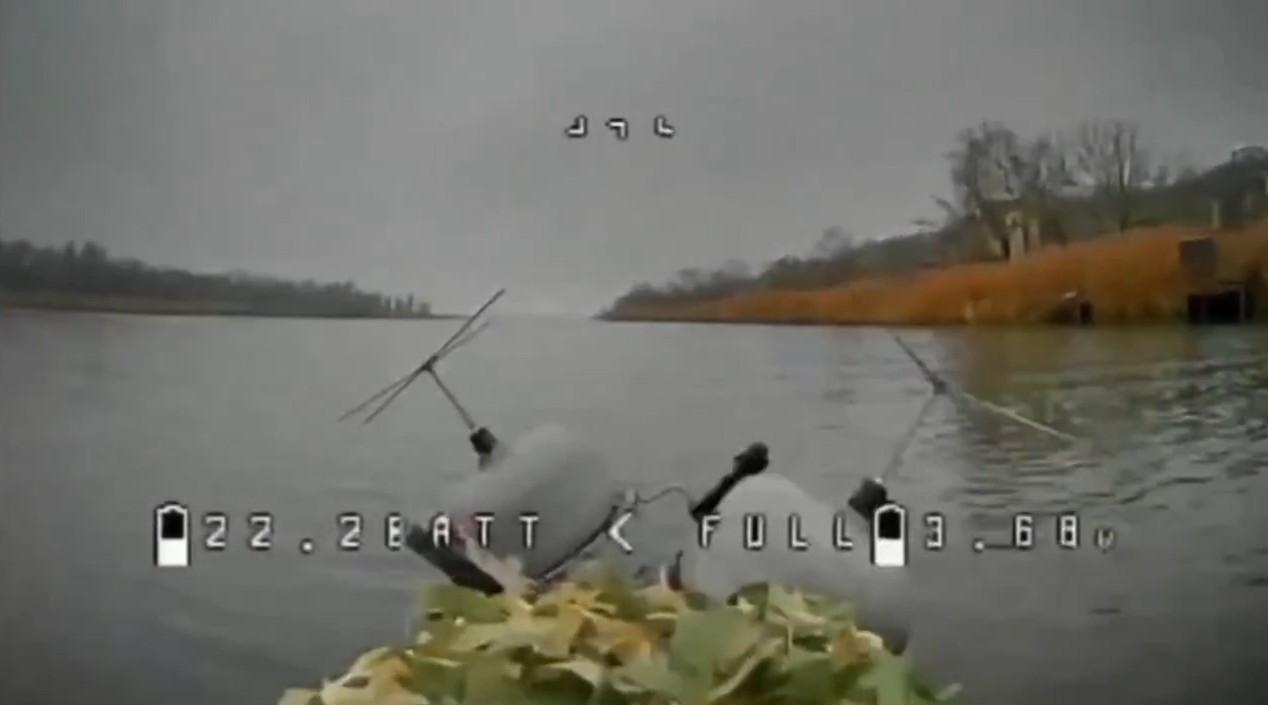
Image captured from drone footage posted on social media showing the Sirius-82 USV being used to detonate a shallow-water mine in the Dnipro River.
Social Media Capture
In addition to laying mines, one of the released videos also indicates that the Sirius-82 can be used for demining. The video shows the Sirius-82 employed as a sacrificial platform, floating into a Ukrainian mine to clear a passage, potentially ahead of a Russian crewed assault boat. A social media post analyzing this new system suggests a more sophisticated approach for demining with the Sirius-82. A common Russian practice for clearing mines in the Dnipro involves dropping demolition charges with delayed fuzes at regular intervals into the river. These charges sink and detonate, triggering nearby mines in the surrounding area. Given its ability to remotely deploy munitions, the Sirius-82 could readily perform this task.
Other Uses Of The Sirius-82 USV
The released videos and commentary also imply that the Sirius-82 can be used to attack Ukrainian military boats in the Dnipro River. Such attacks would likely be “kamikaze”-style, with the Sirius-82 ramming into a Ukrainian boat and detonating an onboard charge, destroying both vessels. The Sirius-82’s low profile and electric propulsion provide a degree of stealth, while its quick speed allows it to close distances rapidly, leaving little time for the other boat’s operators to take evasive action.
Beyond attacking boats, the Sirius-82 may also support assaults on the islands themselves. One post indicates that the USV could potentially be used to medically evacuate soldiers from the islands, although the platform would likely require upgrades to handle heavier payloads. The post further suggests that the Sirius-82 could be used to deliver supplies to support forces once an island has been seized.
Trends and Implications of Systems Like Sirius-82
The emergence of systems like the Sirius-82 reflects a broader shift toward replacing humans with robotic systems on the battlefield. Both Russia and Ukraine face growing personnel constraints driven by a 600-mile front, mounting casualties, and ongoing mobilization challenges. As a result, tasks once performed by soldiers and sailors are increasingly being shifted to unmanned systems. This transition has been facilitated by rapid advances in aerial drone technology, which both sides have adapted and expanded throughout the war and are now applying across other domains.
Image from video posted on social media showing a member of the Russian military preparing the Sirius-82 for deployment.
Social Media Capture
The Sirius-82 also highlights another important trend in battlefield technology. Despite rapid advances in robotics, including increased autonomy and more advanced sensing, the Sirius-82 appears somewhat primitive. Rather than reflecting a push toward cutting-edge systems, it appears to have been purpose-built for this specific conflict and mission set. With no prior public disclosures, the system was likely developed and fielded quickly to meet an urgent operational need. Instead of prioritizing advanced technology, the Sirius-82 emphasizes speed of development and immediate utility. This trend is likely to continue, with both sides rapidly fielding tailored robotic systems designed to address specific battlefield problems.
The Sirius-82 illustrates how quickly a relatively simple unmanned system can be developed to fill critical gaps on the battlefield. Compact, expendable, and purpose-built for riverine operations, the system allows Russia to contest Ukrainian control of the islands in the Dnipro River. As the war continues and manpower pressures intensify, Russia and Ukraine will increasingly turn to purpose-built robotic systems similar to the Sirius-82.