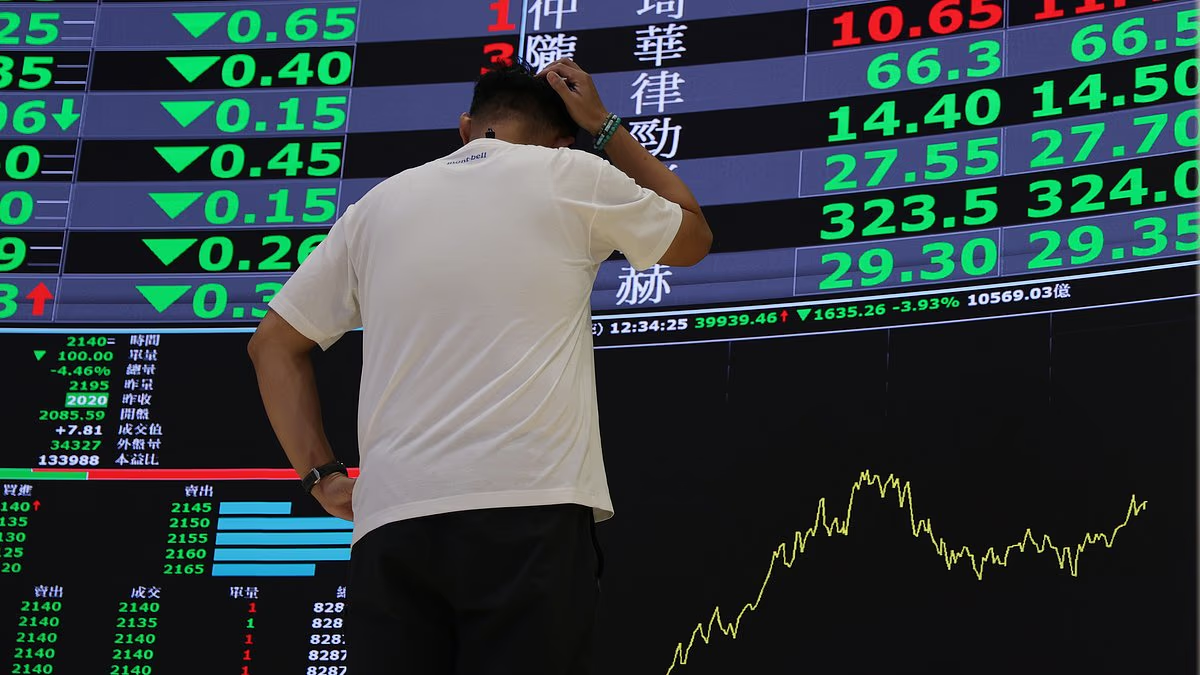

Wall Street’s sharp sell-off steadied during the afternoon session, but the pause did little to prevent losses spreading through global markets as investors continued to retreat from artificial intelligence shares.
The tech-focused Nasdaq opened 1.32 per cent higher, while the blue-chip S&P 500 gained a more modest 0.36 per cent.
Asian markets were far less resilient. Japan’s Nikkei 225 sank 6 per cent overnight in its steepest single-day decline since April 2025. South Korea and Taiwan also suffered, with their benchmark indices falling by more than 8 per cent at the open.
In London, the FTSE 100 lost more than 200 points, or 1.96 per cent, to trade at 10,571. The index had climbed as high as 10,948 on Thursday before the technology-led sell-off reversed the mood.
European equities also came under pressure. Germany’s Dax dropped 2.2 per cent, while France’s Cac 40 fell 1.76 per cent.
The latest moves followed a bruising session in the US on Thursday, when the Nasdaq plunged 5.5 per cent and the S&P 500 slid 4.4 per cent.
Investors have become increasingly uneasy after the Democrats’ midterm election victory, amid concerns that opposition to new data centres could slow the development of AI infrastructure.
That anxiety has intensified wider doubts about the billions being poured into the technology sector and whether an artificial intelligence bubble has formed, triggering a heavy Wall Street sell-off.

Wall Street’s sell-off sent shockwaves through stock markets around the world
‘The size of the declines among some of the market’s biggest companies has been remarkable,’ said Stuart Clark, portfolio manager at Quilter.
‘It also exposes the concentration risk that has accumulated in US equities. A relatively small group of technology and semiconductor companies now accounts for such a large share of the market that weakness in those stocks can quickly produce substantial losses for both the Nasdaq and the S&P 500.’
Wall Street’s volatility measure, often known as the market’s ‘fear gauge’, climbed to a seven-month high as roughly £2trillion was erased from the Nasdaq’s value on Thursday. The sell-off came after a short-lived rally following the US midterm election results.
The technology-heavy index fell as much as 6.4 per cent in early trading, dragging down major names including Elon Musk’s SpaceX and Tesla, which dropped 9 per cent and 11 per cent respectively.
Nvidia shares declined 8 per cent, while SanDisk plunged 17 per cent. Advanced Micro Devices lost nearly 15 per cent and Micron Technology fell 14 per cent.
The falls were broad-based across US markets. The S&P 500 ended 4.36 per cent lower, while the Dow Jones Industrial Average dropped 3.44 per cent.
President Donald Trump blamed voters for the market decline in a post on Truth Social on Thursday.
‘The Stock Market crashed today because the Dumocrats had a big Tuesday — So sad to see, you only have yourselves to blame!’ he wrote.
In another post, he said: ‘The Stock Market suffered one of the Worst Days in History based on the results of the Election.’
Trump added: ‘Such a sad thing to watch! It took so much work to get us to a level that no one has ever seen before, and then this. Your 401(k)s have, therefore, dropped. Remember, it wasn’t Republicans, it was Dumocrats.’
Will shares continue to slide?
Futures tracking US markets pointed to a mixed opening, with further declines indicated for the Dow Jones and S&P 500 but a modest gain expected for the Nasdaq.
The FTSE 100 has relatively little exposure to AI companies, yet it was still caught up in the wider sell-off as concerns about the global economy weighed on investor confidence.
Glencore was among the biggest fallers, down 2.7 per cent. Airtel Africa and AstraZeneca each lost 2.5 per cent.
Susannah Streeter, chief investment strategist at Wealth Club, said: ‘Although the Footsie is likely to be somewhat protected by its limited technology exposure, it is not immune. The performance of its multinational companies remains closely tied to the health of the global economy.’
‘Investor sentiment is deteriorating, and the blue-chip index is expected to finish a turbulent week on a sharply weaker note.’
Oil prices recovered towards $100 a barrel as investors considered whether the Democrats’ election victory could help secure an end to the conflict in the Middle East.
Brent crude rose to $97.80 after briefly falling to about $93 a barrel immediately after the Democrats’ victory.
Why does the market fall matter?
The sell-off is no longer confined to Wall Street and could have important consequences for investors around the world.
In the short term, falling share prices will reduce the value of millions of pension and savings accounts, particularly those invested heavily in US equities.
Long-term investors may view this week’s volatility as a temporary setback. However, the sell-off has revived questions about whether AI stocks are sustainably valued and how long the technology boom can continue.
Billions have flowed into technology companies as investors seek to profit from the growth of artificial intelligence.
Nvidia, Amazon, Microsoft and Alphabet have all enjoyed dramatic share-price gains in recent years. But investors are now demanding proof that the vast sums being spent on data centres and other infrastructure will eventually generate sufficient returns.
The impact will not be limited to individual stockpickers. Funds that track indices such as the Nasdaq and S&P 500 will also see the value of their holdings fall.
There is a further risk that the turmoil could spread into broader market sentiment, affecting investors with little direct exposure to US technology shares.
However, the outlook is not entirely negative.
‘It is impossible to know exactly when a recovery will begin, but history shows that remaining invested is usually a sensible approach,’ said Dan Coatsworth, head of markets at AJ Bell.
‘Recoveries can happen rapidly, and investors who remain on the sidelines can miss some of the strongest days of a rebound.’
He said periods of extreme volatility, when prices swing sharply in both directions, can also create opportunities. Investors may be able to buy quality assets at lower prices during periods of panic and sell at higher levels when confidence returns.
‘The important thing is to avoid becoming a forced seller. If you have sufficient cash to cover your immediate needs, you are less likely to sell investments after a steep market fall and lock in losses.’
DIY INVESTING PLATFORMS
AJ Bell
AJ Bell
Simple investing with ready-made portfolios

Hargreaves Lansdown
Hargreaves Lansdown
Free fund dealing plus investment ideas

interactive investor
interactive investor
Flat-fee investing from £4.99 a month

Freetrade
Freetrade
Invest in an Isa for free on the basic plan

Trading 212
Trading 212
Commission-free share dealing with no account fee
Affiliate links: If you take out a product This is Money may earn a commission. These deals are chosen by our editorial team, as we think they are worth highlighting. This does not affect our editorial independence.
Compare the best investing account for you


