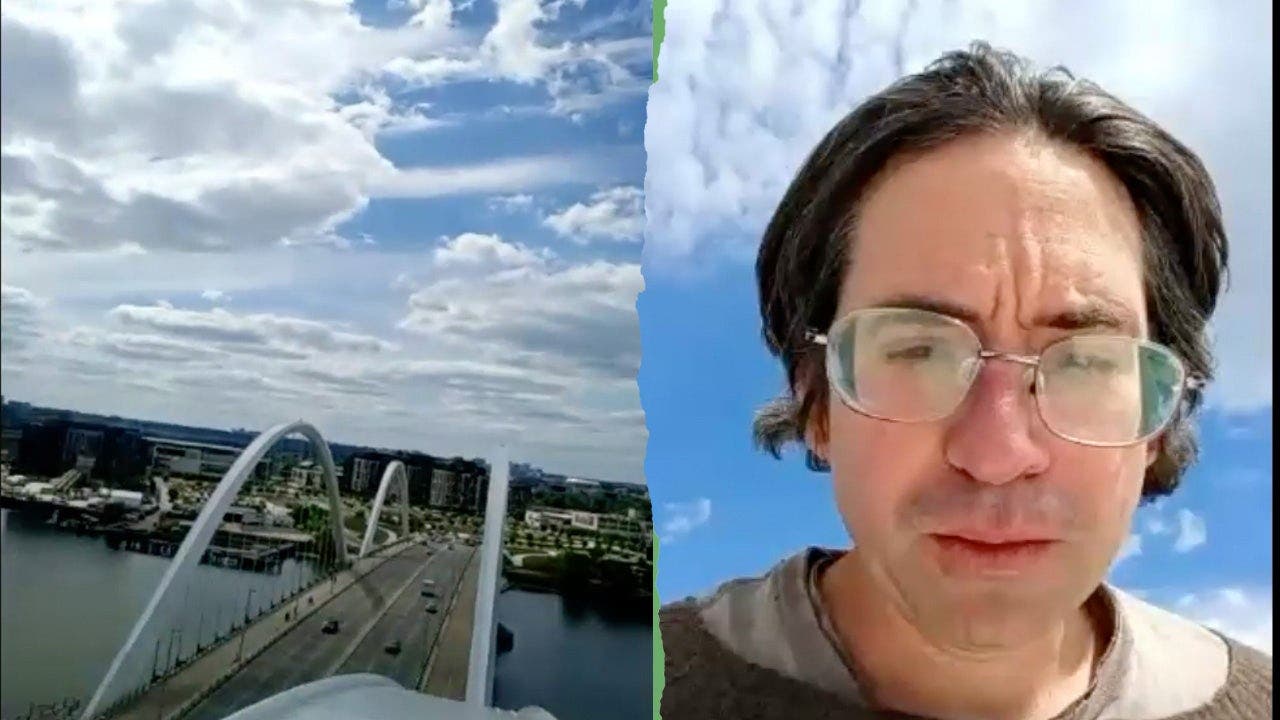

An activist has taken a stand against the war in Iran and the rise of artificial intelligence by occupying the Frederick Douglass Memorial Bridge in Washington, D.C. The protest, marked by a blockade, is being carried out by the demonstrator positioned atop the major roadway.
Guido Reichstadter, aged 45 and a former jeweler who has also studied math and physics, scaled the bridge to a height of 168 feet late Friday. He has vowed to remain there “until the war is ended,” as he explained in an interview with Fox News Digital.
Reichstadter has a history with this particular site, having climbed the bridge previously in 2022 to protest the Supreme Court’s reversal of Roe v. Wade. His current demonstration is aimed at raising awareness about both the conflict in Iran and the advancement of AI technology.
“From my point of view, which aligns with that of many experts, the situation concerning AI is incredibly urgent,” he expressed in a video interview with Fox News Digital, speaking from his vantage point atop the bridge.
Although his protest follows on the heels of a series of “May Day” demonstrations in D.C., Reichstadter has clarified that his actions are independent and not part of that movement.
“I act according to what moves me spiritually,” he shared with Fox News Digital, his voice tinged with emotion. “From the first day the bombing in Iran began, I felt compelled to take action.”
When asked what he would like to see happen with the Iran war, Reichstadter replied “I would like to see Congress grow a spine and do its job. To assert its constitutional authority over the declaration of war and they’re manifestly not doing that.”
Guido Reichstadter shows his view from atop the Frederick Douglass Memorial Bridge in Washington, D.C. Reichstadter claims to be protesting the Iran war and AI. (Guido Reichstadter)
When asked if he would still be protesting if Congress did approve it through a War Powers Resolution Act, Reichstadter said, “it absolutely depends on the particulars.”
Reichstadter did concede that a nuclear Iran would be a threat to the world, though added that he didn’t believe the U.S. or any other country should have nuclear weapons either.
When asked if he saw a distinction between a country like Iran developing a nuclear weapon or a more stable country having one, Reichstadter said he didn’t really see a big difference between Iran having nuclear weapons and other countries.
A man climbed a 168-foot bridge in Washington, D.C., to protest and call for an end to the war in Iran. (WTTG)
“I haven’t seen anything that makes me believe that the Iranian regime is particularly different in terms of its willingness to destroy the world. This is not to excuse anything that the Iranian regime does. I’m not making excuses, or under any illusions that it is not an autocratic regime which has committed atrocities on its own people, but the path to a safe future does not involve nuclear weapons held by any state,” he said.
Iran has been a U.S. State Department-designated state sponsor of terrorism since 1984. In recent years it has financially backed Hezbollah, Palestinian terrorist groups in Gaza, and other terrorist and militant groups in Iraq, Syria and Bahrain, according to the State Department.
The greater threat to Reichstadter, however, was neither a nuclear-armed Iran nor an ongoing war. His greatest fear was the endpoint of AI advancement.
Reichstadter climbed a 168-foot bridge in Washington, D.C., to protest and call for an end to the war in Iran. (WTTG)
“What happens when China or Russia or other nuclear states fear that the United States is on the cusp of developing a technology which will render their nuclear arsenals obsolete? They’ll be incentivized to stop it by any means necessary,” he argued.
“The goal of the frontier AI companies is not to build chatbots. It’s not to help you do your homework or make cute cat videos or something. The core mission of all of these companies is to create AI systems which vastly outperform human cognitive capabilities in every respect,” he said.
Reichstadter has previously been arrested on charges related to AI protests in California. He was twice for protesting OpenAI’s San Francisco campus, including an event where he locked the company’s doors shut, he told Fox News Digital. He was arrested again for violating a judge’s order not to return to the campus in 2025.
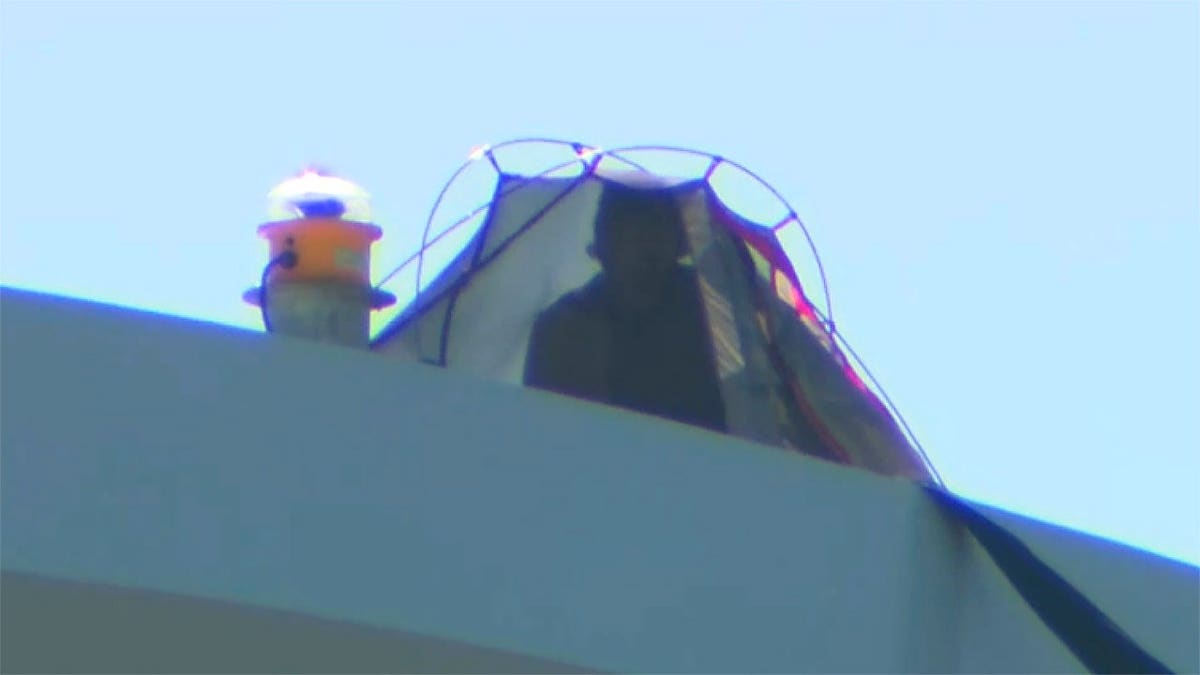
Reichstadter has previously been arrested on charges related to AI protests in California. (WTTG)
The issue for him, he said, is an existential one.
“That’s why I quit my job, that’s why I quit my career, my comfortable lifestyle, to try to get something moving. Because I’ve got two kids,” he told Fox News Digital. “I’ve lived a full life. I’ve been married, I’ve been in love, I’ve had a career. I don’t know if they’re gonna have that. And that’s the most important thing in the world to me, is their future and the future of the whole human race,” he concluded.
Fox News Digital contacted D.C. MPD for comment but did not immediately receive a response.
–>