
UK government borrowing costs have surged during a worldwide bond sell-off, renewing scrutiny of Andy Burnham’s controversial claim that Britain should be less “in hock” to financial markets.
The yield on 10-year UK government bonds, known as gilts, jumped from 5.24 per cent to 5.35 per cent on Wednesday. It was the sharpest daily increase in three weeks.
Yields climbed again on Thursday, rising above 5.38 per cent. Because bond yields move inversely to prices, the increase means higher borrowing costs for the Government, households and companies, including more expensive mortgages and corporate loans.
Market nerves have been amplified by concerns about Mr Burnham’s spending plans. Ten-year gilt yields were below 5 per cent shortly before he became Prime Minister, but have since reached levels not seen since 2007.
However, the latest pressure is not solely domestic. The sell-off has coincided with a sharp rise in US bond yields, driven by higher oil prices and expectations that the Federal Reserve may need to raise interest rates further.
The jump in borrowing costs is expected to pose a fresh challenge for Chancellor John Healey ahead of next month’s Budget.
Mr Burnham had already unsettled bond investors in the run-up to last year’s Labour Party conference, when speculation was mounting that he could challenge Sir Keir Starmer for the leadership.
At the time, his warning that he did not want Britain to remain “in hock” to the markets was viewed by some as a worrying indication that he underestimated the investors who fund the country. A sustained loss of market confidence could sharply increase borrowing costs and, in extreme circumstances, threaten the country’s finances.
Then-Chancellor Rachel Reeves said that although she would also prefer Britain to be less dependent on bond markets, “we rely on those bond markets and those people participating in them to buy our debt”.
In a new interview with the New Statesman, however, the Prime Minister argued that his original comments had been taken out of context by Sir Keir’s team.
“I mean, the point about the bond markets, it holds – in that what I was saying was the country has left itself over-exposed,” he said.

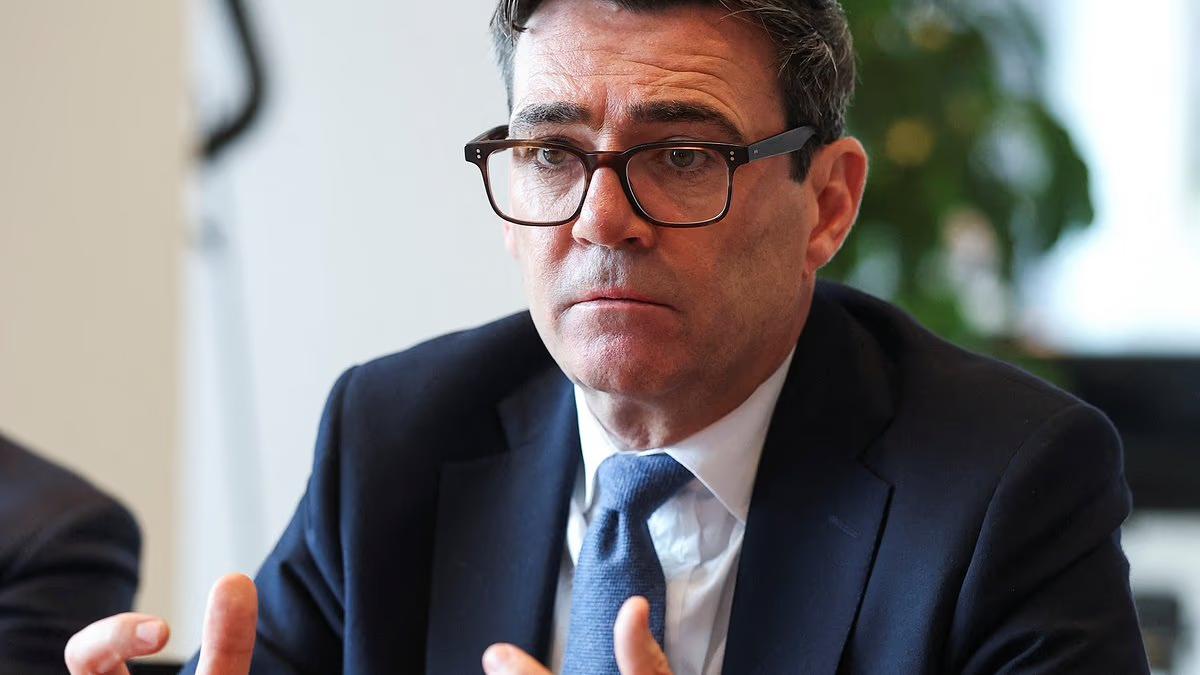
Andy Burnham said his earlier comments about bond markets had been taken out of context.
Mr Burnham said he was not advocating an end to spending discipline. Instead, he said, he was arguing for “a much more streamlined, productive state”.
He added: “They couldn’t understand why I was saying some of the things that I was saying.”
“[They] didn’t know what to do with it, but they did what they always do, which is they pulled one line out of it and then framed that one line within their world, rather than the one that I was talking about.”
The turmoil in bond markets is already feeding into mortgage pricing, and analysts have warned that rates could rise further.
Moneyfacts data shows that the average two-year fixed mortgage rate has reached 5.92 per cent, its highest level since July 2024. The typical five-year fixed rate now stands at 5.96 per cent, matching levels last recorded in October 2023.
Borrowing costs have risen steeply in recent months as investors wager that interest rates will need to increase to contain stubborn inflation, intensified by the war in Iran and a surge in oil and gas prices.
UK government bonds have been hit especially hard amid fears that Labour is unwilling to make difficult spending decisions and may instead increase borrowing to pay for its ambitious plans.
I’m Simon Lambert, publisher of This Is Money, and you need to know that your pension, savings and property could soon be under attack.

On October 28, Andy Burnham’s government will set out its Budget. We don’t know what they will do, but we do know about tax raids already on the way. The best thing you can do is get prepared. So I’ve called on some of Britain’s leading financial experts to create my new six-week plan. I’ll cut through the noise and take you step-by-step through everything you need to do to protect your money.
Don’t wait. Click here and sign up to Protect Your Money now.
Official figures this week laid bare the impact of rising borrowing costs on the Government’s finances with debt interest payments hitting a record high of £8.8billion last month – the highest bill for August on record.
That took interest payments on the near £3trillion national debt to £50billion for the first five months of the fiscal year – or £327million a day.
The surge in interest payments piles pressure on Mr Burnham and Mr Healey ahead of next month’s Budget.
It is feared he will be forced to borrow yet more money – or hammer the economy with ever higher taxes – to fund Labour’s spending plans.
Analysts warned this risks fresh turmoil on the bond markets – pushing up borrowing costs for the government, households and businesses.
It is now thought that the Prime Minister and Chancellor may opt for less fiscal headroom in next month’s Budget to limit tax rises and avoid spending cuts.
Even as analysts warned ‘bond yields are blowing out again’, reports suggested Mr Burnham and Mr Healey are looking at setting a lower buffer than the £24billion forecast in March.
Having seen the headroom eroded by higher interest rates and a ballooning welfare bill, it is thought they could settle on around £14billion in the Budget on October 28.
This would allow them to temper tax rises and spending cuts – but risks spooking the bond markets at a time when the UK government already pays more to borrow than any other G7 country.
Neil Wilson, an investor strategist at Saxo Markets, said: ‘Bond yields are blowing out again.
‘Gilt market participants may have had an eye on the prime minister, Andy Burnham, making the kind of comments you kinda wish he just wouldn’t make. He said he stands by his view that the UK is “in hock” to the bond market. There is this cognitive dissonance where he says we are at the mercy of the bond market but shouldn’t be – like it’s something the government cannot control.’
He added: ‘This morning a test balloon is being flown with a report that the Chancellor would be comfortable with reducing the fiscal headroom in order to avoid more tax hikes. It’s likely the roughly £24billion of headroom left by Rachel Reeves in March has been halved by the spike in bond yields, which would ordinarily require tax hikes to offset.
‘The balloon being floated is that Healey would just accept less headroom and the bond market would be totally fine with this, which I very much doubt.
‘The key will be that the underlying fiscal plan underpinning a Budget with less headroom is credible, but I would think that the gilt market has a low threshold for this kind of thing. It’s not messing with the fiscal rules as such, but it would undermine confidence the government can stay within them and would signal a deeper issue; that they are not willing to take tough decisions on welfare spending.’
Protect Your Money – sign-up to our six-week plan
The Budget is coming – but are you prepared? Sign up to our six-week plan and Simon Lambert and his team of financial experts will reveal how to Protect Your Money. If you’re a subscriber, it’s completely FREE
> Sign-up to Protect Your Money
DIY INVESTING PLATFORMS

AJ Bell
AJ Bell
Easy investing and ready-made portfolios

Hargreaves Lansdown
Hargreaves Lansdown
Free fund dealing and investment ideas

interactive investor
interactive investor
Flat-fee investing from £4.99 per month

Freetrade
Freetrade
Investing Isa now free on basic plan

Trading 212
Trading 212
Free share dealing and no account fee
Affiliate links: If you take out a product This is Money may earn a commission. These deals are chosen by our editorial team, as we think they are worth highlighting. This does not affect our editorial independence.
Compare the best investing account for you


