

At this year’s Cannes Film Festival, one film that stirred considerable excitement was the genre-bending thriller Hope by South Korean director Na Hong-jin. Distinct from the 2013 film of the same name by Lee Joon-ik, Na’s Hope has been lauded for its thrilling blend of horror, comedy, action, and science fiction, complete with an alien twist.
The film, crafted by Na as writer, director, and co-producer, boasts a star-studded cast including Michael Fassbender, Alicia Vikander, and Taylor Russell. Jung Ho-yeon of Squid Game fame joins Korean cinema veterans Zo In-sung and Hwang Jung-min, the latter of whom previously collaborated with Na on the acclaimed 2016 horror film The Wailing.
Set in a rural village near the Korean Demilitarized Zone, the plot of Hope unfolds as the local police chief, portrayed by Hwang, investigates a mysteriously mutilated animal carcass. This leads to the chilling discovery of a superhuman creature wreaking havoc, escalating what starts as a local investigation into an epic cosmic showdown.
Notably, Hope is the first Korean film in four years to be invited to compete at the Cannes Film Festival. This marks Na Hong-jin’s competitive debut at Cannes, although his previous works, including The Chaser, The Yellow Sea, and The Wailing, have been showcased at the festival in non-competitive categories. Although Hope didn’t clinch the Palme d’Or—that honor went to Romanian director Cristian Mungiu’s Fjord—it captivated audiences and critics alike. The film’s teaser, released by distributor NEON on YouTube, has already attracted over 3.2 million views.
‘Hope’ is the most expensive Korean film in history
With a production budget surging past 70 billion won (approximately $46 million), Hope stands as the most expensive Korean film to date, though still modest compared to typical Hollywood blockbusters.
Financially, Hope has already proven successful, recouping half of its production costs through record-breaking overseas pre-sales. The film’s distribution rights have been acquired in over 200 countries and territories, setting a new benchmark for Korean cinema on the global stage.
Fortunately the film has already recouped half of its production budget, as it was recently announced that Hope had set a new record for the highest overseas pre-sale of a Korean film and secured distribution in over 200 countries and territories.
So far the film has garnered mixed reviews, with some critics finding the CGI to be rather lacking. That said, Na has stated that he and his team were still in the middle of post-production when they were invited to Cannes, so the movie technically isn’t even finished yet. (It’s also worth noting that compared with Hollywood blockbusters, South Korean films have generally had to work with more limited budgets, making complex visual effects especially challenging.)
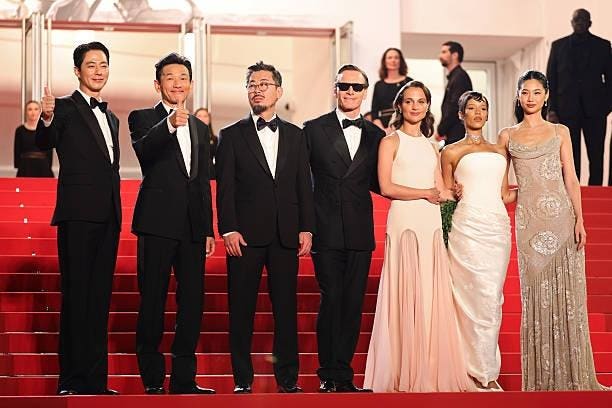
CANNES, FRANCE – MAY 18: (L-R) Michael Fassbender, Alicia Vikander, Hwang Jung-min, Na Hong-jin, Zo In-sung, Jung Ho-yeon and Taylor Russell pose during the “Hope” photocall at the 79th annual Cannes Film Festival at Palais des Festivals on May 18, 2026 in Cannes, France. (Photo by Amy Sussman/Getty Images)
Getty Images
The Korean film ‘Hope’ was invited to the 2026 Cannes Film Festival while still in post-production
Na initially turned down the invitation from Cannes because he and his crew were still deep in the post-production process for Hope. However, he eventually agreed to participate after receiving repeated invitations from the festival as well as an extension of the submission deadline. According to the production team, his decision to attend the 79th Cannes Film Festival was “made out of gratitude for Cannes’ repeated invitations at the most critical stage of postproduction.”
With the Cannes premiere behind him, Na has said that his focus will shift back to completing post-production and polishing the film. Hope is slated to be released in South Korea this summer and in the U.S. this fall.
Na shared with The Associated Press that “xenophobia and immigrant problems” were the starting point for his movie, which later developed into “a much bigger story.”
“In any big tragedy, they don’t necessarily arise from malicious intention. It all starts with difference in perspective,” he told AP. “I think it’s that conflict in perspective or misunderstanding that creates these collisions. That’s what I wanted to talk about.”
How the Cannes press conference for the Korean film ‘Hope’ resulted in controversy
The Cannes conversation around Hope took an uncomfortable turn after a journalist made dismissive remarks during the film’s press conference. The journalist—who failed to state her name and outlet, as is standard protocol—started her question by saying, “Hi Michael, hi Alicia. I don’t know the rest of you.”
She then proceeded to ask, “I’m just wondering if the director could say why he wanted to cast Michael and Alicia. Two actors for the price of one, maybe?”
In response, Jung and Russell (who is biracial) traded glances, while Hwang and Zo remained expressionless. Director Na seemed visibly taken aback by the question.
The incident sparked widespread outrage online, with many netizens calling out the reporter for being racist for not acknowledging the film’s director and actors of color, especially when name cards were clearly displayed in front of each panelist. Some also pointed out that the question was rude to Fassbender and Vikander as well (the two actors are married in real life), while others criticized the couple for not standing up for their castmates and director.
Though the reporter never shared her name, internet sleuths have determined that it’s Helen Barlow, an Australian freelance film critic based in Paris.
What other Korean films were shown at the 2026 Cannes Film Festival besides ‘Hope’?
Hope wasn’t the only Korean movie to be selected for Cannes this year. Train to Busan director Yeon Sang-ho’s new zombie thriller Colony (“Gun-che” in Korean), which boasts an all-star Korean cast that includes Jun Ji-hyun, Koo Kyo-hwan, Ji Chang-wook and others, had its world premiere during the Midnight Screenings portion of the festival.
Dora, a drama written and directed by July Jung and inspired by Sigmund Freud’s case study of a woman whom he believed to be suffering from hysteria, premiered in the Directors’ Fortnight section.
La Cinef, the festival’s competition for student films, selected merely 19 titles out of 2,747 submissions it received from film schools around the world. Two of the 19 films were created by young Korean filmmakers: “Bird Rhapsody,” an animated short by Choi Won-jung of Seoul’s Hongik University, and “Silent Voices,” a short film by Jin Mi-song (credited as Nadine MISONG JIN on the Cannes website) of Columbia University, which also won second prize in that category.
Famed Korean auteur Park Chan-wook, known for classics like Oldboy, No Other Choice, The Handmaiden and Decision to Leave, served as the head of this year’s Cannes jury, making him the first South Korean director to lead the jury at the Cannes Film Festival.
Here’s a look back at some of the South Korean films that have made their mark at Cannes over the years.


