Share this @internewscast.com
Gain free access to the Editor’s Digest
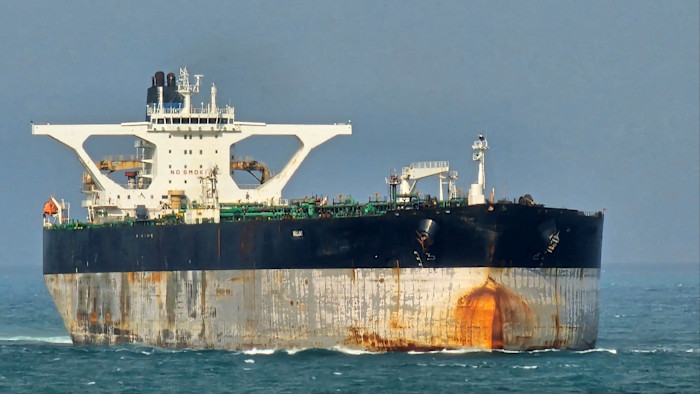
The United States is closely monitoring an oil tanker linked to Venezuela, Russia, and Iran as it navigates near the British coastline, coinciding with an increase in US military presence in the UK.
The vessel, known as the Marinera, was the subject of a US Coast Guard seizure attempt in December while near Venezuelan waters. It is currently traversing the mid-Atlantic and appears to be on a course towards Russia.
While it remains uncertain whether an immediate action to seize the now-empty tanker is planned, UK officials have not dismissed the possibility of the US using its bases in the UK for such an operation. No comment was made on whether the UK is directly involved in this potential mission.
According to a recent CBS News report, US authorities are still considering boarding the tanker, though they have yet to decide on a definitive course of action.
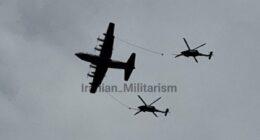
This vigilant tracking of the Marinera’s route is occurring as a significant influx of US military equipment has been observed arriving in the UK over recent days, including flights originating from bases typically used by US special forces.
Reports have suggested that US cargo flights have brought in Black Hawk helicopters alongside other military aircraft.

The US instigated a wider blockade of the Venezuelan oil industry as a means of putting pressure on the country’s government in the run-up to its seizure of former President Nicolás Maduro on Saturday.
The US Coast Guard first attempted to board the vessel, which was previously called the Bella 1, on December 21 as it was sailing towards the Caribbean. But the crew did not allow the coastguard to board and it sailed back towards the Atlantic.
The US said the ship was sailing without a valid flag and had been sanctioned for its involvement in the Iranian oil trade.
US, UK and Irish military aircraft appear to have been tracking the tanker, with an RAF Rivet Joint spy plane flying over the area where the vessel was last spotted on Tuesday afternoon, according to flight tracking data.
A UK Ministry of Defence spokesperson said they would not comment on individual flights.
The vessel registered itself as Russian while sailing back across the Atlantic, which may complicate any attempted seizure. Weather conditions in the north Atlantic are also likely to be challenging in January.
The tanker was being “monitored” by the Irish military, which was normal for vessels suspected of being part of Russia’s so-called shadow fleet, but had not entered the country’s territorial waters, said one person with knowledge of the situation.
In November, the vessel sailed from the Gulf of Oman, through the Suez Canal and Strait of Gibraltar before crossing the Atlantic in early December. As US pressure on Venezuela rose, it abruptly stopped on December 15 near the Caribbean and starting to head back east.
The vessel’s route back across the Atlantic has been highly unconventional, with the tanker cutting sharply north to head into the gap between Iceland and Ireland rather than using the normal route through the English Channel.
“For now, we can see that she’s continuing north-east towards Russia,” said Samir Madani, co-founder and chief executive of TankerTrackers.com, a service that reports on shipments of crude oil.
Any UK involvement in seizing the vessel may lead to questions for the Labour government, which has come under pressure to comment on whether it sees the US operation to seize Maduro as a breach of international law.
The MoD spokesperson declined to comment on whether the UK would place restrictions on US operations from bases in the country.
The UK has pushed for harsher measures against Russian shadow fleet oil tankers.
In June 2024, the vessel, along with its then-owner, a Turkish-registered company, was added to the US Treasury’s sanctions lists “for having materially assisted” the Iranian Revolutionary Guards Quds Force by carrying cargo on behalf of a “Hizbollah-owned” company.
Kpler, the data and analytics company, has identified three voyages the vessel made carrying Iranian oil in 2025.
According to the International Maritime Organization, the vessel operated with a false flag between November 2024 and December 2025.
This means that the vessel, which was pretending to operate under a Guyanese flag, was vulnerable to boarding.
One of the permitted grounds under the United Nations Convention on the Law of the Sea for a warship to board a foreign vessel is suspicion that “the ship is without nationality”.
In December, however, the 23-year-old ship was sold to a Russian company called Burevestmarin and is now listed as legitimately operating under Russian jurisdiction and oversight.
According to Russian corporate records, Burevestmarin was founded in Ryazan in July 2025 by Ilya Bugay, a businessman listed as the general manager of an oil-trading company. Bugay has been contacted for comment.
Cartography by Steven Bernard