
Topline
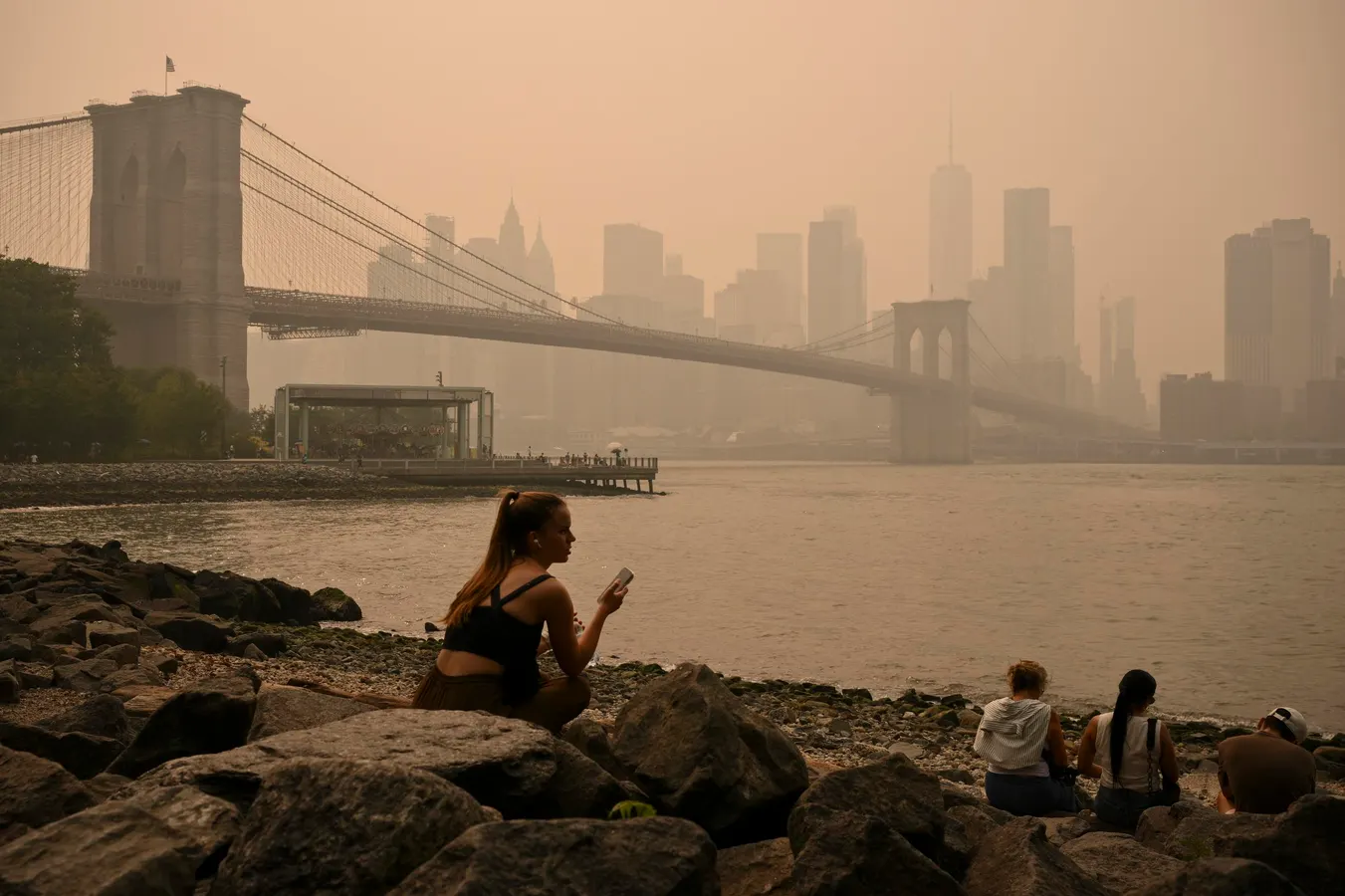
The National Weather Service is urging residents across a broad stretch of the U.S.—reaching as far south as South Carolina—to keep a close watch on local air quality as smoke from hundreds of wildfires in Canada drifts across the border, even as some American politicians criticize Canada’s response to the out-of-control blazes.
People sit near the Brooklyn Bridge as wildfire smoke from Canada creates hazy skies in New York on July 16, 2026.
AFP via Getty Images
Key Facts
The National Weather Service issued air quality alerts Friday as wildfire smoke affected portions of North Dakota, Minnesota, Michigan, Wisconsin, Illinois, Indiana, Ohio, Pennsylvania, West Virginia, Virginia, Kentucky, North Carolina, South Carolina, New Jersey, Delaware, Rhode Island, New York, Connecticut, Maryland and Washington D.C.
Parts of Michigan have reached “hazardous” air quality, the most severe level on the scale, while Wisconsin, Minnesota, Illinois and Indiana are seeing pollution levels categorized as “very unhealthy.”
New York, including New York City, along with New Jersey, Pennsylvania, Ohio, Connecticut, Rhode Island, Delaware and Maryland, are reporting “unhealthy” air and widespread smoke-driven haze, while areas farther south and east are advising that sensitive groups may face elevated health risks.
The smoke is moving into the U.S. from about 850 active wildfires burning in Canada, with many of the largest fires in Ontario, as well as from more than a dozen wildfires in northern Minnesota.
Republican members of Congress have criticized the Canadian government over what they see as a failure to prevent and contain the wildfires driving the smoke and poor air quality, with one lawmaker even calling for sanctions.
Four Michigan Republicans—Reps. John James, Jack Bergman, John Moolenaar and Lisa McClain—said in a letter this week that Canada “has the tools to prevent” the smoke from pouring into the U.S. and “has chosen not to,” and Sen. Bernie Moreno (R-Ohio) said in a post on X that he will table a bill next week to “sanction Canada and the responsible Canadian government officials for this atrocity.”
CRUCIAL QUOTE
“Our constituents are breathing the consequences of this failure right now, and they deserve better than to be told, again, that it will be handled,” the Michigan lawmakers said in their letter.
HOW TO STAY SAFE FROM WILDFIRE SMOKE
Those in states with extreme air quality warnings are being cautioned to limit outdoor activity and, in states with very unhealthy and hazardous warnings, to stay inside altogether with windows closed. Doctors advise anyone with heart or lung disease to stay indoors, and other groups to take precautions. For people who work outside, health officials have recommended wearing an N95 mask, which can filter at least 95% of airborne particles.
WHY IS WIDLFIRE SMOKE SO DANGEROUS?
Smoke from wildfires is made of water vapor, pollutants and particulate matter, which can penetrate the lungs and bloodstream, trigger systemic inflammation, exacerbate conditions like asthma and increase the risk of heart attacks and strokes. Smoke also contains a mix of harmful gases, most notably carbon monoxide. Wildfire smoke has been linked to respiratory and cardiovascular health problems, with children and teenagers, older adults, pregnant people and anyone with pre-existing heart or lung conditions at a particular risk.
SHOULD PEOPLE IN WILDFIRE SMOKE STATES WEAR A MASK?
When the Air Quality Index rises to unhealthy levels—as it has in Michigan, Wisconsin, Minnesota, Illinois, New York, New Jersey, Massachusetts and Connecticut on Thursday—masks are recommended for people who must spend time outside. Respirator masks worn correctly may provide some protection against fine particles in the smoke, but they do not help with hazardous gases. Staying inside is considered the safest option, but those who must go outside can mitigate some risk by wearing a mask. N95 or P100 respirators are considered the most effective.
Key background
Scientists say climate change is creating hotter, drier conditions and longer fire seasons, increasing the likelihood of large, intense wildfires across North America. NASA says human-caused warming is driving more frequent and severe wildfire conditions in many regions, and that extreme wildfire activity has more than doubled worldwide over the past two decades. Research shows fire seasons in some areas are now more than a month longer than they were 35 years ago, and those larger fires also produce more smoke, allowing hazardous air pollution to travel hundreds or even thousands of miles and affect millions of people far from the flames.
BIG NUMBER
$394 billion to $893 billion. That’s the annual cost of wildfires in the United States each year, according to the Joint Economic Committee, including direct and indirect deaths and injuries, health impacts from wildfire smoke, income loss, watershed pollution and other factors.


