
Share this @internewscast.com

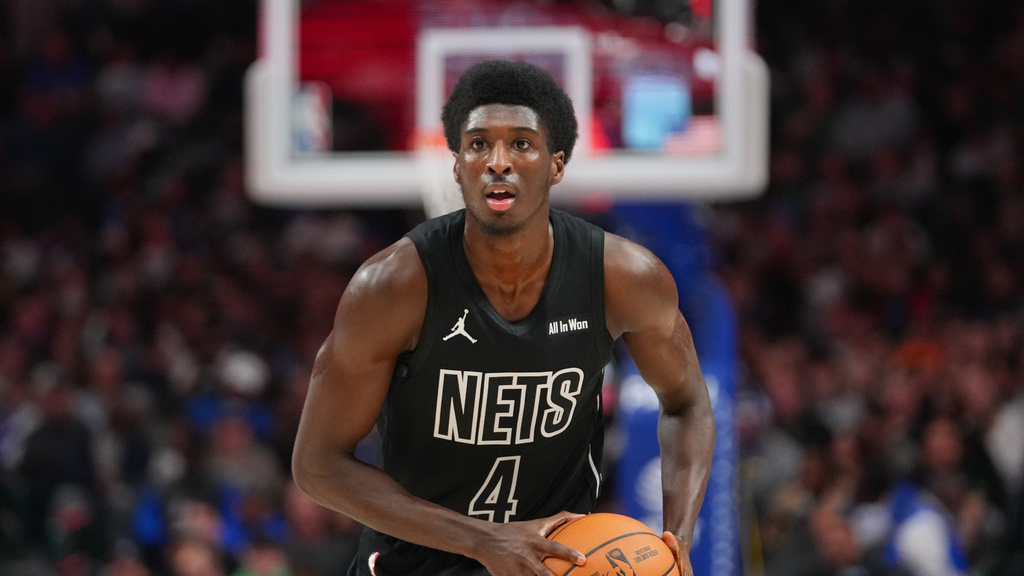
Brooklyn Nets head coach Jordi Fernández has approached Drake Powell’s recent promotion to the starting lineup not as a reward but as an opportunity for assessment. This perspective was evident in his comments before the Nets faced the Chicago Bulls at Barclays Center on Friday.
In his third consecutive start against Chicago, the rookie wing has certainly capitalized on the opportunity. During his previous two starts, Powell averaged 13 points and three rebounds over 24.5 minutes per game, showcasing an impressive 81.8% success rate on his two-point attempts. His performance has been marked by efficiency and impact, underscoring why Brooklyn sees Powell as a cornerstone for the future rather than a mere short-term experiment.
However, Fernández emphasized that Powell’s place in the starting lineup is not set in stone.
“Starting is not a guarantee,” Fernández remarked. “He needs to continue working hard, and from there, we’ll evaluate things on a game-by-game basis.”
This approach reflects Fernández’s overall strategy this season, where he frequently experiments with players in various roles to identify who thrives as the pace intensifies and duties expand. With Powell, the coach is not only satisfied with the rookie’s current contributions but is also challenging him to elevate further, envisioning Powell’s potential as more than just a “rotation wing.”
“Drake did an amazing job last game,” Fernández noted. “We believe he can develop into not just a good but a great two-way player.”
Fernández rattled off the checklist that makes Powell so intriguing, describing him as a shooter and playmaker who can be used on the second side of actions, handle in transition and guard the opponent’s best perimeter threat. It’s a rare combination for a rookie, and it’s why Powell has looked more comfortable each time his role expands. His athleticism, Fernández added, is “top in the NBA for his position.”
The ask now is consistency.
THE NEXT STEP
Egor Dëmin is looking more comfortable by the game, and Fernández said the biggest sign is that the rookie isn’t playing sped up anymore. The reads are coming cleaner, the shots are coming in rhythm, and the Russian guard has been able to knock down 3-pointers without forcing the offense to revolve around him.
“I think his ability to shoot the ball in the flow of the game has been impressive so far,” Fernández said, noting Dëmin can get to it “off the catch or off the dribble.”
But as the season pushes toward its second half, Fernández wants that comfort to turn into aggression. The coach said Dëmin’s next step isn’t just making shots, it’s using his size and skill to consistently touch the paint, finish with balance and create advantages that don’t depend on the jumper falling.
“If he is aggressively touching the paint… I think right there is where he makes the difference and takes the next step,” Fernández said.
RINSE AND REPEAT
The Nets had dropped five straight entering Friday’s game, and the standings don’t leave much room for optimism right now. But Fernández insists the approach can’t be about carrying the last result into the next one, even if he admits he doesn’t personally let it go that easily.
“As a group, we got to believe that the next game is the most important game,” Fernández said.
For him, moving forward doesn’t mean forgetting. It means studying. Fernández said the close-game moments have become constant lessons, from timeout usage to late-game decision-making, and he treats each one like a note for the next time the Nets are in that situation. He called those experiences “super valuable,” not just for the roster, but for the coaching staff too, because there’s rarely one correct answer in the NBA’s tightest moments.
The priority, he said, is being connected when the margin shrinks, staying aligned, and trusting the plan without second-guessing. That’s the challenge for a young team trying to grow through losses: keep the urgency, keep the belief and make sure the lessons actually show up before the next game turns into the same ending.
“You’re right there, but you don’t win,” Fernández said. “And those lessons are very important for us, very important that you understand the NBA. The games keep coming and whenever it’s fast, it’s fast, but no moral victories, we got to go out there and believe that those little things are going to help us get the next one.”