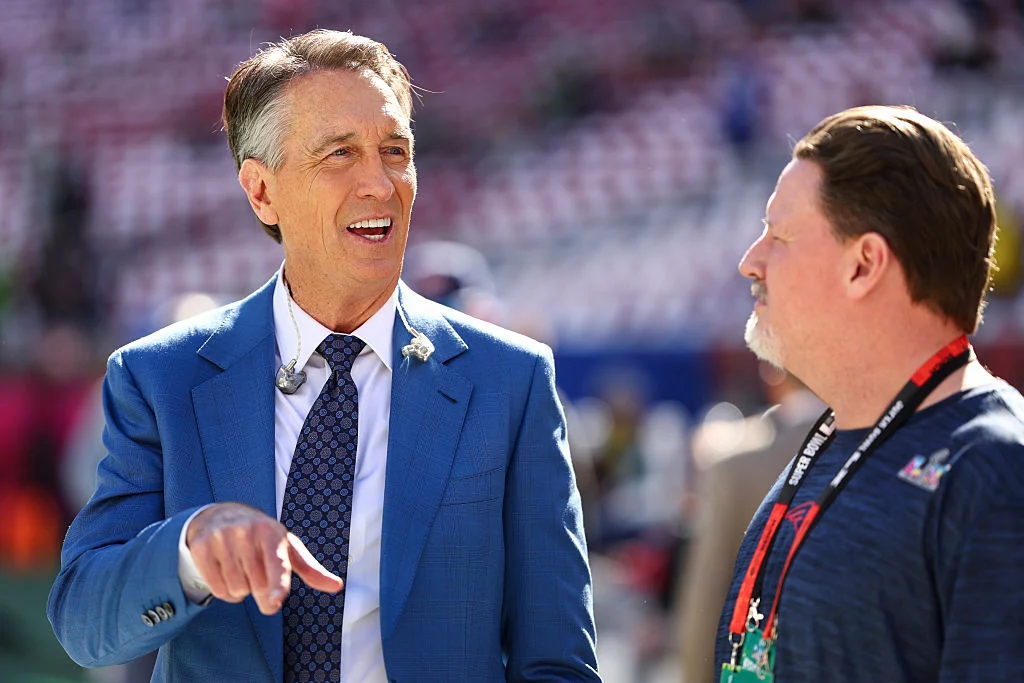

Anyone who has tuned in to NBC’s “Sunday Night Football” over the past 20 years will recognize Cris Collinsworth’s voice. The former Cincinnati Bengals receiver has evolved into one of the most familiar analysts in American sports, spending autumn weekends in the broadcast booth breaking down the NFL for millions of viewers.
That high-profile role has made Collinsworth exceptionally wealthy. He reportedly earns $12.5 million annually as NBC’s lead “Sunday Night Football” analyst. His television résumé also includes lengthy stints with Fox and HBO, along with 17 Sports Emmy Awards and more than 500 NFL broadcasts.
For most football fans, earning $12.5 million a year while discussing the sport with friends would be the ultimate dream job. But broadcasting is only one part of Collinsworth’s financial success. A major share of his fortune came from an unexpected business venture—one that began with an NFL-obsessed Englishman, a small apartment and deep frustration with the limited football statistics available at the time.
A Football Nerd In England
In 2004, Neil Hornsby believed NFL analysis was missing something important. Traditional box scores could show a quarterback’s passing yards or a linebacker’s tackle total, but they offered little insight into the less visible battles shaping a game. They could not easily reveal whether an offensive lineman had controlled his matchup all afternoon or whether a cornerback had performed so well that the opposing quarterback avoided throwing toward him entirely.
Hornsby, an Englishman who became fascinated with American football after discovering the NFL on British television during the 1980s, had spent years collecting statistics on his computer. By the 1990s, his interest had developed into a far more demanding project: watching games closely and grading every player’s contribution on every snap.
By 2006, the workload had grown beyond what Hornsby could manage alone. He recruited a small team of devoted NFL fans, many of whom he encountered through online message boards, and began turning their research into a website. The company was named Pro Football Focus, now widely known as PFF.
PFF officially went live in 2007, but its early audience was tiny. Hornsby later recalled that the site sometimes received only 80 page views a week. He was still operating a business consultancy in England and paying for the NFL analytics project himself.
Still, the database continued to expand. Eventually, the growing archive of player evaluations caught the attention of someone inside the NFL.
In 2009, Jon Berger, an executive with the New York Giants, contacted Hornsby through the website. Hornsby initially thought one of his friends was teasing him.
The message was genuine.
The Giants became PFF’s first NFL customer. Other franchises soon signed on, and Hornsby’s unusual side project began developing into a serious football intelligence company. By 2014, 13 NFL teams were paying for PFF’s data and analysis.
It was around that same period that Cris Collinsworth discovered the company.

(Photo by Kevin Sabitus/Getty Images)
Cris Finds PFF
Collinsworth was searching for more effective ways to prepare for his broadcasts. Covering the NFL required more than simply studying the few games he watched in person or on television each week. He wanted a clearer picture of which offensive linemen were underperforming, which defensive backs were excelling and how players across the league were contributing in ways traditional statistics often overlooked.
PFF had already built much of that information. Collinsworth subscribed to the service and eventually began speaking with Hornsby, though he later acknowledged that he was initially unsure what to make of the mysterious football analytics operation based in England.
Those doubts faded as Collinsworth learned more. He recognized that PFF’s detailed evaluations could serve a much larger audience than broadcasters alone. NFL franchises, college teams, scouts, agents, fantasy football enthusiasts, bettors and everyday fans could all benefit from the same deeper level of analysis.
Collinsworth therefore chose to do more than become a customer. He decided to purchase the company.
The $6 Million Investment
In 2014, Collinsworth invested $6 million to acquire a majority stake in Pro Football Focus.
It was a substantial gamble, even for a former NFL player with a successful broadcasting career. At the time, PFF was not an obvious tech sensation. Its foundation was a labor-intensive process: teams of analysts watching countless hours of football and documenting what happened on every play.
With Collinsworth as its majority owner, PFF entered a period of rapid growth. The company moved its operations to Cincinnati, expanded its analyst staff and developed increasingly advanced football-data products. NFL teams continued subscribing, college programs followed, and major networks began using PFF statistics during broadcasts. Before long, the company’s player grades had also become a familiar resource for fantasy football players and NFL fans.
Eventually, all 32 NFL teams became customers.
PFF had gone from an obscure analytics service founded in England to a company embedded throughout professional football.
Then The Big Money Arrived
The clearest indication of how valuable Collinsworth’s investment had become arrived in September 2021, when private equity giant Silver Lake invested $50 million in Pro Football Focus. The transaction valued PFF at $160 million.
Seven years earlier, Collinsworth had spent $6 million to acquire majority control. Now the entire company was worth more than 26 times that amount.
And the story still wasn’t over.
PFF Gets Split In Two
After the Silver Lake investment, PFF pushed further into fantasy football, betting, consumer subscriptions and other growth areas. The company also went through layoffs, executive turnover and strategic changes as technology transformed the sports-data industry.
One part of PFF remained especially valuable: its enterprise business. Years of proprietary football data had become deeply integrated into the way professional and college teams evaluated players, prepared for opponents and made personnel decisions.
In March 2026, sports technology company Teamworks acquired that portion of PFF. Financial terms were not publicly disclosed, though the transaction was worth nine figures.
More interestingly, Collinsworth didn’t simply take a check and walk away. He and PFF’s other investors received equity in Teamworks, and Collinsworth became an adviser to the company.
Teamworks also did not buy everything. PFF’s consumer-facing business remained independent, continuing to offer fantasy products, draft analysis, player rankings, betting tools and subscriptions directly to fans.
So Collinsworth effectively emerged from the deal with exposure to two different businesses: the remaining PFF consumer operation and a new ownership stake in Teamworks.
Then Teamworks Hit A $1.5 Billion Valuation
The timing was extraordinary. Teamworks announced the PFF acquisition on March 30, 2026. Less than one month later, the company announced a major new investment led by private equity firm Hg that valued Teamworks at more than $1.5 billion.
We don’t know what percentage of Teamworks Collinsworth received in the PFF transaction, so there’s no responsible way to put an exact dollar value on his stake. We also don’t know precisely what percentage of the remaining PFF consumer business he owns.
But the broad financial arc is pretty remarkable.
Collinsworth put $6 million into PFF in 2014. By 2021, the company was valued at $160 million. Five years later, part of the business was exchanged for equity in a company valued above $1.5 billion, while another part remained independently owned.
That’s a much more interesting path to wealth than simply collecting a television salary.
That’s a much more interesting path to wealth than simply collecting a television salary. Collinsworth still has what is arguably one of the greatest jobs in the world, earning $12.5 million a year to watch and talk about football. But the $6 million bet he made on PFF has turned into an entirely separate fortune.
And to think, the whole thing started because an NFL nerd in England was frustrated by box scores.
(function() {
var _fbq = window._fbq || (window._fbq = []);
if (!_fbq.loaded) {
var fbds = document.createElement(‘script’);
fbds.async = true;
fbds.src = ”
var s = document.getElementsByTagName(‘script’)[0];
s.parentNode.insertBefore(fbds, s);
_fbq.loaded = true;
}
_fbq.push([‘addPixelId’, ‘1471602713096627’]);
})();
window._fbq = window._fbq || [];
window._fbq.push([‘track’, ‘PixelInitialized’, {}]);


