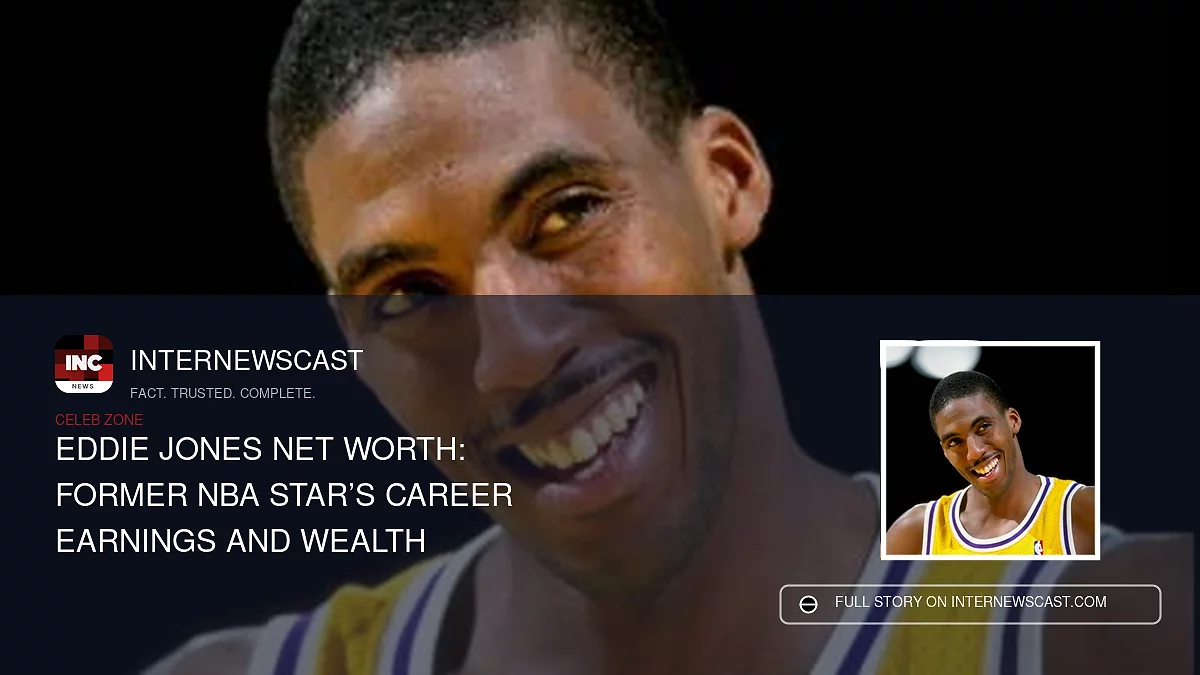

What Is Eddie Jones’ Net Worth and Salary?
Retired American professional basketball player Eddie Jones has an estimated net worth of $40 million.
Over 14 NBA seasons, Eddie Jones earned more than $101 million in salary while building a reputation as one of the league’s top perimeter defenders. The three-time All-Star is best known for his years with the Los Angeles Lakers and Miami Heat, though he also played for the Charlotte Hornets, Memphis Grizzlies, and Dallas Mavericks. The 6-foot-6 shooting guard was selected 10th overall in the 1994 NBA Draft and spent his early career in Los Angeles alongside the emerging Kobe Bryant and Shaquille O’Neal. After establishing himself as a star, Jones signed a reported seven-year, $86 million contract in a sign-and-trade deal that sent him to Miami. He was also among the original athletes signed to Michael Jordan’s Jordan Brand endorsement roster. Jones ended his NBA career with 14,155 points, 1,620 steals, three All-Defensive Second Team selections, and an All-NBA Third Team honor. Despite playing for teams that won championships in both Los Angeles and Miami, he never captured an NBA title himself.
Early Life and College Basketball
Eddie Charles Jones was born on October 20, 1971, in Pompano Beach, Florida. He first made his mark at Blanche Ely High School before heading north to Temple University in Philadelphia. At Temple, Jones played for Hall of Fame coach John Chaney, whose demanding defensive approach helped develop the skills that would later define Jones’ professional career.
Jones faced a major personal setback during college when his father died. He later said Chaney became a father figure and mentor, while teammate Aaron McKie provided important support as well. Together, Jones and McKie helped guide Temple to the Elite Eight in the 1993 NCAA Tournament, raising Jones’ profile nationally ahead of his senior season.
During his 1993-94 senior campaign, Jones averaged 19.2 points and 6.8 rebounds per game and won Atlantic 10 Player of the Year honors. The Associated Press also recognized him as an honorable-mention All-American. He completed his Temple career with 1,470 points and was inducted into the university’s athletics Hall of Fame in 2011.

Vincent Laforet /Allsport
Los Angeles Lakers
The Los Angeles Lakers took Jones with the 10th pick in the 1994 NBA Draft. His athleticism, reach, and defensive awareness made an immediate impact, and he averaged 14 points and two steals per game as a rookie. Jones earned All-Rookie First Team honors and was named MVP of the 1995 Rookie Challenge after scoring 25 points, even though his team came up short.
Jones became a key figure in the Lakers’ rebuilding period during the mid-1990s. By the time Shaquille O’Neal arrived in 1996 and Kobe Bryant joined the team as a teenager, Jones was already an established starting guard. He appeared in consecutive All-Star Games in 1997 and 1998 and earned All-Defensive Second Team recognition in 1998. His ability to pressure opposing guards, create turnovers, and score efficiently without requiring heavy usage made him especially valuable.
Bryant’s arrival and rapid development eventually affected Jones’ place in Los Angeles. The two athletic perimeter players had overlapping strengths, while the Lakers wanted a shooter who could better complement O’Neal’s interior presence. On March 10, 1999, Los Angeles traded Jones and Elden Campbell to the Charlotte Hornets for Glen Rice, J.R. Reid, and B.J. Armstrong. The move disappointed many Lakers fans because Jones had become one of the team’s most popular players. Los Angeles won the championship the next season with Rice on the roster, but Jones had already started a new chapter in Charlotte.
Charlotte Hornets and All-NBA Recognition
The trade allowed Jones to become the featured perimeter player on his own team. After joining Charlotte late in the 1998-99 season, he produced the best all-around year of his career in 1999-2000. Jones posted career highs of 20.1 points, 4.8 rebounds, and 4.2 assists per game, made his third All-Star team, and led the NBA with 2.7 steals per game.
That breakout season brought Jones All-NBA Third Team honors along with another selection to the All-Defensive Second Team. At 28, he had proven he was far more than a complementary player on a prominent Lakers roster. Jones had developed into one of the NBA’s most accomplished two-way guards, strengthening his position as he moved toward free agency.
$86 Million Contract and Miami Heat Years
In August 2000, Charlotte signed Jones to a reported seven-year, $86 million contract before sending him to the Miami Heat in a major sign-and-trade deal. The nine-player transaction, orchestrated by Miami executive and coach Pat Riley, sent Jones and Anthony Mason to the Heat while Jamal Mashburn, P.J. Brown, and others moved to Charlotte. The agreement became the most financially significant contract of Jones’ career.
Jones quickly became one of Miami’s central players. He averaged 17.4 points per game in his first season with the Heat and remained a leading offensive option through multiple changes to the roster. For four consecutive seasons, he led Miami in scoring average, blending reliable three-point shooting and defense with the ability to generate his own offense. His regular-season scoring average peaked at 18.5 points in 2002-03, one of his best campaigns with the franchise.
The arrival of new stars eventually changed Jones’ responsibilities. Dwyane Wade joined the Heat in 2003, followed by Shaquille O’Neal in 2004, and Jones moved from shooting guard to small forward. His outside shooting and defensive versatility allowed him to support the team’s younger core. In 2004-05, he averaged 12.7 points and a career-best 5.1 rebounds as Miami reached the Eastern Conference finals, where the Detroit Pistons prevailed in a seven-game series.
That playoff run represented Jones’ closest opportunity to win a championship in Miami. In the summer of 2005, the Heat traded him to the Memphis Grizzlies as part of a five-team, 13-player deal designed to reshape the roster. Miami won the 2006 NBA championship after Jones had left the organization.
Memphis, Return to Miami, and Retirement
Jones spent portions of two seasons in Memphis, where his role and scoring output declined as he entered his mid-30s. The Grizzlies waived him in January 2007, and Miami signed him as a free agent the following month. His return reunited him with Wade and O’Neal, but his second stint with the Heat lasted only through the remainder of that season.
Jones joined the Dallas Mavericks in August 2007. During the 2007-08 season, he appeared in 47 regular-season games and averaged 3.7 points as a reserve. Dallas traded him to the Indiana Pacers in October 2008, and Indiana later waived him. He never appeared in another NBA regular-season game.
Jones played 954 NBA regular-season games, averaging 14.8 points, four rebounds, 2.9 assists, and 1.7 steals. His totals of 14,155 points and 1,620 steals underscore the consistency he brought on both ends of the floor throughout a long career, even though he never earned a championship ring.
NBA Contracts and Career Earnings
Jones collected $101,254,222 in recorded NBA salary during his career. His first Lakers contract paid him $1.3 million in 1994-95, with that figure rising to $2 million by 1997-98. He earned $2.5 million from Charlotte in 1999-2000, shortly before signing the major contract that significantly increased his annual income.
The seven-year deal signed in 2000, commonly reported as being worth $86 million, covered Jones’ peak earning years. His salary climbed from $8.96 million in 2000-01 to $13.46 million in 2004-05, followed by $14.58 million in 2005-06 and $14.86 million in 2006-07 while he was under contract with Memphis. His 2006-07 earnings also included a separate payment of approximately $532,000 for his return to Miami. His recorded compensation afterward included $1.83 million for 2007-08 and $2 million assigned to the 2008-09 season.
The $101.3 million figure represents gross salary before income taxes, agent commissions, and other expenses, rather than money that automatically remained in his personal accounts. It also excludes endorsement income. Jones’ reported $40 million net worth is an estimate of accumulated assets and wealth, not an addition to his career salary total.
Jordan Brand Endorsement Deal
Jones was an early face of one of basketball’s most consequential footwear businesses. In 1997, when Michael Jordan and Nike formally launched Jordan Brand as a distinct label, Jones was among the original NBA players selected to represent the company. Other early members of Team Jordan included Ray Allen, Vin Baker, Derek Anderson, and Michael Finley.
The association gave Jones a presence in the sneaker business at the same time his popularity with the Lakers was growing. He wore Jordan Brand footwear, appeared in the company’s marketing campaigns, and became closely associated with models including the Jumpman Pro Quick and Jumpman Swift 6. His specific compensation under the endorsement arrangement has not been publicly established, but the deal was an important commercial partnership beyond his NBA playing contracts.
Jones has generally kept his family life more private than many of the stars with whom he played. His wife, Trina Jones, appeared in a Miami Heat television profile of him in 2005, and the program also featured his mother, Frances Thigpen. In that profile, Jones discussed how the loss of his father influenced his life and how his relationship with Temple coach John Chaney helped him through difficult years.
During his time with the Heat, Jones became involved in community service in South Florida, including work with the Boys & Girls Club. His relationship with the region extended back to his upbringing in Pompano Beach, making his years with Miami especially meaningful. He has also been identified as a cousin of NBA guard Tyrese Haliburton.
All net worths are calculated using data drawn from public sources. When provided, we also incorporate private tips and feedback received from the celebrities or their representatives. While we work diligently to ensure that our numbers are as accurate as possible, unless otherwise indicated they are only estimates. We welcome all corrections and feedback using the button below.


