
What Is Felipe Calderón’s Net Worth?
Felipe Calderón is a Mexican politician, lawyer, author, and former president whose estimated net worth is $5 million. He led Mexico from 2006 to 2012 as the second consecutive president elected from the National Action Party, or PAN, following Vicente Fox. Before winning the presidency, Calderón spent decades advancing within the PAN, holding positions as a legislator, national party leader, head of Mexico’s development bank Banobras, and secretary of energy.
Calderón won the 2006 presidential election by one of the narrowest margins in Mexico’s modern history, defeating Andrés Manuel López Obrador by approximately 234,000 votes, or 0.56 percentage points. His administration became closely associated with the decision to deploy Mexico’s military and federal security forces against powerful drug cartels. The policy sparked intense controversy as violence escalated and human-rights groups reported serious abuses by security personnel. During his presidency, Calderón also managed the effects of the global financial crisis and the 2009 H1N1 outbreak, expanded access to public health care, hosted the 2010 United Nations climate conference in Cancún, and signed Mexico’s General Climate Change Law in 2012.
Following his presidency, Calderón became involved with international organizations focused on climate policy, economic development, and sustainability. He spent time at Harvard Kennedy School, served on corporate boards, published books, and worked as a paid public speaker. In 2018, after nearly 40 years as a PAN member, he left the party. He later joined his wife, Margarita Zavala, in an unsuccessful attempt to create a new political party.
Early Life and Education
Felipe de Jesús Calderón Hinojosa was born on August 18, 1962, in Morelia, in the Mexican state of Michoacán. Political engagement shaped his upbringing. His father, Luis Calderón Vega, was a writer, activist, and founding member of the National Action Party, which was created in 1939 to oppose the Institutional Revolutionary Party’s long dominance of Mexican politics. Calderón became involved in PAN activities at an early age and formally joined the party in 1980.
He earned a law degree from the Escuela Libre de Derecho in Mexico City. Calderón later completed a master’s degree in economics at the Instituto Tecnológico Autónomo de México, commonly known as ITAM, as well as a master’s degree in public administration at Harvard University’s John F. Kennedy School of Government. Harvard identifies him as a 2000 graduate of its Mid-Career Master in Public Administration program.
Rise Through the National Action Party
During the late 1980s, Calderón became the first leader of the PAN’s reorganized national youth organization. At 25, he won election in 1988 to the Assembly of Representatives of the Federal District, an institution that preceded Mexico City’s current legislature. He entered Mexico’s Chamber of Deputies in 1991 and, two years later, became secretary-general of the PAN’s national executive committee.
Calderón’s first bid for major elected office came in 1995, when he unsuccessfully ran for governor of Michoacán. A year later, at 33, he was elected national president of the PAN. He led the party for three years before returning to the Chamber of Deputies after the 2000 election, which brought Vicente Fox to power and ended more than 70 years of uninterrupted presidential rule by the PRI.
In February 2003, Fox appointed Calderón to lead Banobras, the state-owned development bank that finances infrastructure and public services. Seven months later, he became Mexico’s secretary of energy. Calderón resigned in May 2004 after tensions with Fox intensified when political allies began openly presenting him as a possible presidential contender. He then sought the PAN’s presidential nomination and defeated more prominent rivals in the party’s 2005 primary process.
2006 Presidential Election
Calderón faced López Obrador, the nominee of a left-wing coalition, in Mexico’s July 2006 presidential election. The final results certified by electoral authorities gave Calderón 14,916,927 votes, equivalent to 35.89% of the total. López Obrador received 14,683,096 votes, or 35.33%. The difference between the two candidates was only 233,831 votes.
López Obrador and his supporters disputed the outcome, alleging electoral irregularities. Mexico’s Federal Electoral Tribunal reviewed the challenge and ultimately upheld Calderón’s victory. He was sworn in on December 1, 2006, as protests and deep political divisions continued to surround the election.

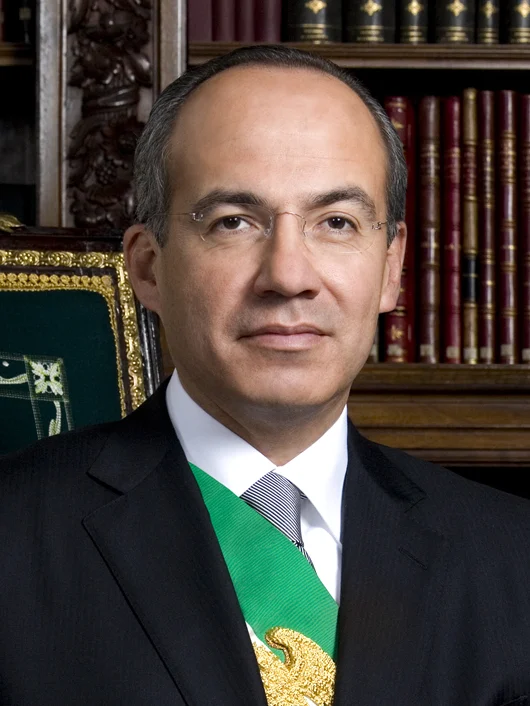
Felipe Calderón in his official 2006 portrait. Photo: Unknown author/Wikimedia Commons (CC BY-SA 4.0).
Presidency and the Fight Against Drug Cartels
Within weeks of taking office, Calderón deployed thousands of troops to regions affected by organized crime, significantly broadening the federal campaign against Mexico’s drug cartels. The military, federal police, and other security agencies increasingly took on duties that had traditionally been handled by civilian law-enforcement bodies. Mexico also deepened security cooperation with the United States through the Mérida Initiative, launched during George W. Bush’s presidency.
The campaign against organized crime became the central and most controversial feature of Calderón’s presidency. Authorities captured or killed numerous senior cartel figures and weakened some trafficking organizations, but violence surged among criminal groups and in confrontations between cartels and the government. Human Rights Watch said in a 2011 report that research across five Mexican states uncovered evidence strongly indicating security-force involvement in more than 170 torture cases, 39 disappearances, and 24 extrajudicial killings since Calderón took office. The group argued that the government’s reliance on the military had fueled severe human-rights violations and allowed impunity to persist.
Mexico continues to debate the broader impact of Calderón’s security strategy, both politically and academically. However, the militarization of the fight against organized crime that expanded sharply during his administration remained a feature of Mexican security policy under later presidents, though its form varied over time.
Economy, Healthcare, and Climate Policy
Calderón also guided Mexico through the global financial crisis. The country’s close economic ties to the United States left it particularly exposed to the 2008–2009 downturn. According to the International Monetary Fund, Mexico’s economic output fell by about 6.5% in 2009. The government responded with fiscal stimulus, interest-rate cuts by the independent central bank, support for financial markets, and other measures. Growth resumed later that year.
His administration continued expanding Seguro Popular, Mexico’s public health-insurance program, and launched coverage for children born after the beginning of his term. The government also pursued reforms involving taxes, pensions, energy, and infrastructure. The reach and effectiveness of those initiatives, however, remained matters of political dispute.
Climate and environmental policy became another important part of Calderón’s record. Mexico hosted the United Nations COP16 climate summit in Cancún in 2010. The meeting produced the Cancún Agreements, a package of international commitments and institutions that included the framework for the Green Climate Fund.
In June 2012, Calderón signed Mexico’s General Climate Change Law, creating a national legal framework for reducing greenhouse-gas emissions and adapting to the effects of climate change.
Calderón concluded his six-year presidency in 2012 and handed power to Enrique Peña Nieto of the PRI.
Post-Presidential Career
After leaving office, Calderón spent a period living in the United States and became the first Angelopoulos Global Public Leaders Fellow at Harvard Kennedy School. He later focused much of his professional work on climate change, sustainable economic growth, and international public policy.
Calderón became a member of the board of the World Resources Institute and has chaired the Global Commission on the Economy and Climate. He is also president of the Sustainable Human Development Foundation. The FIA, the international governing body for automobile racing, has listed him as president of its Environment and Sustainability Commission.
He has also worked as an author and public speaker. His books include “Los retos que enfrentamos,” published in 2014, and the memoir “Decisiones difíciles,” published in 2020.
Calderón left the PAN in 2018 following disagreements with the party’s leadership. He and Margarita Zavala subsequently supported the creation of México Libre, a political organization that sought recognition as a national political party. Mexican election authorities denied the organization party registration in 2020.
Avangrid Board and Post-Presidential Income
Calderón joined the board of U.S. energy company Avangrid in July 2016. Securities and Exchange Commission filings show that he received $200,000 in director compensation in 2017 and another $200,000 in 2018. He resigned from the board effective December 31, 2018.
His other post-presidential income has included speaking engagements, academic and advisory work, and organizational positions. Calderón has acknowledged that paid speaking became one of his sources of income after leaving public office.
Presidential Salary and Financial Disclosures
Calderón’s government salary was publicly disclosed. The proposed 2012 federal budget listed his monthly income before benefits at 208,548 Mexican pesos. Including compensation and benefits, his total annual gross remuneration was listed at approximately 4.2 million pesos, with annual net compensation of approximately 3.38 million pesos.
Public financial declarations also provide a rare look at Calderón’s finances while he was president. A review of the filings by “El Universal” found that Calderón and Zavala reported combined assets of more than 17.1 million pesos at the end of his presidency in early 2013, compared with approximately 7.1 million pesos when he entered office. The assets included real estate, investments, personal property, and a vehicle.
Like other former Mexican presidents at the time, Calderón was also entitled to a government-funded presidential pension after leaving office. In 2017, he announced that he would donate his pension payments to a children’s cancer organization. Mexico subsequently eliminated the special pension system for former presidents.
Genaro García Luna
One of the most consequential later developments connected to Calderón’s administration involved Genaro García Luna, who served as Calderón’s secretary of public security and was one of the most powerful officials directing Mexico’s anti-cartel operations. In 2023, a federal jury in the United States convicted García Luna of participating in a continuing criminal enterprise, cocaine-trafficking conspiracies, and making false statements after prosecutors presented evidence that he had accepted millions of dollars in bribes from the Sinaloa Cartel. In October 2024, he was sentenced to 460 months, or more than 38 years, in federal prison and ordered to pay a $2 million fine.
Calderón has said that while he was president he never received verifiable evidence that García Luna was involved in criminal activity. The conviction nevertheless renewed scrutiny of the security institutions and officials who played central roles in Calderón’s anti-cartel strategy.
Personal Life
Felipe Calderón married lawyer and politician Margarita Zavala in 1993. The two had met through their involvement in the PAN, where Zavala also built a long political career. They have three children, María, Luis Felipe, and Juan Pablo.
Zavala served in Mexico’s Chamber of Deputies and later pursued a national political career of her own. She sought the presidency as an independent candidate in the 2018 election before withdrawing from the race ahead of voting. Calderón and Zavala have remained active in Mexican public affairs following his presidency.
All net worths are calculated using data drawn from public sources. When provided, we also incorporate private tips and feedback received from the celebrities or their representatives. While we work diligently to ensure that our numbers are as accurate as possible, unless otherwise indicated they are only estimates. We welcome all corrections and feedback using the button below.
(function() {
var _fbq = window._fbq || (window._fbq = []);
if (!_fbq.loaded) {
var fbds = document.createElement(‘script’);
fbds.async = true;
fbds.src = ”
var s = document.getElementsByTagName(‘script’)[0];
s.parentNode.insertBefore(fbds, s);
_fbq.loaded = true;
}
_fbq.push([‘addPixelId’, ‘1471602713096627’]);
})();
window._fbq = window._fbq || [];
window._fbq.push([‘track’, ‘PixelInitialized’, {}]);


