
In May, Floyd Mayweather launched an extraordinary lawsuit accusing several former business associates of taking control of at least $175 million in money and assets. The alleged financial scheme reportedly stretched across Manhattan real estate, private aircraft, substantial loans, legal settlements and a jewelry collection the boxing icon valued at $100 million.
Mayweather’s complaint laid out a series of detailed accusations. He alleged that funds from loans backed by his properties were diverted, that a Gulfstream jet bought with real estate-related financing was transferred without his knowledge and that he never received money from its sale. He also claimed jewelry worth $100 million was effectively converted into only $13 million, while real estate distributions and settlement payments were directed to accounts managed by people he trusted.
Now, just four months after filing the case, Mayweather has walked away from the lawsuit. The timing of the decision has drawn particular attention.
Mayweather voluntarily dismissed the complaint last night, just one day before the defendants were scheduled to respond formally to his allegations in court.

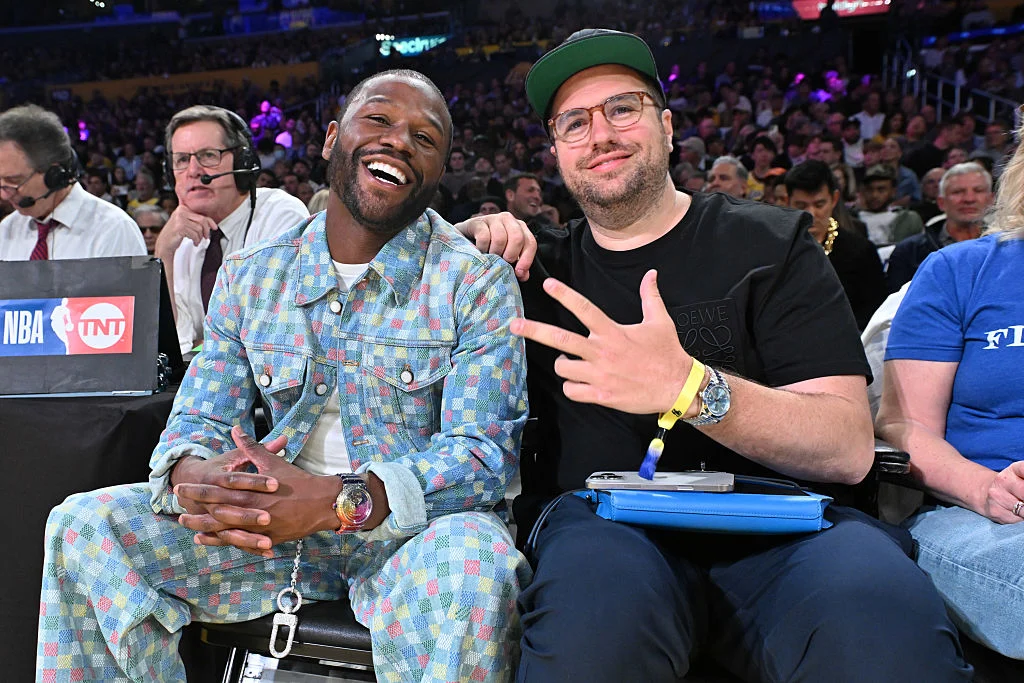
Floyd Mayweather and Jona Rechnitz (Photo by Allen Berezovsky/Getty Images)
The $175 Million Lawsuit
The lawsuit focused largely on Jona Rechnitz, whom Mayweather said had become his investment manager, real estate consultant and financial go-between. According to the complaint, Rechnitz steadily earned Mayweather’s confidence before gaining extensive access to his banking activity, investments and property transactions.
Mayweather also identified Ayal Frist, Frist Apex Ventures and attorney Alexander Seligson as defendants. The claims included alleged fraud, breach of fiduciary duty, conversion, unjust enrichment and other related allegations.
The $175 million case emerged during a turbulent period for the retired boxing champion, who has faced a series of lawsuits, liens and financial disputes in recent months.
One of the most striking claims involved Mayweather’s jewelry collection. He alleged that pieces he believed were worth $100 million had been delivered to Miami jewelry dealers in exchange for approximately $13 million. Mayweather further claimed that a significant portion of the collection could not be accounted for and that he was never given a complete breakdown of the money generated.
The complaint also raised questions about a private jet. Mayweather said a $13 million loan secured against his Miami Beach property was used in connection with the purchase of a Gulfstream G-IV. Although the aircraft was later transferred to another owner, he claimed he did not know the buyer’s identity and never received the proceeds from the transaction.
Mayweather’s Manhattan property holdings formed another major part of the dispute.
Earlier in 2025, Mayweather publicly said he had invested $400 million to purchase 62 New York City apartment buildings. At the time, he declared:
“All the buildings belong to me. I don’t have no partners.”
However, the legal filing offered a notably different account. The complaint stated that the documented deal gave Mayweather a 5% Class A interest in a Manhattan residential portfolio, purchased for a total consideration of $31.5 million.
Mayweather also alleged that 20% of the distributions from the investment were sent to Frist Apex without his approval. He described those payments as part of the broader $175 million that he claimed had been diverted, pledged, transferred or otherwise taken from him.
And Then Floyd Dropped The Case
On September 24, Mayweather informed the New York Supreme Court that he was voluntarily ending the action. The dismissal was entered without prejudice, meaning the claims were not permanently abandoned and could potentially be filed again.
Mayweather did not provide a public explanation for the decision, and there is no known indication that the parties reached a settlement. Rechnitz, in fact, has said the opposite.
“No Settlement, No Payment”
Rechnitz has rejected Mayweather’s accusations since the case was filed. His attorney previously characterized the allegations as “utterly baseless and refuted by substantial documentary evidence.”
Following the dismissal, Rechnitz issued an even sharper response in a statement to ESPN:
“Mr. Mayweather filed this lawsuit with a lot of noise and dropped it in silence, right before our court deadline to answer his frivolous claims with documented evidence.”
He continued:
“He verified his complaint under penalty of perjury, and our evidence directly contradicts what he swore to. When the time came to back up his claims, he walked away. No settlement, no payment.”
Those are Rechnitz’s claims. The court never ruled that Floyd’s allegations were false, nor did the case reach the point where either side’s evidence was tested at trial.
But the timing is hard to ignore. The defendants’ formal response to Mayweather’s complaint was due the following day. TMZ similarly reported that a source close to Rechnitz claimed the defendants were preparing to file records that they believed contradicted Floyd’s accusations.
Then, immediately before that filing was due, Floyd withdrew the lawsuit.
Again, that does not prove Rechnitz’s version of events. But considering how explosive and detailed Floyd’s original allegations were, the abrupt dismissal adds another strange chapter to an already extraordinary financial saga.
Floyd’s Other $340 Million Lawsuit Is Still Alive
This was not Floyd’s only enormous financial lawsuit.
Earlier in 2026, Mayweather filed a $340 million lawsuit against Showtime Networks and former Showtime Sports president Stephen Espinoza.
In that case, Floyd alleged that a significant portion of his boxing earnings had never been properly paid to him and instead flowed through third-party accounts he did not control. We subsequently downloaded and examined the full $340 million complaint, which laid out Floyd’s allegations about where he believes hundreds of millions of dollars in career earnings went.
That lawsuit remains pending.
At the time Floyd filed the $175 million case in May, the combination of the two lawsuits produced a staggering implication. Mayweather — one of the highest-paid athletes in history, with more than $1.1 billion in career earnings — was effectively claiming that more than half a billion dollars connected to his financial life was missing, diverted or improperly handled.
Now one half of that extraordinary story has disappeared from the courthouse, at least for the moment.
Floyd’s Financial Drama Isn’t Over
Dropping the $175 million lawsuit also doesn’t end the broader series of financial and legal issues surrounding Mayweather.
Earlier this year, a Business Insider investigation raised significant questions about Floyd’s post-boxing finances, including real estate borrowing, liens, high-interest loans, property disputes and aircraft expenses. We broke down those allegations in detail in our article about Floyd Mayweather’s increasingly complicated financial picture. Floyd’s attorney strongly denied that Mayweather was experiencing financial distress, and Floyd has challenged some of that reporting in court.
The IRS also filed a nearly $7.3 million tax lien against Floyd for unpaid federal taxes connected to 2018 and 2023. Mayweather has additionally faced lawsuits alleging unpaid obligations for various goods and services, including a dispute over a $100,000-per-month Manhattan apartment that resulted in allegations of more than $330,000 in unpaid rent and fees.
According to ESPN, Mayweather is also facing criminal charges in Clark County, Nevada, related to allegations that he wrote a $200,000 bad check to purchase a watch. Those allegations remain unresolved. There is also a separate civil lawsuit involving Mayweather and Frist Apex connected to potential boxing matches involving Manny Pacquiao, Mike Tyson and Mike Zambidis.
For someone whose public persona has revolved around practically limitless wealth for more than two decades, 2026 has produced an extraordinary amount of litigation involving money. And perhaps no chapter has been stranger than this one.
(function() {
var _fbq = window._fbq || (window._fbq = []);
if (!_fbq.loaded) {
var fbds = document.createElement(‘script’);
fbds.async = true;
fbds.src = ”
var s = document.getElementsByTagName(‘script’)[0];
s.parentNode.insertBefore(fbds, s);
_fbq.loaded = true;
}
_fbq.push([‘addPixelId’, ‘1471602713096627’]);
})();
window._fbq = window._fbq || [];
window._fbq.push([‘track’, ‘PixelInitialized’, {}]);


