
For a short but unforgettable run in the early 1990s, C+C Music Factory stood near the center of global pop culture. The group arrived at exactly the right time, as the lines between pop, hip-hop, house, club music and mainstream dance were rapidly breaking down.
The group’s debut album, “Gonna Make You Sweat,” moved millions of copies, and its hard-driving, sweat-soaked videos became impossible to miss on MTV. By the end of 1991, Billboard had crowned C+C Music Factory the year’s top group, cementing their place as one of the defining acts of the era.
For listeners who came of age then, those tracks were everywhere. They shook car speakers, filled dance floors, appeared in films and commercials, and became reliable arena anthems. “Gonna Make You Sweat” could ignite a nightclub just as easily as it could soundtrack a football team storming onto the field.
Still, many casual fans likely never gave much thought to the origin of the name C+C Music Factory. Watching the group’s famous videos, often built around explosive choreography and a shirtless, high-energy rapper at center stage, it would have been easy to assume that performer was the driving force behind the project. That rapper was Freedom Williams.
It would also be easy to believe that once C+C Music Factory’s chart dominance cooled, the group simply vanished. That is not what happened. Williams has continued to perform under the C+C Music Factory name for decades. A newly filed federal lawsuit alleges that he has regularly earned between $5,000 and $10,000 per performance while appearing internationally as C+C Music Factory. His company also holds a federal trademark registration for the name “C & C MUSIC FACTORY.”
To some, that might look like a successful second life for the face of a beloved 1990s dance act. But producer Robert Clivillés tells a very different story. Clivillés argues that Williams did not create C+C Music Factory, never owned the group and had no right to take control of its name. Now, more than 30 years after the act’s commercial peak, Clivillés has filed a federal lawsuit seeking damages that could total at least $30 million and asking the court to decide who can legally use the C+C Music Factory name.
Who Created C+C Music Factory?
C+C Music Factory grew out of the partnership between Robert Clivillés and David Cole, two New York producers, songwriters, musicians and remixers who began working together during the late 1980s. According to Clivillés’ lawsuit, C+C stands for Clivillés and Cole.
Around 1989, Robert and David developed a new studio-driven project that combined house and dance production with hip-hop, pop and powerful vocal performances. The project’s structure is important to understanding the ownership fight today. C+C Music Factory was not created as a conventional band in which several musicians came together as equal founding members. Clivillés says he and Cole created and produced the project, built its tracks and arrangements, and were signed directly by Sony as C+C Music Factory before the featured performers were brought aboard.
Freedom Williams was one of those recruits, although his contribution quickly became much more substantial than that description might suggest. Williams, whose real name is Frederick Brandon Williams, became the group’s most recognizable male performer and co-wrote several of its biggest songs. “Gonna Make You Sweat (Everybody Dance Now),” “Here We Go, Let’s Rock & Roll” and “Things That Make You Go Hmmm…” were all written by Clivillés and Williams, while Clivillés and Cole produced the recordings.
Williams therefore wasn’t merely a hired frontman. He was an important creative contributor who wrote his own raps and shared songwriting credits on the group’s three biggest hits. But according to Clivillés, he was not one of the two producers who conceived C+C Music Factory or supplied the initials in its name.
The wider cast of performers included Martha Wash, Zelma Davis and Deborah Cooper. Their involvement could vary from song to song, underscoring how much C+C Music Factory functioned as a producer-driven recording project rather than a traditional fixed-member band.
That unusual structure was evident even on the group’s biggest hit. The thunderous “Everybody dance now!” vocal on “Gonna Make You Sweat” was performed by Martha Wash, while Zelma Davis appeared lip-syncing the part in the famous music video. Wash later sued over the use and presentation of her vocals.
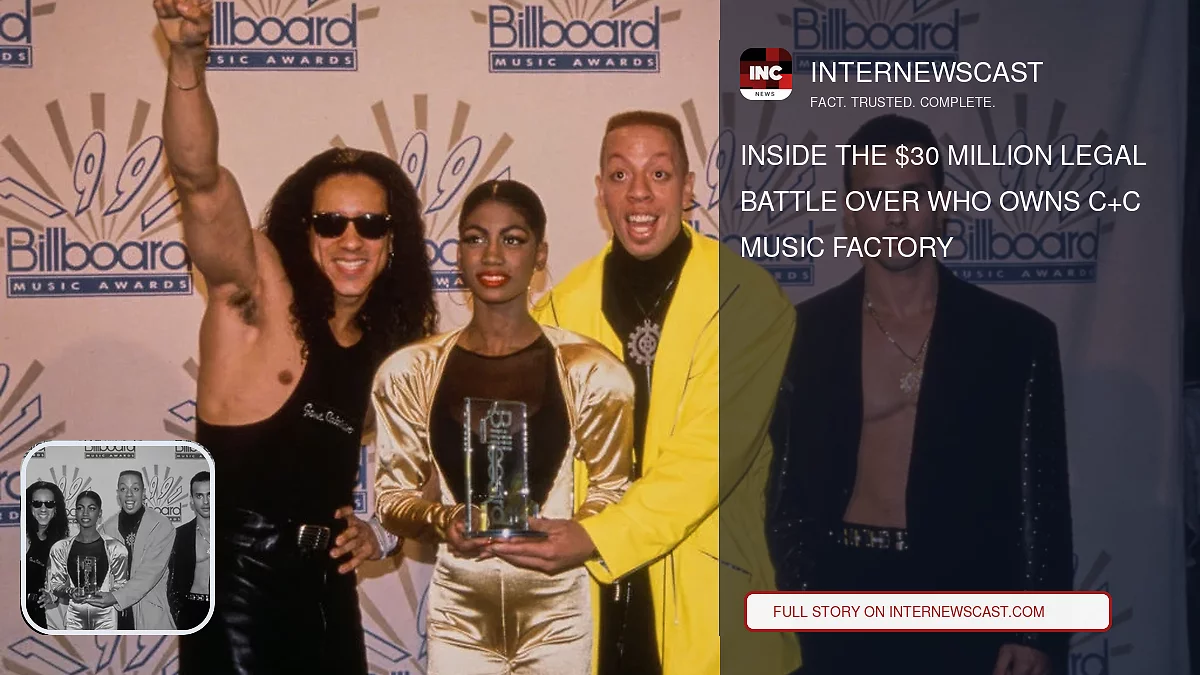
The photo below was taken at the Billboard Music Awards in 1991. From left to right are Freedom Williams, Zelma Davis, David Cole and Robert Clivillés. C+C Music Factory took home five awards that night, tying Garth Brooks for the most wins of the ceremony. Their haul included #1 New Pop Artist, #1 Hot Dance Club Play Artist and #1 Hot Dance 12″ Singles Artist, while “Gonna Make You Sweat” won the corresponding club-play and 12-inch-sales single awards.

(Photo by Vinnie Zuffante/Getty Images)
Freedom Williams Leaves – And Sues For $10 Million
Williams’ original stint with C+C Music Factory did not last long. According to Clivillés, Williams wanted to pursue a solo career and asked to be released from his recording arrangement around 1991. C+C Music Factory continued without him, while Williams eventually released the solo album “Freedom” in 1993.
Before that album arrived, Williams launched a financial battle that now looks remarkably similar to the dispute unfolding today. In June 1992, Williams sued Clivillés and Cole for $10 million, accusing them of failing to properly pay him royalties and honor obligations arising from his recording and management agreements.
David Cole died in January 1995 at just 32 years old. Clivillés says an agreement reached with Cole’s estate the following year recognized Clivillés’ exclusive right to commercially use the C+C Music Factory name. According to the new lawsuit, Williams nevertheless began performing under the name around the same period and continued doing so for decades, allegedly collecting between $5,000 and $10,000 per performance at concerts, festivals, private events and corporate bookings around the world.
The Trademark Issue
Freedom Williams has something substantial on his side in this dispute: a federal trademark registration.
Williams first registered “C AND C MUSIC FACTORY” in his own name in 2005, although that registration was eventually canceled after required maintenance documents were not filed. His company, Freedom Williams Entertainment, applied again in 2014 and received federal registration for “C & C MUSIC FACTORY” in 2015.
Clivillés challenged that registration before the U.S. Trademark Trial and Appeal Board in 2016. The proceeding ended badly for him. His cancellation petition was dismissed with prejudice in 2018 after his attorney failed to submit a required trial brief.
Clivillés argues that the dismissal was procedural and that nobody actually decided the underlying ownership dispute on its merits. Williams’ attorney has called the new claims meritless, maintains that Williams is the lawful owner of the registered trademark and argues that Clivillés should not be allowed another attempt to undo a registration he previously challenged unsuccessfully.
That history makes the case considerably more complicated than the otherwise compelling argument that the two C’s literally represent Clivillés and Cole.
Why Is The Fight Exploding Now?
The decades-old dispute exploded into public view in May 2026 after Williams was announced as a performer at the Great American State Fair, part of the Donald Trump-linked Freedom 250 celebration of America’s 250th anniversary in Washington, D.C.
Williams said he had agreed to what he thought was simply another Washington concert and had not been told about any connection to Trump. After fans began criticizing him for appearing on the bill, he initially told his agent he would back out. Then, apparently angered by people telling him what he could and could not do, Williams posted a profanity-filled, roughly seven-minute video to the C+C Music Factory Instagram account while sitting on a toilet.
Williams repeatedly insisted that he was not a Trump supporter, but said he would sooner vote for Genghis Khan, Adolf Hitler or Ivan the Terrible than allow people on social media to dictate whether he performed. The rant went considerably further from there. Williams repeatedly used racial slurs, accused Barack Obama of having Muammar Gaddafi killed on behalf of “Zionists and white capitalists,” suggested that people who received COVID vaccines had been injected with poison, hurled racial and homophobic insults at Kid Rock, and directed graphic sexual insults at his critics. He also argued that many people attending his nostalgia concerts are white and probably vote Republican anyway, before joking that perhaps he should call Trump, join the “MAGA crew” and take the money.
For Robert Clivillés, the larger issue was that Williams delivered all of this through an account carrying the C+C Music Factory name. Clivillés publicly disavowed the rant, saying Williams’ political and personal views did not represent him, David Cole’s estate or the people who originally created C+C Music Factory. On June 2, Clivillés issued a public legal warning demanding that Williams stop using the name.
Ten days later, according to the lawsuit, Williams and Big Mac Entertainment released a new song titled “Into the Future” as C+C Music Factory and distributed it to more than 80 digital platforms. That gave Clivillés something much more recent than decades of disputed nostalgia performances to point to as alleged trademark infringement.
The $30 Million Lawsuit
On August 14, 2026, Clivillés filed a nine-count lawsuit in the U.S. District Court for the Eastern District of New York against Williams, Freedom Williams Entertainment, Big Mac Entertainment and unnamed additional defendants. The claims include trademark infringement, false designation of origin, trademark cancellation, fraud on the U.S. Patent and Trademark Office, unfair competition, unjust enrichment, fraud, defamation and breach of contract.
The $30 million figure requires a little explanation. Clivillés is seeking at least $10 million in compensatory damages, based partly on the money he alleges Williams earned from decades of unauthorized performances, recordings and streaming. He then asks the court to treble those damages under federal trademark law, bringing the requested Lanham Act award to at least $30 million.
Clivillés is also seeking punitive damages, disgorgement of Williams’ allegedly improper profits, cancellation of Williams’ C+C Music Factory trademark, control of the C+C Music Factory Instagram account and an injunction preventing Williams from continuing to perform or release music under the name. No court has awarded any of that money.
So Who Owns C+C Music Factory?
On one side is Freedom Williams, the rapper millions of people remember as the public face of C+C Music Factory during its greatest commercial success. He co-wrote the group’s three biggest hits, has performed under the name for decades and controls the company that currently holds the federal trademark.
On the other side is Robert Clivillés, the surviving producer who says he and David Cole created C+C Music Factory, that the “C+C” literally represents their surnames, and that Williams was an important featured performer and songwriter but never an owner of the musical brand itself.
There is also a remarkable symmetry to the money fight. In 1992, Freedom Williams sued Clivillés and Cole for $10 million. Thirty-four years later, Clivillés is suing Williams in a case where the requested damages could reach at least $30 million.
More than three decades after “Things That Make You Go Hmmm…” became one of C+C Music Factory’s signature hits, the question of who actually owns C+C Music Factory has become a multimillion-dollar federal court battle.
Things that make you go hmmm, indeed.
(function() {
var _fbq = window._fbq || (window._fbq = []);
if (!_fbq.loaded) {
var fbds = document.createElement(‘script’);
fbds.async = true;
fbds.src = ”
var s = document.getElementsByTagName(‘script’)[0];
s.parentNode.insertBefore(fbds, s);
_fbq.loaded = true;
}
_fbq.push([‘addPixelId’, ‘1471602713096627’]);
})();
window._fbq = window._fbq || [];
window._fbq.push([‘track’, ‘PixelInitialized’, {}]);