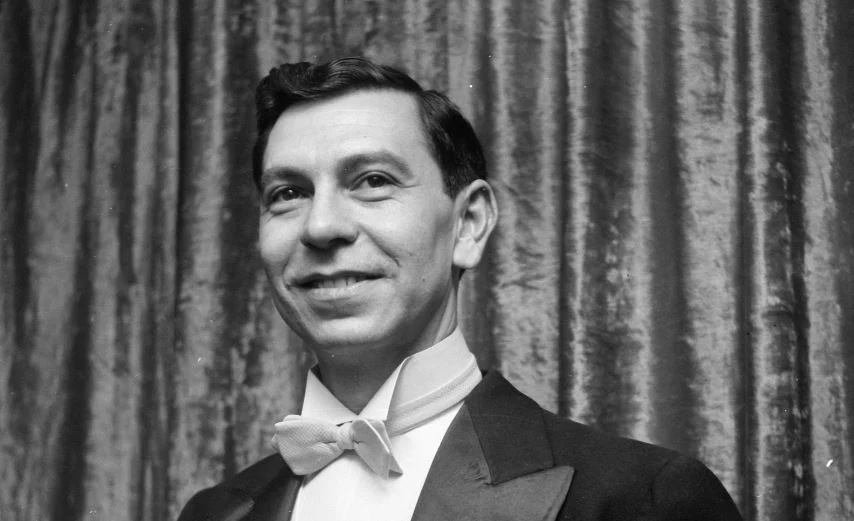

What was Jack Webb’s Net Worth?
Jack Webb was an American actor, director, producer, writer, and television innovator whose net worth was estimated at $4 million when he died. Adjusted for inflation, that would be roughly $12 million today.
Webb is most widely remembered as the creator and star of “Dragnet,” the groundbreaking police procedural that cast him as the famously stoic Los Angeles detective Sgt. Joe Friday, with Harry Morgan appearing alongside him as Officer Bill Gannon. Defined by brisk dialogue, a documentary-like voiceover style, restrained emotion, and a meticulous focus on law-enforcement routine, “Dragnet” became one of the most important and influential crime dramas ever produced for television.
His wealth, however, was not built solely on his screen performances. Through his company, Mark VII Limited, Webb emerged as a powerful television producer, particularly in the realm of police, emergency-response, and public-service programming. Beyond “Dragnet,” he developed or produced series including “Adam-12,” “Emergency!,” “Chase,” “Hec Ramsey,” and “The D.A.” Collectively, his work shaped the visual style, pacing, and serious-minded tone of American procedural dramas for generations. Even though Webb was known to be modest about his acting talents, he created one of early television’s most distinctive and enduring brands.
Early Life
Jack Webb was born John Randolph Webb on April 2, 1920, in Santa Monica, California. After his father left the family when Webb was still young, he was raised primarily by his mother and grandmother. As a teenager, he helped contribute to the household income by taking a job in a clothing store.
Webb went to Belmont High School in Los Angeles. In 1942, during World War II, he enlisted in the Army Air Forces, though he was discharged before being sent overseas. Following the war, he found work in San Francisco radio, starting out as an announcer. That medium became the foundation of his career, helping him refine the exacting vocal cadence and stripped-down dramatic approach that would later become hallmarks of “Dragnet.”
Radio Career and Dragnet
During the 1940s, Webb moved into radio drama, appearing on programs such as “Pat Novak, for Hire.” The experience taught him how to create tension, mood, and realism through voice, timing, and sound design rather than relying on elaborate visuals.
In 1949, Webb launched “Dragnet” as a radio show inspired by actual Los Angeles Police Department case files. He starred as Sgt. Joe Friday, a disciplined, tightly composed detective who handled investigations with professionalism and almost no outward display of emotion. Rather than leaning into sensationalism, the series centered on procedure, making listeners feel as though they were following genuine police work as it progressed step by step.
“Dragnet” soon became a major success. Its unmistakable theme music, terse narration, and Friday’s association with the phrase “just the facts” entered the American cultural vocabulary. For part of the 1950s, the franchise aired on both radio and television, firmly establishing Webb as one of the key figures of early broadcast entertainment.
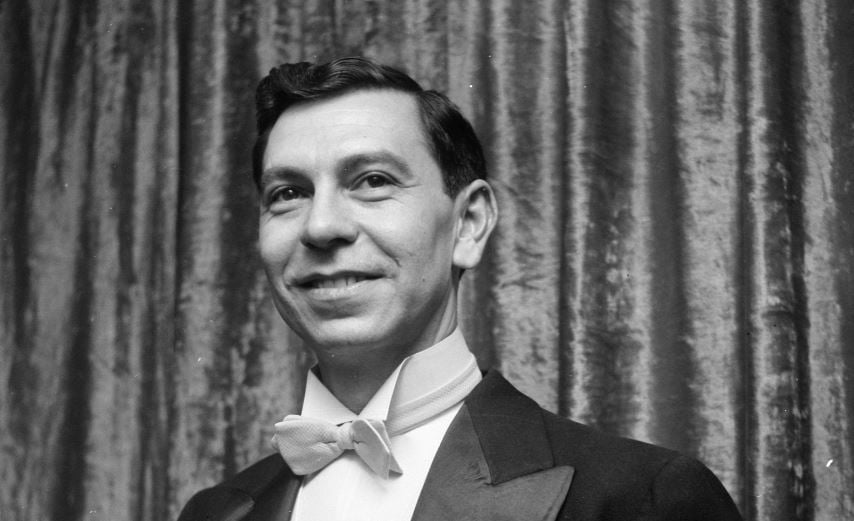
Getty
Television Success
Webb brought “Dragnet” to television in 1952. The show became a massive success and reportedly drew tens of millions of viewers at its peak. Unlike many crime dramas of the era, “Dragnet” was deliberately restrained. Webb was proud that the show used relatively little gunfire or physical violence, relying instead on interviews, paperwork, procedure, and the moral seriousness of law enforcement.
The original television version of “Dragnet” ran through 1959. Webb revived the series in 1967 as “Dragnet 1967,” again starring as Sgt. Friday. By that point, he was not merely the star. He was also a director, producer, and executive producer. The revival introduced the Friday character to a new generation and reinforced Webb’s reputation as television’s great procedural minimalist.
Webb’s acting style was often parodied, but it was also highly influential. His delivery was clipped, dry, and almost mechanical. That style turned Sgt. Friday into an icon and helped establish the template for countless later police dramas.
Film Career
Although Webb was never primarily known as a movie star, he appeared in several notable films. He had a supporting role in “Sunset Boulevard” and appeared in “The Men,” the 1950 Stanley Kramer drama that marked Marlon Brando’s screen debut. He also appeared in “The Halls of Montezuma.”
Webb later produced and starred in several films connected to his own interests, including the 1954 film version of “Dragnet,” the jazz drama “Pete Kelly’s Blues,” the Marine Corps film “The D.I.,” and the newspaper drama “-30-.” His films often reflected the same fascination with institutions, discipline, work, and American professional life that defined his television career.
Mark VII and Production Empire
Webb’s greatest financial success came through Mark VII Limited, his production company. By the early 1970s, Webb was one of the busiest producers in television. At one point, he was producing several series at the same time, including “Adam-12,” “Emergency!,” “Escape,” “Chase,” and “Hec Ramsey.”
“Adam-12,” which followed two Los Angeles patrol officers, extended Webb’s procedural world beyond detectives and into uniformed police work. “Emergency!” shifted the formula to paramedics, firefighters, doctors, and rescue workers. The show starred Randolph Mantooth and Kevin Tighe, while Webb’s first wife, Julie London, played Nurse Dixie McCall and her husband Bobby Troup played Dr. Joe Early.
Webb’s shows were often produced in close cooperation with public agencies, especially the Los Angeles Police Department. That relationship gave his programs an official, procedural tone that distinguished them from more sensational crime dramas. It also made Webb a trusted figure among police and rescue professionals, even as critics sometimes argued that his shows were too respectful of authority.
Personal Life
Webb was married four times. His first wife was singer and actress Julie London, whom he married in 1947. They had two daughters, Stacy and Lisa, before divorcing in 1953. London later became a major recording star with “Cry Me a River” and eventually appeared on Webb’s series “Emergency!”
Webb later married Dorothy Towne and Jackie Loughery, who was Miss USA 1952. His fourth wife was Olga, who was with him at the time of his death.
Jack Webb died on December 23, 1982, at his home in Los Angeles after an apparent heart attack. He was 62 years old. Following his death, the Los Angeles Police Department ordered flags at its headquarters and substations to be flown at half-staff, a reflection of the unusually close connection between Webb’s television work and the real-life institutions he portrayed.
All net worths are calculated using data drawn from public sources. When provided, we also incorporate private tips and feedback received from the celebrities or their representatives. While we work diligently to ensure that our numbers are as accurate as possible, unless otherwise indicated they are only estimates. We welcome all corrections and feedback using the button below.
(function() {
var _fbq = window._fbq || (window._fbq = []);
if (!_fbq.loaded) {
var fbds = document.createElement(‘script’);
fbds.async = true;
fbds.src = ”
var s = document.getElementsByTagName(‘script’)[0];
s.parentNode.insertBefore(fbds, s);
_fbq.loaded = true;
}
_fbq.push([‘addPixelId’, ‘1471602713096627’]);
})();
window._fbq = window._fbq || [];
window._fbq.push([‘track’, ‘PixelInitialized’, {}]);


