
A quick personal note before we get into the real estate: I grew up in Marin County, and Metallica has always been my favorite band.
Back when I was a teenager in the 1990s, Lars Ulrich and James Hetfield both called Marin home. James later relocated to Vail, Colorado. Jason Newsted was living in the East Bay during that era and now splits his time between Montana and Florida. Kirk Hammett, meanwhile, has remained a San Francisco guy through and through.
I never once spotted James Hetfield out and about, which would have been incredible. Lars, on the other hand, I did see around town every so often — maybe two or three times a year. Almost without fail, it was at one of the area’s two open-air shopping centers, The Village or Town Center. Truly. My best guess is that Lars enjoyed taking his family there for lunch or dinner.
So for someone who loves Metallica, has long been fascinated by Marin County real estate, and now runs CelebrityNetWorth, this particular story sits right at the intersection of several lifelong obsessions.
Genentech Founder’s Dream Mansion
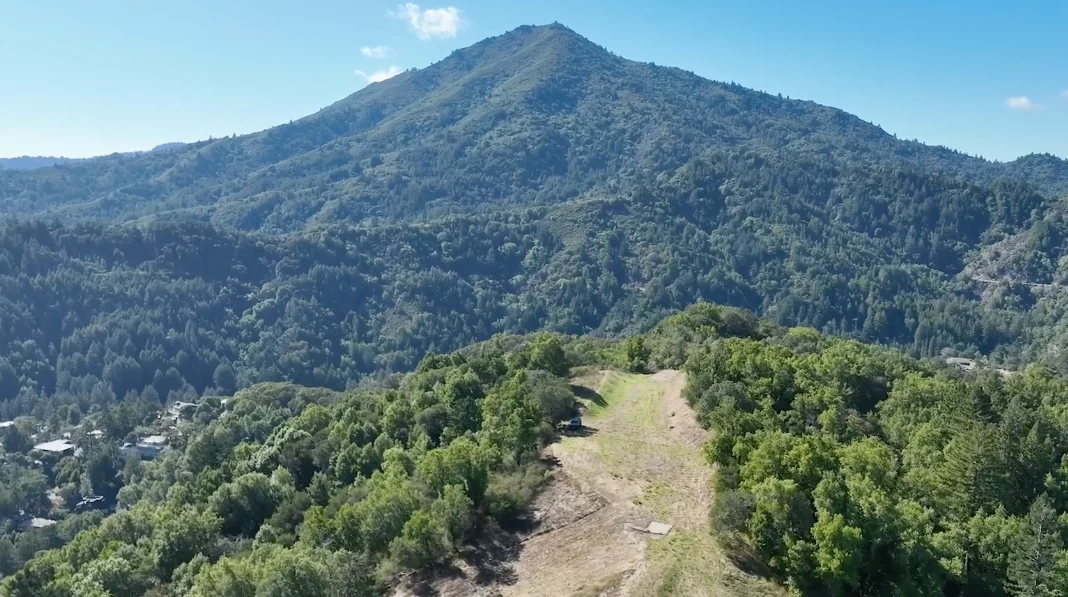
But before Lars Ulrich became connected to the property, the summit of King Mountain was owned by Dr. Herbert Boyer, the trailblazing biochemist who co-founded Genentech and helped create one of the biotechnology industry’s first great fortunes.
Boyer purchased the prized Marin County ridgetop in the 1980s, envisioning a sprawling Tuscan-style estate with sweeping views over Larkspur, Kentfield, and San Francisco Bay.
This was not simply another luxury mansion plan.
Throughout the 1990s, Boyer worked his way through Marin County’s notoriously complex zoning, environmental review, and planning approval process. In the end, he obtained formal entitlements for a residential compound measuring roughly 27,500 square feet.
The approved estate reportedly included:
- A sprawling main villa
- Multiple guest and auxiliary residences
- Swimming pools
- Horse stables and corrals
- Vineyards and orchards
- Private roads and walking paths
- Extensive landscaping and water features
Those approvals were an extraordinary accomplishment. Local residents had been fighting to preserve King Mountain since the 1980s, when developers began eyeing the area for residential construction. Marin County eventually purchased 131 acres on the mountain’s lower slopes and secured a scenic easement over another 129 acres, but the privately owned summit retained valuable development rights.
After years of regulatory battles, Boyer had won permission to build one of the largest private residential compounds in Marin County.
And then he never built it.
For reasons that were never publicly explained, Boyer abandoned his plans before construction began and eventually placed the property on the market.
Enter Sandman
At some point in the early 2000s, Lars Ulrich acquired the property from Boyer through a sealed-bid auction. Lars bought the property through a trust called “Omega Three Trust.”
Lars apparently had no interest in building Boyer’s sprawling Tuscan villa. Instead, he hired acclaimed San Francisco architect Stanley Saitowitz to imagine something radically different for the mountaintop. The project was called “Omega 3.”
Saitowitz envisioned a futuristic compound made up of four long concrete-and-glass structures laid directly into the hillside. Rather than disguising the mansion as a traditional country estate, the design leaned into the drama of the location. The house would have stretched horizontally across the ridge, with expansive walls of glass framing the surrounding mountains and bay. And perhaps to appease local opposition, Lars scaled the size of the estate down from an enormous 27,500 square feet to a much more modest 19,000 square feet 🙂
The main section was designed to contain the kitchen and family room, with children’s playrooms below and bedrooms above. A separate eastern section would hold the primary suite. The central structure contained the entrance and formal living areas.
The western section was where the identity of the client became especially interesting. According to the architect’s description, it was designed to contain “the music archives, studio, and work room for the rock-star owner.“
There’s actually a scene in the 2004 Metallica documentary “Metallica: Some Kind of Monster” where Lars takes his dad on a hike at the property. And thanks to whoever put the entire documentary on YouTube, I was able to load it up in the embed below (should start at the 33-minute mark):
Exit Sandman
For whatever reason (likely a combination of feasibility and local opposition), in 2015, Lars listed the property for $39 million. The asking price was later reduced to $25 million, and an attempted auction in 2021 ended without an accepted offer. The property subsequently returned to the market for $19 million. Below is a video tour of the property. At the 34-second mark, you can see a rendering of the mansion Lars once hoped to build:
Marin Open Space Trust Agrees To Buy The Land
For decades, local conservationists had dreamed of adding the King Mountain summit to Marin County’s extensive open-space system.
The county already owned 108 acres elsewhere on the mountain, and the King Mountain Loop Trail allowed hikers to circle the private estate. But anyone who tried to reach the actual summit was stopped by a fence and a padlocked gate.
A Marin County staff report bluntly concluded that acquiring the property had historically been “financially infeasible.”
According to the SF Chronicle, in early 2026, Marin Open Space Trust chairman Bill Long received a completely unexpected email.
The message came from a representative of the Shelby Cullom Davis Charitable Fund, a Delaware-based private foundation that supports education, culture, medical research, and environmental conservation. Long had never heard of the foundation.
The representative wanted to know what it would take to purchase King Mountain and donate it to Marin County.
Long was initially skeptical. Conservation groups receive plenty of enthusiastic calls and emails that never amount to anything, especially when the property in question is worth tens of millions of dollars.
This offer was real.
Long contacted the King Mountain Open Space Association and Marin County. In April 2026, backed entirely by money from the Shelby Cullom Davis Charitable Fund, Marin Open Space Trust signed an agreement to purchase the full 161-acre property from Lars’ Omega Three Trust.
The final purchase price was not disclosed.
On July 14, 2026, the Marin County Board of Supervisors, acting as the Marin County Open Space District Board, approved the agreements needed to accept the donation.
The transaction will increase the King Mountain Open Space Preserve from 108 acres to approximately 269 acres. Most importantly, the previously inaccessible 32-acre summit will be permanently protected from development and eventually opened for public enjoyment.
In addition to providing enough money to buy the property, the Shelby Cullom Davis Charitable Fund is donating another $2 million to pay for at least a decade of:
- Habitat restoration
- Invasive-species removal
- Trail and fire-road maintenance
- Signs and public-access improvements
- Long-term conservation work
Marin County has not announced exactly when hikers will be allowed to reach the summit. Officials will first need to inspect the property, restore portions of the land, and determine how it should connect to the existing trail system.
After decades of political battles, development proposals, and multimillion-dollar listings, opening King Mountain to the public could ultimately be as simple as unlocking a gate.
Did Lars Donate The Mountain?
Unclear. His trust certainly appears to have sold the property to the Shelby Cullom Davis Charitable Fund… for an undisclosed price. The Shelby Cullom Davis Charitable Fund is supplying the purchase money. Marin Open Space Trust is buying the property and then donating it to Marin County.
It is entirely possible that Omega Three Trust agreed to accept substantially less than the property’s previous $19 million asking price. It is also possible that the seller cooperated with the conservation organizations or accepted terms that made the deal unusually favorable.
Who Was Shelby Cullom Davis?
Born in 1909, Davis studied political science at Princeton and Columbia before earning a doctorate in Geneva in 1934. Early in his career, he worked as a European radio correspondent and later became an economist and adviser to Thomas E. Dewey, the governor of New York and two-time Republican presidential nominee.
From 1944 to 1947, Davis served as the first deputy superintendent of insurance for New York State.
It was not the most glamorous job in government, but it gave him an education that would eventually make him extraordinarily rich.
While regulating insurance companies, Davis learned how they collected premiums, invested those premiums, and built enormous portfolios of stocks and bonds. He noticed that many insurers generated dependable profits and dividends while trading at extremely low valuations.
In 1947, at age 38, Davis founded Shelby Cullom Davis & Company and began investing roughly $50,000 to $100,000 of his family’s money.
He focused heavily on undervalued insurance stocks, including companies such as AIG and Chubb, along with insurers in Japan and other international markets.
His approach was influenced by Benjamin Graham’s principles of value investing. Davis searched for financially strong companies that were being ignored or misunderstood by the broader market. After buying them cheaply, he was willing to hold the shares for years or even decades. Warren Buffett is another famous Benjamin Graham devotee.
When the strategy worked, Davis benefited twice. First, the insurance company’s earnings increased. Second, Wall Street eventually recognized the company’s quality and became willing to pay a higher multiple for those earnings.
The combination of rising profits and an expanding valuation became known as the “Davis Double Play.”
Davis is widely credited with compounding his money at an average annual rate of more than 23% over approximately 47 years.
By the time he died in 1994, his personal fortune was estimated at $900 million.
Diplomat And Philanthropist
Davis did not spend his entire life studying insurance companies.
In 1969, President Richard Nixon appointed him United States ambassador to Switzerland. Davis remained in the role until 1975, serving under both Nixon and President Gerald Ford.
He and his wife, Kathryn Wasserman Davis, also became major philanthropists. They supported universities, libraries, historical research, international education, museums, cultural organizations, and environmental causes.
The Shelby Cullom Davis Center for Historical Studies at Princeton University was named in his honor. Davis also funded academic chairs and programs at institutions including Wellesley College, Colby College, and Tufts University’s Fletcher School.
His descendants continued both sides of the family legacy.
His son, Shelby M.C. Davis, became a successful investor and helped build the family business that developed into Davis Advisors, an asset-management firm that has overseen tens of billions of dollars.
After Shelby Cullom Davis’ death, members of the family continued his philanthropic work through several charitable organizations, including the Shelby Cullom Davis Charitable Fund.
A $3.1 Billion Charitable Fund
The foundation that stepped in to save King Mountain is not some small family charity writing occasional five-figure checks.
According to its 2024 federal tax filing, the Shelby Cullom Davis Charitable Fund controlled approximately $3.1 billion in net assets.
In 2024 alone, it made approximately $120.6 million in charitable disbursements. Public filings show that the fund has distributed more than $1 billion since 2013, even without counting several years for which conveniently summarized figures are not available.
Its major gifts have included:
- $25 million to establish the Davis Alzheimer Prevention Program at Brigham and Women’s Hospital
- $10 million to support the Davis Science Center at Colby College
- Millions of dollars for scholarships and international education programs
- Major grants to museums, performing-arts organizations, and historical institutions
- Ongoing support for land trusts, wildlife organizations, and environmental conservation
That last category ultimately led the foundation all the way across the country to a fenced-off mountain in Marin County that was once the spot where a Genentech founder wanted to build a Tuscan villa and a rock star wanted to build a modern mountaintop lair/music archive.


