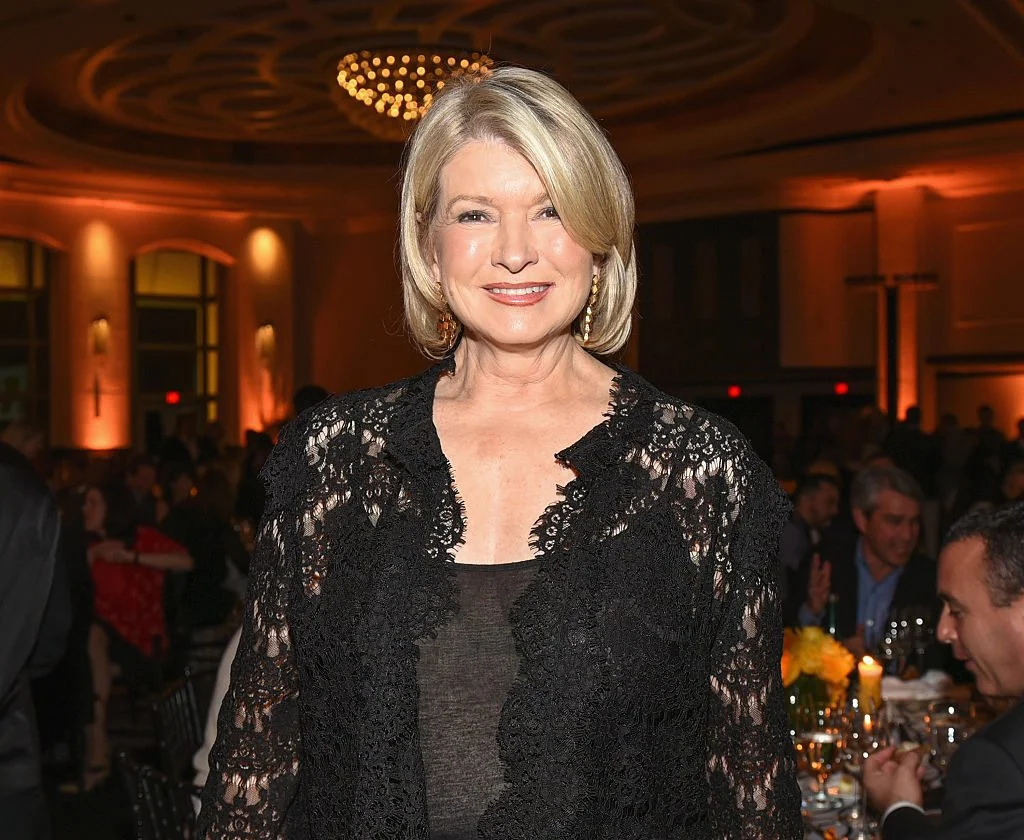

On December 27, 2001, Martha Stewart was flying to Mexico aboard a private aircraft when a brief phone call set off a chain of events that would reshape her life and career. During a fuel stop in San Antonio, Texas, she contacted the assistant to her stockbroker and instructed him to sell all 3,928 of her shares in biotechnology firm ImClone Systems.
The timing proved remarkably fortunate. The next day, ImClone revealed that the Food and Drug Administration had delivered damaging news about its experimental cancer treatment, causing the company’s stock to collapse. Stewart’s sale spared her a loss of exactly $45,673.
That relatively small trade soon became the starting point for one of the most consequential financial scandals involving a celebrity. The transaction led to a federal investigation, a criminal conviction, five months behind bars and a dramatic blow to the business empire that had established Stewart as America’s first self-made female billionaire.
Almost a quarter-century later, Stewart says the wider ordeal cost her an astonishing $1 billion. In an unexpected full-circle moment, she cited that figure while explaining why she no longer owns a private jet.
Mid-Life Millionaires -Martha Stewart / Denis Contreras/Getty Images
Why Martha Stewart Doesn’t Own A Private Jet
Stewart discussed the episode during an appearance on “Other People’s Business,” a new podcast hosted by MasterClass founder David Rogier. The conversation touched on today’s celebrity entrepreneurs, including Kim Kardashian. Stewart praised the Kardashian family’s commercial success, said Kim had asked her for business advice and noted that Kardashian now travels in a Gulfstream G5 private jet.
Rogier then asked the lifestyle icon why she had not purchased a private aircraft of her own. Stewart’s response quickly turned the discussion toward the legal scandal that nearly dismantled her career.
“Because I fell in a hole,” Stewart said. “I lost about a billion dollars in my legal problems. The lawyers took me to the cleaners, and they were horrible.”
Now 85, Stewart said she intends to revisit the experience in her upcoming autobiography. She also emphasized that she has rebuilt her finances and remains in a strong position today. “But I’m back. I mean, I’m pretty good,” she told Rogier.
Stewart’s estimate offers a striking measure of how severely she believes the legal battle affected her wealth. To understand the origins of that billion-dollar calculation, however, it is necessary to return to the December 2001 stock sale and everything that followed.
The full interview, which also examines Stewart’s career income and the expansive company she built, can be viewed below:
The $45,673 Stock Trade That Started Everything
At the center of the controversy was ImClone Systems, the biotechnology company led by Samuel Waksal, who was a friend of Stewart’s. In December 2001, the company was awaiting an important FDA decision on Erbitux, an experimental treatment for cancer.
On December 27, Waksal and relatives began trying to sell their ImClone holdings. Peter Bacanovic, Stewart’s Merrill Lynch broker, became aware of the transactions and reached out to Stewart’s office while she was en route to Mexico. Stewart then spoke with Bacanovic’s assistant, Douglas Faneuil, who informed her that Waksal was attempting to unload his shares.
Stewart directed Faneuil to liquidate her entire position of 3,928 ImClone shares. She also attempted to contact Waksal for more information about the company. The following day, the FDA announced that it would not review ImClone’s application for Erbitux, triggering a steep decline in the stock price.
Investigators later concluded that Stewart’s well-timed sale prevented a loss of $45,673. Compared with the fortune she had already accumulated, the amount was modest—but the circumstances surrounding the trade drew intense scrutiny.
Stewart and Bacanovic told investigators that they had previously agreed to sell the shares if ImClone dropped below $60. Prosecutors disputed that account, arguing that the two had misled officials during the inquiry.
In March 2004, Stewart was found guilty of conspiracy, obstructing an agency proceeding and making false statements to federal investigators. Notably, she was never criminally convicted of insider trading. Her prison sentence resulted from her actions during the investigation, rather than from a criminal insider-trading conviction.
A judge sentenced Stewart to five months in federal prison, followed by five months of home confinement and two years of supervised release. She reported to the federal prison in Alderson, West Virginia, in October 2004 and regained her freedom in March 2005.
The legal consequences continued beyond her criminal case. In 2006, Stewart settled a separate civil insider-trading action brought by the Securities and Exchange Commission. She agreed to pay roughly $195,000 in disgorgement, interest and penalties without admitting or denying the allegations, and accepted a five-year ban on serving as a director of a publicly traded company.
The direct financial penalties were a tiny fraction of the amount Stewart now says the entire ordeal cost her. The far greater damage came from what happened to the company she had spent decades building.
Before The Scandal, Martha Stewart Was A Billionaire
To appreciate the size of Stewart’s financial losses, it’s worth remembering just how successful her business had become before ImClone.
Stewart began her professional career as a model before working as a stockbroker on Wall Street. She later built a catering business out of her Connecticut farmhouse, published the bestselling 1982 book “Entertaining,” and transformed her expertise in cooking, gardening, decorating, and entertaining into an enormously successful magazine and television franchise. Her frequent television appearances, including on Oprah Winfrey’s program, helped introduce her to an even larger national audience.
In 1997, she consolidated her publishing, television, and merchandising interests into Martha Stewart Living Omnimedia, or MSLO. Two years later, on October 19, 1999, she took the company public on the New York Stock Exchange.
Shares were priced at $18 in the IPO, opened at $37.25, briefly traded as high as $52, and closed the first trading day at $35.56. At that price, MSLO had a market capitalization exceeding $2 billion.
Martha personally controlled more than 34 million shares, giving her an ownership stake worth $1.2 billion at the end of that first day. The IPO made her America’s first self-made female billionaire, an extraordinary achievement for someone who had started her business in a farmhouse kitchen.
And the operation behind that valuation was a formidable money-making machine. One of its most successful components was a retail licensing arrangement that generated tens of millions of dollars in annual royalties.
The $65 Million-A-Year Kmart Deal
One of Stewart’s greatest business triumphs was her partnership with Kmart. Long before celebrity entrepreneurs like Gwyneth Paltrow and Jessica Alba launched their own lifestyle and consumer-product empires, Martha had developed an entire universe of merchandise bearing her name.
Through the Martha Stewart Everyday collection, Kmart sold everything from sheets, towels, and cookware to furniture, gardening supplies, and Christmas decorations. At its peak, according to Stewart’s new interview, the partnership generated nearly $2 billion in annual merchandise sales.
Even more impressively, Stewart said the arrangement generated as much as $65 million annually in royalties. Those royalties flowed through Martha Stewart Living Omnimedia under its licensing agreement with the retailer. The company’s SEC filings confirm a $65 million guaranteed royalty payment under the Kmart agreement.
It was one of the great celebrity merchandising deals of its era. The revenue helped fuel Stewart’s expansion into magazines, television, publishing, and other ventures, while giving her the financial resources to consolidate her businesses into a publicly traded company.
In many ways, Martha had developed the template that modern celebrity entrepreneurs would eventually follow. She wasn’t simply endorsing other companies’ products. She had created an entire commercial ecosystem around her personal brand, using the same name and expertise to generate revenue through television, publishing, and merchandise.
That business model also created a tremendous vulnerability. When Martha’s personal reputation came under attack, the value of the company bearing her name was exposed to the fallout.
How Did Martha Stewart Lose $1 Billion?
Some of the financial devastation was visible almost immediately after the ImClone investigation became public.
MSLO’s share price had already retreated substantially from its post-IPO highs, but the scandal compounded the company’s troubles. Shares that had traded in the mid-$30s eventually sank into single digits. Contemporary reporting documented hundreds of millions of dollars disappearing from the value of Stewart’s personal company holdings, including a decline of $330 million associated with the controversy.
Stewart relinquished her positions as chairwoman and CEO following her indictment, although she remained the company’s largest shareholder. The investigation dominated headlines, her television career was disrupted, and the business faced years of uncertainty about whether its founder would be able to continue serving as the public face of the brand.
There was one especially bizarre development. While Stewart was actually serving her prison sentence, MSLO shares staged an enormous rally. The rebound briefly restored the value of her holdings to billionaire territory. But those gains did not last, and the company’s longer-term decline continued.
By 2015, Martha Stewart Living Omnimedia was a shadow of the company that had once commanded a valuation exceeding $2 billion. That June, Sequential Brands Group announced it would acquire MSLO in a cash-and-stock transaction worth $353 million.
As we wrote when the sale was announced, selling a business for $353 million would ordinarily qualify as an enormous success. But for a company that had once been valued above $2 billion, it represented a dramatic fall from its glory days.
Stewart did not personally receive the full $353 million, which represented the value of the entire business. She received consideration for her shares, maintained an ongoing relationship with the Martha Stewart brand, and continued developing new ventures.
Four years later, Sequential sold the Martha Stewart and Emeril Lagasse brands to Marquee Brands for $175 million, with the possibility of another $40 million in additional payments. Martha remained the defining public personality associated with the brand, but the intellectual property was now controlled by another company.
So where does her new $1 billion figure come from? Stewart didn’t provide a detailed breakdown. The decline in her company holdings accounts for hundreds of millions of dollars, while legal expenses, damaged business relationships, interrupted commercial opportunities, and the long-term consequences of the scandal could have contributed to the broader financial fallout she describes.
Stewart clearly believes the ultimate damage was vastly greater than the publicly documented legal settlements or the initial stock-market decline. Her forthcoming autobiography may provide a fuller accounting of how she arrived at the billion-dollar figure.
A $400 Million Comeback
Despite the extraordinary financial and personal setbacks, Stewart managed something that few public figures could have accomplished: she rebuilt her career and remained culturally relevant for decades after the scandal.
She returned to television shortly after her release from prison, continuing to publish books and rebuild commercial relationships with advertisers and retailers. In 2005, she even starred in “The Apprentice: Martha Stewart,” a spinoff of the reality franchise associated with Donald Trump.
Her unexpected friendship with Snoop Dogg eventually developed into the VH1 series “Martha & Snoop’s Potluck Dinner Party,” introducing Stewart to a new generation of fans who knew her as much for her sense of humor as for her recipes. Their partnership led to numerous television appearances, commercials, and other collaborations, helping reinvent her public image.
At 81, she became the oldest cover model in Sports Illustrated Swimsuit Issue history. She also published her 100th book, opened a restaurant in Las Vegas, launched additional consumer businesses, and became the subject of the 2024 Netflix documentary “Martha.”
Today, Martha Stewart has a net worth of $400 million. Her real estate holdings include her sprawling Bedford estate in New York, the historic Skylands property in Maine, and a $12.3 million Manhattan duplex purchased with her daughter Alexis in 2024.
She may no longer be a billionaire, but she has built a second act that would be an extraordinary lifetime accomplishment for almost anyone else. And at 85, she continues to develop new businesses, publish books, and expand a brand that has already endured for more than four decades.
Still, the contrast is difficult to ignore. In December 2001, Martha Stewart was traveling aboard a private jet when she made a stock trade that saved her $45,673. Nearly a quarter-century later, she says the consequences of that trade cost her $1 billion and help explain why she doesn’t own a private jet today.
It’s one of the strangest financial round trips in American business history. And for Martha Stewart, it’s apparently still a painful one.


