
If there is one phrase every Hollywood actor should keep permanently in mind, it is “strike while the iron is hot”.
Fame in the entertainment business can rise and vanish with dizzying speed. One moment, an actor is commanding massive salaries, topping studio wish lists and being courted for every would-be blockbuster franchise. The next, the offers slow, the spotlight shifts and that once-blazing career can feel as disposable as a stale bagel abandoned somewhere off Sunset Boulevard.
Sandra Bullock understood that unforgiving Hollywood rhythm as well as anyone.
On March 7, 2010, Bullock claimed the Academy Award for Best Actress for her portrayal of Leigh Anne Tuohy in “The Blind Side.” At roughly the same time, filmmaker Alfonso Cuarón and Warner Bros. were working to cast “Gravity,” an unusually daring and technically complex space thriller that would demand enormous confidence from both its studio and its star.
Angelina Jolie had been a major target for the lead role, but she ultimately stepped away and turned her attention to writing and directing the Bosnian war drama “In the Land of Blood and Honey.” Robert Downey Jr., once attached to the film’s male lead, also exited the project. Warner Bros. explored other high-profile possibilities for the central part, with Scarlett Johansson, Blake Lively and Natalie Portman among the names considered, before the search eventually led to Bullock.
By that point, the studio was facing a serious creative and commercial challenge. “Gravity” was built around a woman stranded in space, alone for much of the film’s running time. There would be no large ensemble to share the burden and few traditional blockbuster elements to distract audiences from the central performance. To make the movie work, Warner Bros. needed an actress capable of carrying a major studio release almost entirely on her own.
It needed a HUGE STAR.
And in 2010, Sandra Bullock was about as big as movie stars got.
That’s great news if you’re Sandra Bullock. Less great if you’re the Warner Bros. executive opening her contract proposal…
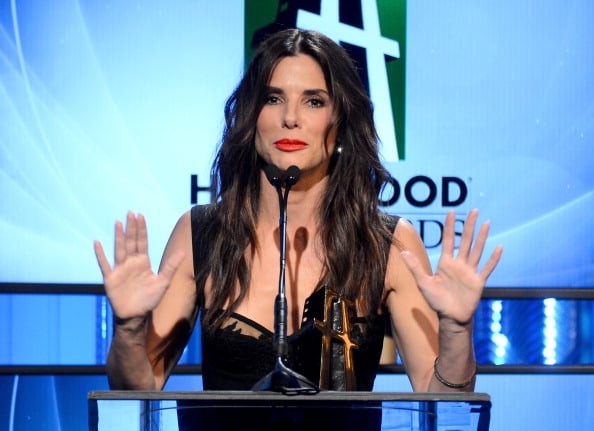
Mark Davis/Getty Images
The $20 Million Salary Was Just The Beginning
Warner Bros. knew Bullock could command an enormous salary. “The Blind Side” had grossed more than $300 million worldwide, “The Proposal” had been another major hit the year before, and Bullock had an Oscar sitting on her shelf. If Warner Bros. didn’t make the deal attractive enough, she could simply go make something else.
So the studio guaranteed her $20 million.
For most actors, that’s the end of the negotiation. Twenty million dollars was essentially the gold standard for an A-list Hollywood salary.
Sandra’s agents kept going.
Bullock’s deal called for that $20 million upfront payment against 15% of first-dollar gross. She also participated in revenue from home video, television and other ancillary sources.
What Is “First-Dollar Gross”?
Hollywood accounting has a notorious reputation for making profitable movies look unprofitable on paper.
An actor who agrees to receive a percentage of a movie’s “net profits” may have to wait for the studio to deduct production costs, advertising expenses, distribution fees, interest and other charges before the contract says there is any profit to share. A movie can generate hundreds of millions of dollars and still produce surprisingly little contractual net profit.
Bullock’s deal largely sidestepped that problem.
First-dollar gross participation means the participant receives a share of the studio’s revenue before the studio deducts the movie’s production and marketing expenses. That’s substantially more valuable than ordinary profit participation.
There is one important nuance. Bullock did not receive 15% of every dollar moviegoers handed over at the ticket counter. Theater owners keep a significant portion of ticket sales. Her percentage applied to Warner Bros.’ share of the revenue, often referred to as film rentals.
And her $20 million wasn’t simply added on top of the full 15% calculation. It was an advance against her participation. In other words, Sandra was guaranteed $20 million no matter what happened. Once her 15% share generated more than $20 million, she began collecting the additional money.
$724 Million At The Box Office
“Gravity” opened in October 2013 and was an immediate critical and commercial sensation.
The movie ultimately earned $274.1 million in North America and another $449.8 million internationally, bringing its worldwide box office total to: $723.9 million
Not bad for a movie in which the main character spends a large portion of the running time floating around alone in a spacesuit.
The performance was particularly impressive considering how unconventional the movie was. “Gravity” wasn’t based on a comic book, a bestselling novel or an established franchise. It was an original story with a tiny cast, long stretches of isolation and a filmmaking process so technically demanding that Cuarón and his team had to develop new ways to shoot it.
Even George Clooney, the film’s other major star, disappears for substantial portions of the movie.
Bullock was the movie.
And thanks to her contract, every additional dollar of success mattered enormously.
So How Much Did Sandra Bullock Make From “Gravity”?
Movie studios don’t keep every dollar of box-office revenue. Theaters take their share, with the exact split varying by movie, market and week of release.
Let’s use a rough assumption that Warner Bros. ultimately received around 45% of the film’s worldwide box office.
“Gravity” earned $732 million worldwide. This alone would translate into $50 million.
And movie theaters represented only the first revenue stream.
Bullock also had participation in home video, television and ancillary revenue. In 2014, DVD and Blu-ray sales and rentals were still an extremely important part of the economics of a blockbuster movie, while pay television, broadcast licensing and international television deals could generate tens of millions more.
Industry sources estimated those additional revenue streams would add at least another $20 million to Bullock’s take.
That brought the projected payday from one movie to: AT LEAST $70 MILLION.
One Of Hollywood’s Greatest Movie-Star Deals
Bullock is hardly the only actor who has turned backend participation into a gigantic fortune.
Jack Nicholson famously accepted a reduced salary for 1989’s “Batman” in exchange for lucrative participation that eventually produced an estimated $60 million payday.
Tom Hanks gave up part of his salary when “Forrest Gump” ran into budget problems and took first-dollar points instead. The decision reportedly earned him around $70 million.
Bruce Willis’ salary and backend participation in “The Sixth Sense” eventually produced an estimated $120 million payday. And stars such as Tom Cruise and Robert Downey Jr. have repeatedly used gross participation to turn blockbuster movies into enormous personal windfalls.
What makes Bullock’s deal particularly impressive is how little downside she accepted.
Some actors on the largest movie paydays list sacrificed most or all of their normal salaries in exchange for backend points. That can produce a fortune when a movie works, but it’s still a gamble.
Sandra didn’t give up her huge salary.
She got $20 million guaranteed AND secured access to the upside.
And Then Came The Oscars
The financial success of “Gravity” would have been remarkable on its own. The movie also became one of the most acclaimed films of the year.
“Gravity” received 10 Academy Award nominations, including Best Picture and another Best Actress nomination for Bullock.
It won seven Oscars.
Alfonso Cuarón won Best Director. The movie also won for cinematography, film editing, original score, sound editing, sound mixing and visual effects.
Bullock did not win her second Best Actress trophy. That award went to Cate Blanchett for “Blue Jasmine.”
Something tells me Sandra wasn’t devastated 🙂
(function() {
var _fbq = window._fbq || (window._fbq = []);
if (!_fbq.loaded) {
var fbds = document.createElement(‘script’);
fbds.async = true;
fbds.src = ”
var s = document.getElementsByTagName(‘script’)[0];
s.parentNode.insertBefore(fbds, s);
_fbq.loaded = true;
}
_fbq.push([‘addPixelId’, ‘1471602713096627’]);
})();
window._fbq = window._fbq || [];
window._fbq.push([‘track’, ‘PixelInitialized’, {}]);


