
What Is Sherrod Brown’s Net Worth?
Sherrod Brown is an American politician, author, and former U.S. senator with an estimated net worth of $1 million. He represented Ohio in the Senate for three terms, serving from 2007 to 2025, after spending 14 years in the U.S. House. Earlier in his career, Brown served in the Ohio House of Representatives and completed two terms as Ohio’s secretary of state. During his final four years in the Senate, he led the Senate Committee on Banking, Housing, and Urban Affairs.
Brown’s 18-year Senate career ended when he lost his 2024 reelection bid to Republican businessman Bernie Moreno. After several months away from elected office, he returned to the political arena as the Democratic candidate in Ohio’s 2026 U.S. Senate race. Federal Election Commission records identify Brown as a challenger to Republican Senator Jon Husted, who took office in 2025 after J.D. Vance resigned his Senate seat to become vice president.
Financial Disclosures
Public financial disclosures portray Brown’s finances as relatively modest compared with those of many politicians who have spent decades in Washington. A 2025 filing reported assets valued at approximately $497,000 to $1.18 million. His largest holdings included a pension through the Ohio Public Employees Retirement System, worth between $100,001 and $250,000, his wife’s retirement investments, and several bank accounts.
The disclosure listed no reportable liabilities, though Senate candidates are not required to report a mortgage on their primary home. Brown reported $47,689 in Ohio pension income in 2025, as well as $5,500 for a temporary teaching position at Harvard’s Kennedy School. He also received $4,000 for an article published in “The New Republic” and $500 for an article in “The New York Times.” His wife disclosed earnings from teaching, writing, Substack, and book royalties, but financial disclosure rules do not require specific figures when spousal income exceeds certain thresholds.
Throughout his time as a rank-and-file senator, Brown received the standard annual Senate salary of $174,000, a figure that has remained unchanged since 2009.
Early Life and Education
Sherrod Campbell Brown was born on November 9, 1952, in Mansfield, Ohio. He graduated from Yale University with a bachelor’s degree in 1974 and later earned a master’s degree from Ohio State University in 1981. In the years between his studies and his public-service career, Brown taught at Ohio State University’s Mansfield campus.
Brown entered politics early. He was elected to the Ohio House of Representatives in the 1970s and served from 1975 through 1982. His first elected office foreshadowed the issues that would remain central throughout his career, including organized labor, manufacturing, trade, and the economic challenges facing Ohio’s industrial communities.
Ohio Secretary of State
Voters elected Brown as Ohio’s secretary of state, a position he held from 1983 through 1991. The office administers elections, oversees business registrations, and handles other state-government responsibilities. His two terms provided Brown with a statewide political profile before he moved into federal office.
Brown returned to electoral politics in 1992, winning a seat in the U.S. House of Representatives. From that point forward, he remained in Congress for 32 consecutive years.
U.S. House of Representatives
He represented Ohio’s 13th Congressional District from January 1993 until January 2007, winning seven straight House elections. His tenure coincided with major shifts in northern Ohio’s manufacturing base, trade environment, and employment landscape.
Trade policy became a defining part of Brown’s public record. He voted against the North American Free Trade Agreement in 1993 and later opposed the Central America Free Trade Agreement. Brown also wrote extensively on trade, labor, and manufacturing, themes that consistently appeared in his legislative work and published books.
United States Senate
Brown won election to the U.S. Senate in 2006 and began serving in January 2007. He secured reelection in 2012 and 2018, completing three six-year terms. During his Senate career, he served on panels overseeing banking, finance, agriculture, veterans’ affairs, and other economic policy areas.
In 2021, Brown became chairman of the Senate Banking, Housing, and Urban Affairs Committee, a role he held until leaving the Senate in January 2025. The committee has jurisdiction over banks, securities markets, housing, financial regulation, and parts of the transportation and insurance industries.
Brown’s policy agenda often emphasized organized labor, pension security, U.S. manufacturing, trade enforcement, consumer financial protections, and health care. Supporters characterized his approach as economically populist, while critics challenged his positions on government spending, regulation, and taxes. Those disagreements frequently shaped his statewide campaigns.
2024 Senate Election
Brown pursued a fourth Senate term in 2024 in what became one of the nation’s most expensive Senate contests. His campaign reported more than $96 million in receipts during the 2023–24 election cycle. Those funds belonged to the campaign committee and do not count toward Brown’s personal net worth.
He faced Republican nominee Bernie Moreno and Libertarian candidate Don Kissick. Ohio certified Moreno as the winner, bringing Brown’s Senate service to an end on January 3, 2025.

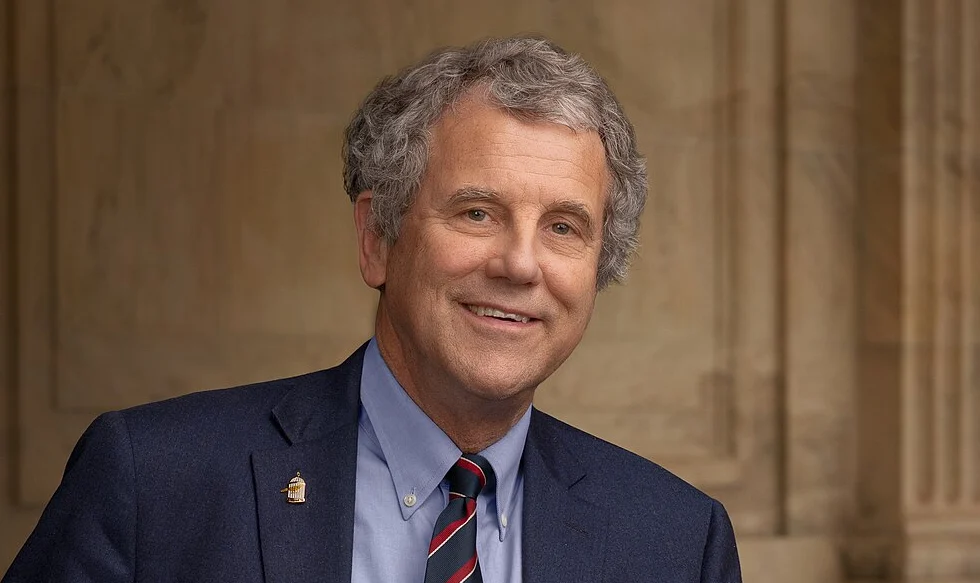
(Official U.S. Senate photo by Rebecca Hammel – Public Domain)
Post-Senate Work
After leaving Capitol Hill, Brown spent several months writing, teaching, and pursuing labor-related projects. Harvard University’s Institute of Politics selected him as a visiting fellow for the spring 2025 term. He also launched the Dignity of Work Institute, an organization focused on employment and economic policy.
His financial disclosure suggests that his time outside elected office was financially modest compared with the corporate board positions, lobbying work, consulting roles, and paid speaking engagements often pursued by former lawmakers. Brown reported $5,500 from Harvard and a total of $4,500 from two opinion articles before reentering electoral politics.
2026 Senate Campaign
Brown filed to seek another U.S. Senate term in 2025 and remains a candidate in Ohio’s 2026 election. He is challenging incumbent Senator Jon Husted, who was appointed to the Senate in January 2025 after J.D. Vance resigned from the chamber.
Federal Election Commission records showed Brown’s authorized campaign raising more than $38 million from August 2025 through June 2026, with approximately $16.2 million in cash on hand at the end of that reporting period. Those funds are campaign assets and cannot be treated as Brown’s personal money.
Books
Brown has written several books about Congress, trade, and political history. His first, “Congress from the Inside: Observations from the Majority and the Minority,” drew on his experience as a member of the House of Representatives.
He later wrote “Myths of Free Trade: Why American Trade Policy Has Failed.” In 2019, he published “Desk 88: Eight Progressive Senators Who Changed America,” a history of senators whose desks Brown had occupied during his time in the chamber. His financial disclosure shows that royalty agreements for those books remained in effect, with proceeds from “Myths of Free Trade” designated for charitable organizations.
Personal Life
Brown has been married to journalist and author Connie Schultz since 2004. Schultz won the 2005 Pulitzer Prize for Commentary for her work at Cleveland’s “Plain Dealer” and later became an author, columnist, and university instructor. Brown and Schultz each had two children before their marriage, creating a blended family that now includes eight grandchildren.
After Brown left the Senate, the couple sold their longtime Cleveland home and a condominium in Columbus and moved to the Columbus area. Public records reported that they took out a $589,000 mortgage on a home in Bexley in 2025. Their primary residence is not included in the ordinary asset totals shown on Senate financial-disclosure forms.
Brown and Schultz have remained active in writing and education alongside Brown’s political career. Their disclosed household assets consist largely of pensions, retirement accounts, cash, and their residence rather than large individual stock portfolios or private businesses.
All net worths are calculated using data drawn from public sources. When provided, we also incorporate private tips and feedback received from the celebrities or their representatives. While we work diligently to ensure that our numbers are as accurate as possible, unless otherwise indicated they are only estimates. We welcome all corrections and feedback using the button below.
(function() {
var _fbq = window._fbq || (window._fbq = []);
if (!_fbq.loaded) {
var fbds = document.createElement(‘script’);
fbds.async = true;
fbds.src = ”
var s = document.getElementsByTagName(‘script’)[0];
s.parentNode.insertBefore(fbds, s);
_fbq.loaded = true;
}
_fbq.push([‘addPixelId’, ‘1471602713096627’]);
})();
window._fbq = window._fbq || [];
window._fbq.push([‘track’, ‘PixelInitialized’, {}]);