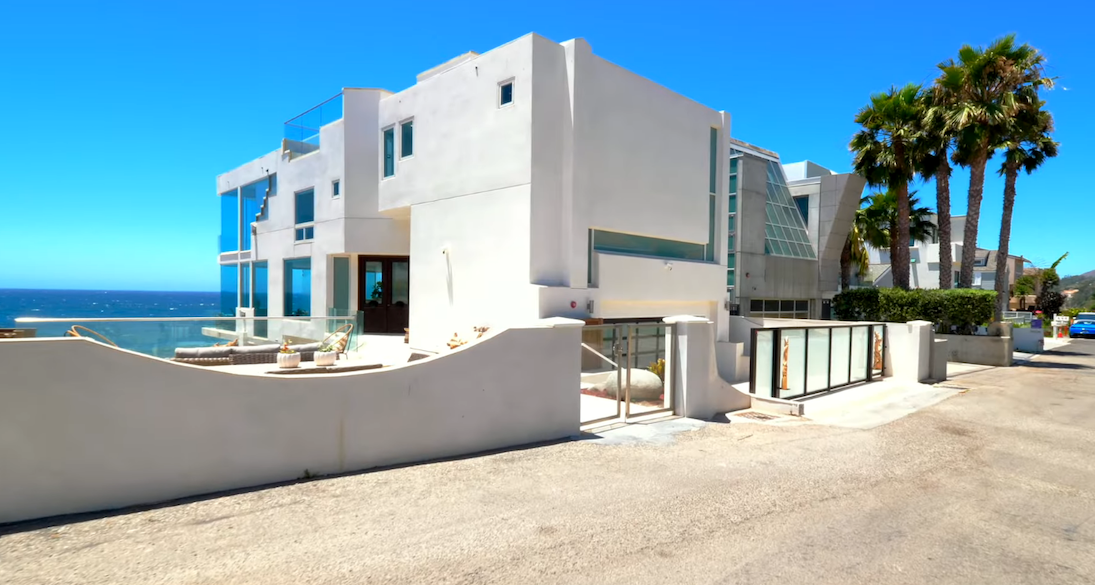

Firefighters were called to Malibu’s Lechuza Beach area early Tuesday after reports of a possible gas-main rupture, but crews quickly found a far more dramatic scene: the driveway of an oceanfront estate had caved into a sprawling sinkhole. The property is tied to a beachfront mansion purchased in 2024 for $10.5 million. Its owner?
Nicolas Cage.
This was no ordinary crack in the pavement.
Los Angeles County fire officials said the sinkhole measured about 30 feet by 30 feet. Aerial video captured surf surging beneath the home through the gaping void, which swallowed the driveway, tore into part of the nearby street and even dragged a portable restroom down with it.
No injuries were reported, authorities said.
Photos and video circulating after the collapse showed the extent of the damage:
This is terrifying. This sink hole formed outside the $10.5 million-dollar Malibu mansion of Nicholas Cage. pic.twitter.com/7NZL00Vj15
— Tired of being politically correct (@USBornNRaised) September 8, 2026
Video shows Nicolas Cage’s $10.5 million Malibu mansion literally sinking into the ground, with asphalt and concrete appearing to crack open and collapse near the garage, along with a port-a-potty and what appear to be pieces of a privacy fence. pic.twitter.com/JtJl6nU2Wm
— California Post (@californiapost) September 8, 2026
A $10.5 Million Oceanfront Home
Cage bought the home in 2024 from the family of the late Jose Liberman, co-founder of Liberman Broadcasting.
The oceanfront property sits in one of Malibu’s most coveted beachfront locations and includes direct access to a secluded beach, soaring glass walls, multiple bedrooms, a chef’s kitchen and a rooftop deck with a Jacuzzi. The garage also has elevator access.
At the time of the sale, Liberman’s son Lenard told the New York Times that the house had been his father’s “happy place.” After his father’s death, his mother found the memories associated with the property too painful and stopped visiting.
Cage eventually stepped in with a $10.5 million purchase.
Here is a video tour of the mansion from when it was listed back in June 2022:
High Surf Has Been Hammering Southern California
The collapse came after several days of unusually aggressive surf along the Southern California coastline.
Former Hurricane Marie generated large waves and coastal flooding conditions that battered beaches and waterfront communities throughout the region. On Tuesday morning, high tides were still threatening to overtop seawalls and damage homes in other parts of Southern California.
The National Weather Service had both a High Surf Advisory and a Coastal Flood Advisory in effect.
For an oceanfront homeowner, those conditions can be brutal.
What’s perhaps more concerning is that this happened on September 8, which is several months before a potentially brutal El Niño storm season is expected to strike.
El Niño is a naturally occurring climate pattern caused by unusually warm water across the central and eastern tropical Pacific Ocean. That extra heat changes atmospheric circulation thousands of miles away and can alter the position of the jet stream. For Southern California, a strong El Niño can tilt the odds toward a storm track that sends more Pacific moisture directly into the region.
And the El Niño currently developing in the Pacific isn’t expected to be a mild one.
NOAA’s Climate Prediction Center says there is now a greater than 90% chance that the 2026-27 El Niño will become “very strong” during the fall and winter. Even more remarkably, NOAA currently puts the odds at 69% that the October-through-December period reaches a level stronger than any El Niño event in its record dating back to 1950.
That does not mean Southern California is guaranteed to experience a historically wet winter. El Niño increases the odds of certain weather patterns; it doesn’t determine where every individual storm goes.
But NOAA’s actual precipitation forecast isn’t exactly comforting for Malibu homeowners. By the heart of winter, forecasters see a particularly strong wet signal across California. NOAA currently gives much of coastal California a greater than 50% chance of above-normal precipitation from December through April, with the strongest signal arriving during the January-through-March period.
Now consider what just happened.
Southern California did receive rain over the weekend, but this was hardly a gigantic winter atmospheric river. Malibu recorded 0.76 inches of rain in the 24-hour period ending Monday morning. Downtown Los Angeles received 0.73 inches over the broader 48-hour storm period. Bel Air got 1.56 inches, while the wettest locations in Los Angeles County topped out around 1.8 inches.
Winter storms can deliver that much rain in a matter of hours.
And rainfall intensity matters enormously. When several inches arrive slowly, drainage systems and hillsides have time to absorb or move some of that water. When the same amount arrives in a few hours, streets flood, slopes fail, debris flows begin and already-eroded coastal terrain can take an absolute beating.
If this is what Malibu looks like after an early-September storm that dropped 0.76 inches of rain, what happens when a very strong El Niño sends a winter storm that drops that much rain in an hour?
Or several inches in a night?
For Nicolas Cage, the immediate problem is figuring out how to rebuild a driveway that currently leads to a 30-foot hole with the Pacific Ocean visible underneath it.
For Malibu, the potentially much bigger problem may be what’s coming this winter.