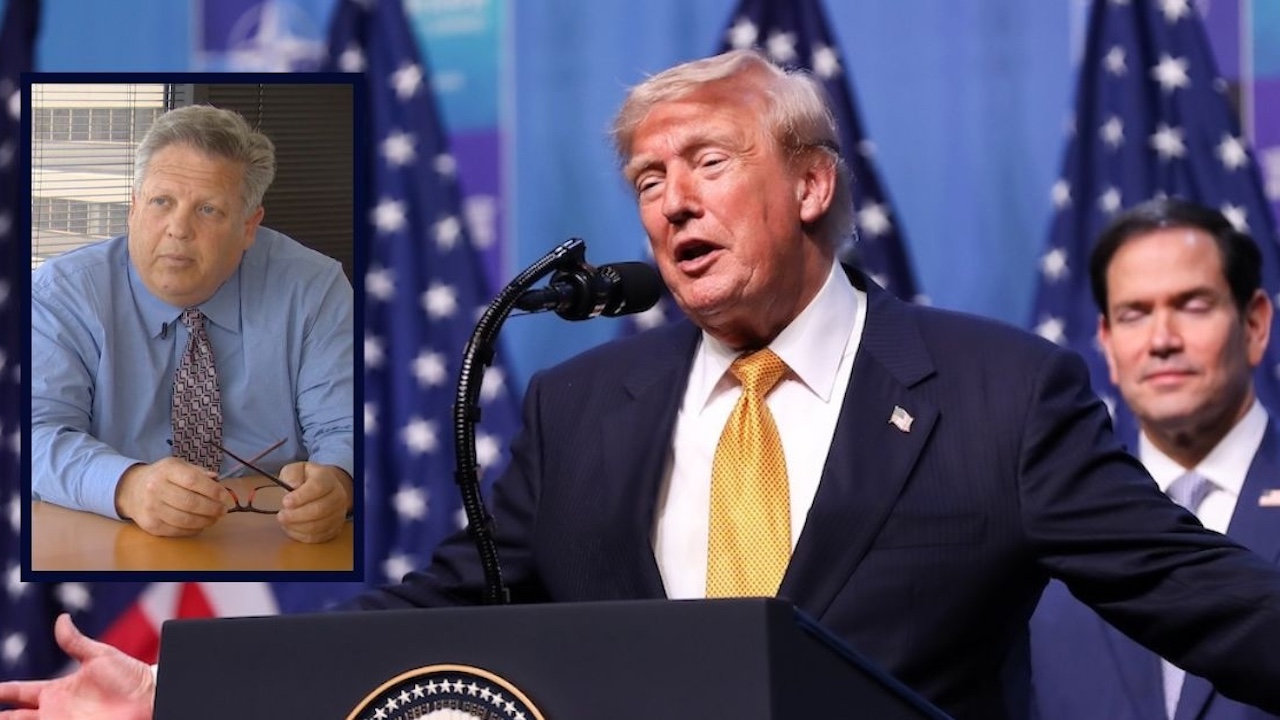

Left inset: Roger Rogoff speaks in an interview about his firing on July 15, 2026 (KING). Main: President Donald Trump and Secretary of State Marco Rubio attend a press conference during the NATO Summit at the Presidential Complex in Ankara, Türkiye, on July 8, 2026 (Photo by Klaudia Radecka/NurPhoto via AP).
Attorneys clashed Friday over the scope of presidential removal authority in a case involving a federal prosecutor in Washington state who was appointed as U.S. attorney by district court judges rather than by President Donald Trump.
The dispute began after the full slate of judges in the Western District of Washington selected longtime Seattle prosecutor Roger Rogoff to fill a vacancy the Trump administration had left open.
Rogoff was later dismissed in an email from the White House. After a lower court reinstated him, the government asked the 9th U.S. Circuit Court of Appeals to affirm the president’s authority to remove him.
In broad terms, the lower court’s ruling blocked the president from removing the judges’ appointee unless a nominee for the position was first nominated and confirmed by the U.S. Senate.
Neither side disputes that the case would become moot if the Senate confirmed a nominee to a four-year term. But that process does not appear imminent—or likely to happen anytime soon.
The Justice Department argues that this effective limitation on presidential authority creates a serious constitutional conflict, one the 9th Circuit should resolve rather than leave in place.
During Friday’s hearing, the panel focused heavily on the constitutional questions.
One judge asked DOJ attorney Mark Freeman to address the principle that “the removal power is incidental to the appointing power.”
Freeman responded that the principle operates as a default rule. He said it can be displaced when Congress establishes a different arrangement by statute or when allowing removal to automatically follow appointment would itself violate the Constitution.
Freeman said both circumstances applied in Rogoff’s case, but he concentrated his argument on the statute favored by the government.
“Mr. Rogoff was a United States attorney, not something else … he was the United States attorney and he was therefore removable by the president,” Freeman said. “We have a very straightforward argument: ‘each U.S. attorney is removable by the president’ means ‘each U.S. attorney is removable by the president.’”
The DOJ’s position is that the statute governing presidential removal overrides the statute allowing judicial appointments when U.S. attorney vacancies remain unfilled.
Freeman argued that Rogoff’s interpretation of the relevant statute “rests on inferences and assumptions.”
“We are not here challenging the ability of Congress to assign to a court of law the authority to appoint a U.S. attorney,” Freeman said. “Mr. Rogoff was validly appointed. If Congress actually wrote the statute that my friend thinks it wrote—that you can appoint an attorney and no one can remove him—we think that would be unconstitutional.”
A judge then asked Freeman whether the district court and the president possessed “concurrent removal power.”
“To allow a court to remove a U.S. attorney would impose, I think, fairly severe problems,” the government lawyer replied.
Freeman expanded on what he described as a potential slippery slope:
MUST READ: Unveiling the Truth: James Talarico’s Adoption Journey and Real Parentage Revealed
“I think probably every criminal defendant would say both that charge is outrageous, and the court should have thrown it out, and the district court’s failure to throw it means the district court should have removed the U.S. attorney. And you would get appeals from parties arguing that the district court erred by not removing the U.S. attorney. And the U.S. attorney would have to take every comment or remark from the district court judge as ‘Is that an implied threat to remove me if I don’t follow it?’”
The judge next asked whether a district court could remove a magistrate judge or whether an appeals court could remove a bankruptcy judge. Freeman indicated that he had seen a court remove a bankruptcy judge, but then redirected the discussion to the government’s broader arguments.
“It’s the interbranch appointment piece here,” Freeman went on. “And the fact that the Supreme Court has said again and again that the power of removal gives you at least an implied and sometimes an explicit power of control that produces the mixing of executive and judicial functions that would be so deeply problematic in this case.”
Rogoff’s attorney, Donald B. Verrilli, also tried to keep the focus on statutory arguments but said the government was “wrong twice over” about the statutes being relied upon — by both parties.
The plaintiff’s lawyer said the controlling law was the vacancy-filling statute and argued the government was wrong about its own reading of the presidential removal statute.
On that second point, Verrilli argued the word “each” in the presidential removal statute is not a synonym for “any” but rather is a referent that points back to the immediately preceding language and therefore only applies to U.S. attorneys who are appointed to serve full four-year terms.
One of the judges interjected to move the conversation back to the Constitution, essaying the idea that Rogoff’s argument would amount to the creation of a legislative removal power.
The plaintiff’s lawyer strongly rejected this line of thought.
“I don’t think nomination and confirmation is an exercise of legislate removal power by the Senate,” Verrilli said. “That’s an exercise of the constitutional advice and consent power in the appointments clause which the Senate indisputably has. If the president nominates a candidate and the Senate confirms that candidate, that candidate becomes U.S. attorney and that would end the tenure of a U.S. attorney appointed, but it doesn’t amount to a removal.”
Rogoff’s lawyer also rejected the idea that a court-appointed U.S. attorney is somehow immune to political accountability.
“A court-appointed U.S. attorney, just like a confirmed U.S. attorney or an acting U.S. attorney, is subject to the plenary control of the Attorney General in everything that U.S. attorney does,” Verrilli said.
The plaintiff’s lawyer, similarly under sustained judicial fire about the constitutional issues, offered a dovetailing argument about the interplay between congressional intent and the separation of powers.
“This is not a for-cause removal provision,” Verrilli argued, referring to Section 546 of the U.S. Code — the plaintiff’s controlling statute that allows the judicial appointment if no candidate is confirmed.
“This is supposed to function as a stopgap to incentivize a president who has opted for the 546 route to get a nomination before the Senate,” Rogoff’s lawyer explained. “It is supposed to act as a protection for the Senate’s advice and consent power.”
The plaintiff’s attorney then sought to put a fine point on the basic facts of the case in the context of the applicable law.
“This is all voluntary,” Verrilli said. “The president opts to use 546. The president can use the Vacancy Reform Act. The president can get a nomination up to the Senate and get a confirmation.”
The post ‘This is all voluntary’: Attorney for disputed federal prosecutor resisting Trump’s firing tells 9th Circuit that federal law protects the Senate’s ‘advice and consent’ power first appeared on Law & Crime.