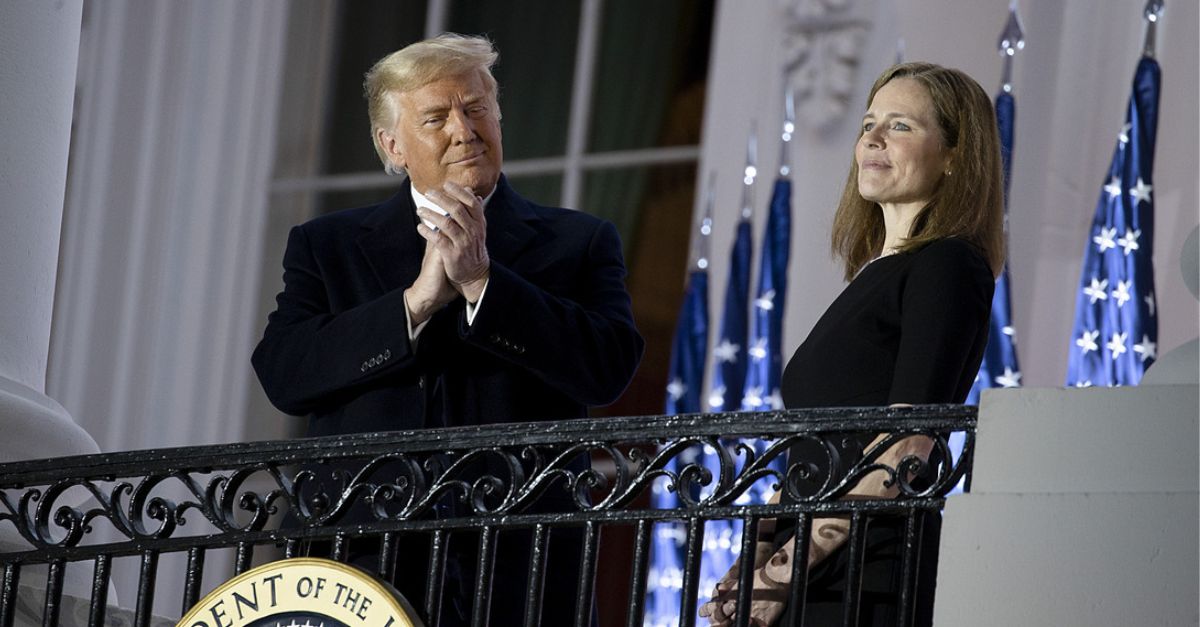

U.S. President Donald Trump stands with newly sworn-in U.S. Supreme Court Associate Justice Amy Coney Barrett during a ceremonial swearing-in event on the South Lawn of the White House in Washington, D.C. on Oct. 26, 2020 (Tasos Katopodis/Getty Images).
On Friday, the U.S. Supreme Court provided a major legal triumph for the Trump administration by significantly restricting federal judges’ power to issue universal injunctions that prevent the president’s policies from being enforced nationwide. This success also seems to have quieted numerous vocal critics of Justice Amy Coney Barrett, who delivered the majority opinion enabling the administration to start implementing its policy aimed at ending birthright citizenship by limiting the reach of the various nationwide injunctions impeding the contentious measure.
Barrett had faced criticism from MAGA supporters after she sided with the court’s liberal justices on multiple prior issues, causing some of the president’s most fervent supporters to criticize her appointment to the Supreme Court.
In a 6-3 vote that split along ideological lines Friday, the court granted a request from the Trump administration to curtail the ability of district court judges to stymie the president’s political agenda by holding that “universal injunctions likely exceed the equitable authority that Congress has given to federal courts.”
“Government’s applications for partial stays of the preliminary injunctions are granted, but only to the extent that the injunctions are broader than necessary to provide complete relief to each plaintiff with standing to sue,” Barrett wrote in the 26-page order.
The justices did not address the constitutionality of Trump’s executive order on birthright citizenship, but allows the administration to begin taking steps for implementation of the policy, which may be partially implemented in 30 days.
The order, signed on Trump’s first day in office, directs the secretary of state, attorney general, secretary of homeland security, and social security commissioner to cease recognizing citizenship for children born in the U.S. whose parents are in the country illegally or in the country on a legal but temporary basis. It is largely viewed by legal experts as being unconstitutional and contra to more than a century of Supreme Court precedent.
Love true crime? Sign up for our newsletter, The Law&Crime Docket, to get the latest real-life crime stories delivered right to your inbox.
According to the ruling, federal judges will typically be limited to granting relief only to the plaintiffs — individuals or groups — that filed a particular lawsuit, meaning that the named plaintiffs in the current consolidated lawsuit will remain protected by the lower court injunctions, but those without legal representation in the matter will not.
“Prohibiting enforcement of the Executive Order against the child of an individual pregnant plaintiff will give that plaintiff complete relief: Her child will not be denied citizenship,” Barrett wrote. “Extending the injunction to cover all other similarly situated individuals would not render her relief any more complete.”
Barrett’s order did not completely bar universal injunctions, particularly in cases where states sue the federal government. However, the court was ambiguous as to how such matters should be resolved.
“The complete-relief inquiry is more complicated for the state respondents, because the relevant injunction does not purport to directly benefit nonparties. Instead, the District Court for the District of Massachusetts decided that a universal injunction was necessary to provide the States themselves with complete relief,” the order states. “The Government — unsurprisingly — sees matters differently. It retorts that even if the injunction is designed to benefit only the States, it is “more burdensome than necessary to redress” their asserted harms. After all, to say that a court can award complete relief is not to say that it should do so.”
The court ultimately “decline[d] to take up these arguments,” instead directing that the lower courts should “determine whether a narrower injunction is appropriate,” adding, “we therefore leave it to them to consider these and any related arguments.”
Barrett also got personal, taking aim at Justice Kentanji Brown Jackson and her dissent in the case. Jackson wrote that the majority’s decision “to permit the Executive to violate the Constitution with respect to anyone who has not yet sued is an existential threat to the rule of law.”
According to Barrett, Brown believes the “the fundamental role of courts is to ‘order everyone (including the Executive) to follow the law — full stop,'” which she describes as “startling” and “tethered neither to these sources nor, frankly, to any doctrine whatsoever.”
Barrett continued:
We will not dwell on Justice Jackson’s argument, which is at odds with more than two centuries’ worth of precedent, not to mention the Constitution itself. We observe only this: Justice Jackson decries an imperial Executive while embracing an imperial Judiciary.
No one disputes that the Executive has a duty to follow the law. But the Judiciary does not have unbridled authority to enforce this obligation — in fact, sometimes the law prohibits the Judiciary from doing so.
The personal rebuke earned Coney Barrett heaps of praise from MAGA influencers, with many claiming the conservative justice effectively “torched” her liberal counterpart.
Justice Sonia Sotomayor also penned a dissent that was joined by Brown and Justice Elena Kagan in which she warned that “no right is safe in the new legal regime the Court creates.”
“The majority holds that, absent cumbersome class-action litigation, courts cannot completely enjoin even such plainly unlawful policies unless doing so is necessary to afford the formal parties complete relief,” Sotomayor wrote. “That holding renders constitutional guarantees meaningful in name only for any individuals who are not parties to a lawsuit. Because I will not be complicit in so grave an attack on our system of law, I dissent.”