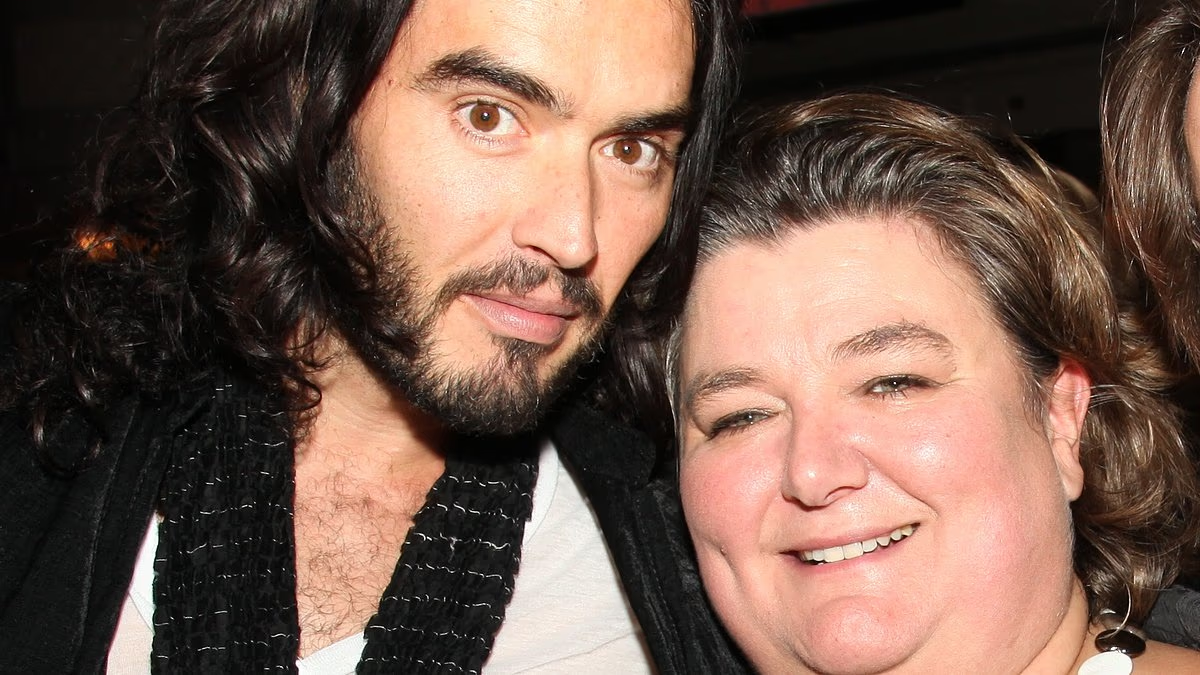
Lesley Douglas, accused of enabling Russell Brand during his BBC years, has kept a remarkably low profile since leaving the corporation.
She is not alone. In the wake of Brand’s conviction, attention has turned to others who allegedly allowed him to operate openly during the height of his celebrity and influence.
Now that the comedian has been brought to justice, scrutiny of those around him is intensifying.
“His television and radio enablers have many questions to answer,” said one former TV executive involved in the media investigation that exposed Brand.
Few face more questions than Douglas.
Her LinkedIn profile reflects the discreet rewriting of history that has characterised the careers of several people connected to Brand.
It does not mention her 22 years at the BBC, including her tenure as controller of Radio 2, the role in which she brought her former protégé to the station.
Brand’s second autobiography contains especially damaging passages. In Booky Wook 2, he wrote that he had been “indulged like the world’s naughtiest schoolboy”, repeatedly describing “beloved Lesley, a gorgeous matriarch” who “loved me and gave me lots of room – so I took that room”.
Whatever Brand intended by that self-serving praise, it remains an uncomfortable endorsement from a man now facing years in prison for rape and sexual assaults.
He also wrote: “You will notice that all the competition winners who came into the studio, while we broadcast, as a prize, were female.”

Lesley Douglas, accused of enabling Russell Brand, has kept a low profile since leaving the BBC, although it was her decision to hire him
“This was because there was an additional aspect to the prize which could not be explicitly stated due to the BBC’s rigid policy prohibiting the misuse of the disabled lavvy.”
The apparent suggestion was that Brand had been having sex with members of the public in BBC toilets while those around him looked the other way.
One woman has now come forward with an account that casts a harsh light on the culture said to have existed under Douglas’s leadership. She was in her late 20s when she first met Brand at one of his comedy shows in 2006.
After winning a 6 Music competition, she was invited into the studio as a guest. Brand later asked to discuss an “arrangement”, which ended in a sexual encounter in a disabled toilet – just as he had described in his autobiography.
The encounter ended abruptly when Brand said he had to leave. He took her telephone number after noticing that she appeared visibly distressed.
“I was back on the train feeling regret and like I had been tricked, but I also felt slightly happy that someone I had fancied on the telly fancied me back,” she told The Times.
Whether she consented is not the central issue, particularly when considering the power imbalance between a famous performer and an enthralled fan. The stark fact is that, according to her account, the encounter took place inside the BBC.
They continued seeing each other intermittently for about a year, including a visit to Brand’s home. After they had sex, she says, he told her: “I want you to lick that toilet seat.” She refused.
“He then got angry and seemed p****d off that I wouldn’t let him humiliate me,” she said.
“I think he left the bathroom and it was as if he was repulsed by me.”
She believes the demand was a test to determine how far she would go for him.
Douglas has said she knew nothing about the alleged encounter.
Even so, her LinkedIn profile leaves out her long BBC career, which began in 1986 when she joined as a production assistant.
Many will also be surprised to learn that, despite her resignation after the 2008 Sachsgate scandal, Douglas continues to receive BBC-related income through her production company.
At least, Lonesome Pine does.
The company, co-founded by Douglas in her native Newcastle in 2013, appears to be thriving. Its latest accounts show £1.76 million in cash and net assets of £328,000.
Some of that money has come from BBC commissions, including The Northumbria Mysteries, a crime drama starring Robson Green and Simon Callow that aired on the channel last month.
Few would object to Douglas, now in her 60s, rebuilding her career after leaving the BBC with a reported six-figure payout. But her continuing financial relationship with the corporation is likely to surprise many.
Professionally, however, it is her decision to hire Brand in 2006 that remains most closely associated with her legacy. He was brought in to attract younger listeners and given his own Radio 2 programme after presenting on 6 Music.
Coverage of Brand’s collapse has rightly examined the organisations he worked for, from MTV to Channel 4. Yet his BBC years were particularly significant: they marked the point at which a foul-mouthed, sexually fixated outsider with a devoted following was ushered into the mainstream by Britain’s publicly funded broadcaster.
The trial judge noted: “About 20 years ago, you Russell Brand were becoming famous, you were clever, and in many people’s eyes, you were funny and charismatic. You had become a sexual predator.”
That was precisely the period Brand spent at the BBC. His two years on Radio 2, from 2006 to 2008, offer a concentrated example of the failures that have since shadowed the corporation and other broadcasters, from Jimmy Savile to Huw Edwards.
The BBC, and Brand’s admirers on the Left, have repeatedly stressed that his criminal conduct did not become widely known until 2019, when investigations by Channel 4’s Dispatches, The Times and The Sunday Times began exposing his treatment of women.

Despite her resignation after Sachsgate in 2008, Lesley Douglas continues to benefit financially from BBC commissions
YOU MAY ALSO READ: Prince William and Kate Play Street Cricket on India Tour

Brand boasted about “lovely sex” with Sachs’s granddaughter as Jonathan Ross shouted an obscenity in the background
That explanation is little more than a fig leaf. Quite apart from the criminal allegations, much of Brand’s disturbing behaviour was already visible to the public.
His sexually explicit monologues on the comedy circuit, delivered in silky shirts open to the waist and unnaturally narrow trousers, should have prompted serious questions from future employers.
So should his appearance in a seven-part series about breaking social taboos. Brand was paid £250,000 by the fledgling cable channel Play UK several years before joining the BBC.
In one episode, My Old Tart, he took an 81-year-old woman named Wendy to Eastbourne for a “dirty weekend” intended to revive her sexuality. They visited a strip club and kissed, but when Brand proposed sex, Wendy replied: “Don’t be silly, Russell.”
In another storyline, Brand staged a challenge to his own sexuality by pleasuring a gay man named Gary in a Soho pub toilet.
Around the same time, he appeared in the comedy drama Cruise of the Gods, about a science-fiction convention aboard a ship in the Aegean. David Walliams was among the cast.
Brand was dismissed for drug-fuelled behaviour away from the set. After allegedly trying to seduce an 18-year-old passenger’s daughter, he visited an Istanbul brothel three times and became involved in a fight with a doorman after smashing a sex worker’s phone against a wall. He said he had done so because she repeatedly answered calls after he paid for sex.
The programme, incidentally, was produced by the BBC.
Four years later, the corporation announced in a press release: “RUSSELL BRAND TO JOIN RADIO 2.”
“I’m sure Russell’s new show will become a ‘must listen’ for Saturday nights,” Douglas predicted.
This was before the #MeToo movement and the rise of social media, in an era dominated by lads’ magazines and “kiss-and-tell” stories.
Standards have changed, but that does not excuse the sycophantic culture surrounding Brand at the BBC, where the word “no” appears to have been in short supply.
That culture was evident in the decision to let Brand’s own company, Vanity Projects – an apt name for a performer accused of narcissism – produce his late-night Saturday show, the programme at the centre of Sachsgate. “The grown-ups had left the room,” one television source said. Mark Thompson, then the BBC director-general and now chairman and chief executive of CNN Worldwide, has so far attracted little attention over his role.
Thompson was nevertheless called before the Commons Culture, Media and Sport Committee after the scandal, which involved Brand leaving offensive messages for Andrew Sachs, the late Fawlty Towers actor, over Brand’s brief relationship with Sachs’s granddaughter.
The BBC was paying Brand £200,000 a year for that kind of programming.
What has received less attention is that the Sachsgate broadcast, like Brand’s other programmes, was recorded in advance. It was reportedly approved for transmission by Douglas in a one-word email sent from her BlackBerry: “yes”.
Thompson told MPs: “I do not think you can go back, as it were, through the audit trail and say, even of this programme, that it was obvious that it was an accident waiting to happen.”
A CNN spokesman said the former director-general had acted immediately after the Sachsgate controversy, which led to Brand’s departure and the exit of several senior executives. He added that Thompson, like everyone else, was horrified by the behaviour recently brought to light.
Thompson’s assertion that there had been no warning signs appears difficult to sustain.
How could there have been none? Some of Brand’s conduct was broadcast, including remarks about a female newsreader, whom we have chosen not to name. He called her “erotic” and told listeners: “We’re going to get under that desk and we’re going to unleash all hell on your thighs.”
On several occasions, production staff appear to have compelled him to apologise, only for similar jokes to return in later programmes.
The former newsreader, now in her 60s and living in the Home Counties, declined to comment. Brand was also, by his own account, having sex with competition winners in disabled toilets.
Against that backdrop, it is easier to understand why Brand felt able to call Jimmy Savile live on air in May 2007 and joke about sending his assistant to meet the disgraced television and radio presenter.
When Brand asked, “Would you like her to wear anything in particular, Jimmy?”, Savile replied: “I’d actually prefer her to wear nothing.”
There were warning signs. Ofcom reached a similar conclusion after Sachsgate, finding that although the BBC had classified Brand’s show as “high risk”, it had handed elements of programme management to people working for him.
“The presenter’s interests had been given greater priority than the BBC’s responsibility to avoid unwarranted infringements of privacy, minimise the risk of harm and offence, and maintain generally accepted standards,” the regulator concluded.
The BBC’s own review, conducted by Peter Johnston, director of editorial complaints and reviews, was even more critical.
“There was a clear perception of the then-Controller of Radio 2 being the ultimate decision maker, but that the presenters, and Russell Brand in particular, held great sway and he was perceived to have a direct line to the then-Controller, who would be expected to back him.
“The perception was that Russell Brand would get his way and would go, or threaten to go, to the then-Controller if not, and that he would be supported.
“I also heard a number of staff saying that anyone who raised an issue would be moved off the programme.”
In a statement issued by her lawyers before her resignation, Douglas denied showing Brand preferential treatment.
“Ms Douglas did not at any time encourage, enable and/or fail herself to take any adequate steps within her power with regard to the conduct of Mr Brand of which she was aware,” the statement said.
But Johnston’s conclusion was stark: “I am satisfied that the evidence I have heard shows a clear perception from members of staff that Russell Brand had preferential access to the then-Controller [Ms Douglas].”
And, rightly or wrongly, Douglas continues to receive BBC income through her production company.


