
Share this @internewscast.com
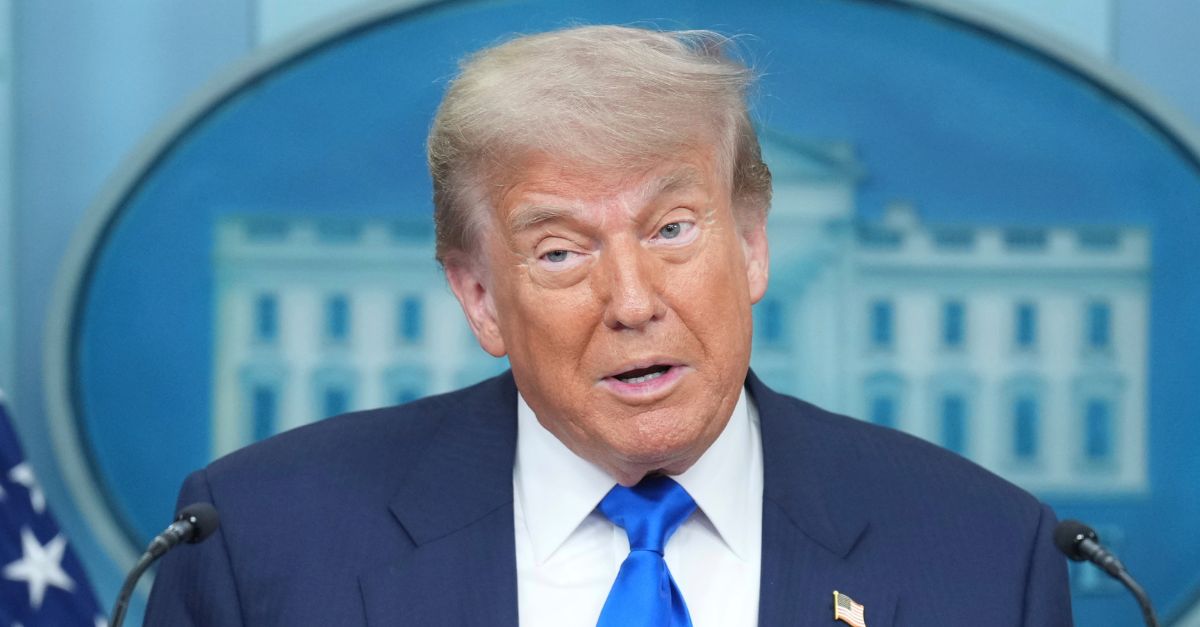
FILE – President Donald Trump addresses reporters, Friday, June 27, 2025, in Washington’s White House briefing room (AP Photo/Jacquelyn Martin, File).
A federal district court judge voiced some frustration with the U.S. Supreme Court over a case involving the Trump administration’s “unlawful” dismissal of 16,000 federal employees.
On Friday, U.S. District Judge William Alsup, appointed by Bill Clinton, ruled mostly in favor of the plaintiffs against the government in a 38-page order regarding motions for summary judgment.
“In early 2025, the Office of Personnel Management ordered federal agencies to dismiss their probationary employees in large numbers,” the judge remarked. “This directive was illegal, as were the methods used for these dismissals.”
However, the judge pointed out that the remedies provided by the court’s order were greatly restricted by existing circumstances, assigning blame to the nation’s high court for the current situation.
The particular issue sticking in the judge’s craw is the dispensation of cases and controversies by way of the so-called “shadow docket.”
In cases handled via the shadow docket, the court’s majority often issues influential decisions—impacting the real world—without thorough analysis, which prevents lower courts from determining any new precedents. Critics argue that these decisions frequently align with the conservative majority in the Roberts Court.
The justices largely eschew – and sometimes reject – references to the shadow docket; the formal term is the emergency docket.
The perhaps more sinister-sounding term, however, is widely used in legal circles after being coined by University of Chicago Law Professor William Baude in a 2015 law review article. Since then, it has been popularized by Georgetown University Law Professor Steve Vladeck, who penned a 2023 book on the subject.
Alsup, for his part, had an earlier ruling in the case – a preliminary injunction in favor of the plaintiffs – nixed by the high court’s shadow docket in early April, Law&Crime previously reported.
In a terse, two-paragraph order, at least five justices granted a stay of the early March injunction and order that directed various federal agencies to rehire the workers in question.
The case itself has long been a foregone conclusion at the district court level. Alsup originally issued a restraining order against the Office of Personnel Management (OPM) in late February over the firings, calling them “illegal” under the Administrative Procedure Act (APA), which is the federal statute broadly governing the behavior of administrative agencies.
In a later extension of that same relief, the judge termed the government’s justification “a sham in order to try to avoid statutory requirements.”
Now, Alsup has made that injunction permanent – but says there are obvious limits as to what the court’s order can do at this point.
“In the ordinary course, this order would, as required by the APA, set aside OPM’s unlawful directive and unwind its consequences, returning the parties to the ex ante status quo, and as a consequence, probationers to their posts,” Alsup opines. “But the Supreme Court has made clear enough by way of its emergency docket that it will overrule judicially granted relief respecting hirings and firings within the executive, not just in this case but in others.”
The court’s complaints go on, at length:
And, too much water has now passed under the bridge since the Supreme Court stayed this Court’s preliminary injunction reinstating probationary employees. The terminated probationary employees have moved on with their lives and found new jobs. Many would no longer be willing or able to return to their posts. The agencies in question have also transformed in the intervening months by new executive priorities and sweeping reorganization. Many probationers would have no post to return to.
Still, the court says, the plaintiffs “nevertheless continue to be harmed by OPM’s pretextual termination ‘for performance,’ and that harm can be redressed without reinstatement.”
To that end, the judge refashioned the injunction and order to require the government to “update each terminated probationary employee’s personnel files, including their [notice of personnel action], to reflect that their termination was not performance or conduct based.”
The order also mandates that the government pen individualized letters to each of the fired federal workers – and warned the Trump administration to keep such epistolary relief short and sweet.
Again, the order at length:
Each relief defendant agency shall issue corrective notices to terminated probationers stating that “You were not terminated on the basis of your personal performance.” Those letters shall be individually addressed to each probationer, meaning that the letter itself shall state on its face the name, address, and any other appropriate identifying information of that probationer (as well as that of the agency). The corrective letters, however, are not an appropriate medium for the litigation of those disagreements. To do so would undercut their fundamental purpose, as it did the first time around. To that end, corrective notices shall not contain further statements from each agency concerning the validity of this Court’s ruling or the agency’s opinions on this Court’s ruling. There is no need to lard the letters with such distractions.
The order continues to bar the manner of firings originally employed by OPM – but allows for firings “so long as the agency makes that decision on its own, does not use the OPM template termination notice, and is otherwise in compliance with applicable law.”