
Share this @internewscast.com
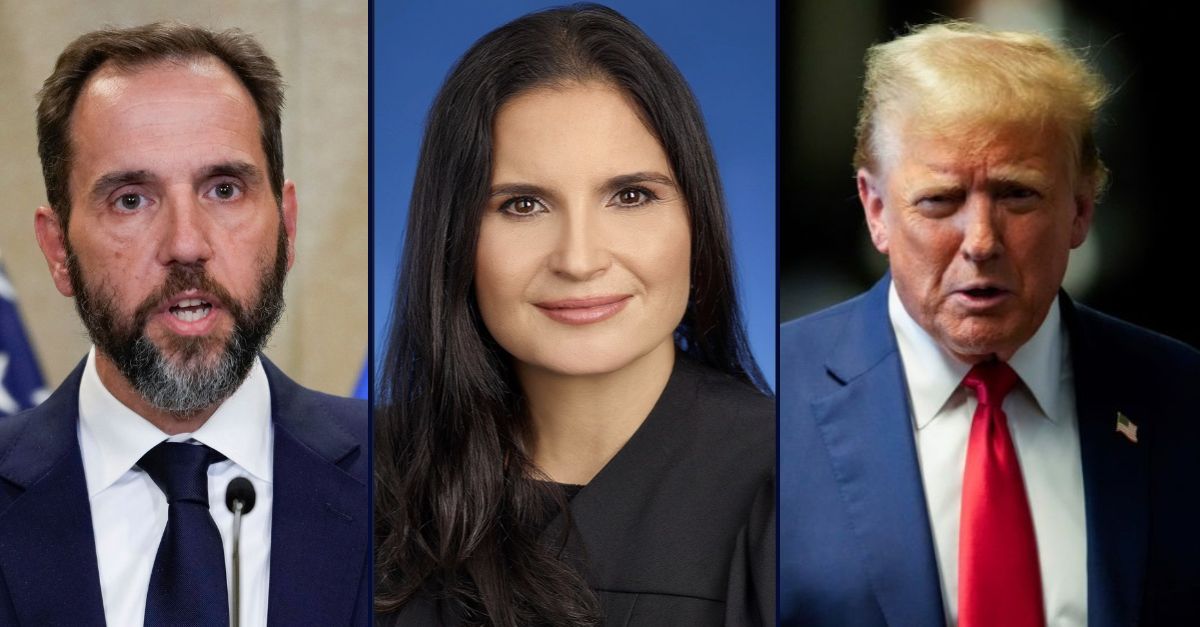
Left: Then-special counsel Jack Smith speaks to the media about an indictment of then-former President Donald Trump, Aug. 1, 2023, at an office of the Department of Justice in Washington (AP Photo/J. Scott Applewhite, File). Center: U.S. District Judge Aileen Cannon (U.S. District Court for the Southern District of Florida). Right: Donald Trump speaks to members of the media before departing Manhattan criminal court, Monday, May 6, 2024, in New York (AP Photo/Julia Nikhinson, Pool).
The U.S. Department of Justice is adamant that the second segment of former special counsel Jack Smith’s comprehensive report on investigations into former President Donald Trump must remain undisclosed.
In December 2025, U.S. District Judge Aileen Cannon, appointed during Trump’s initial term, issued two rulings concerning the ongoing debate over the report’s second volume.
In her initial decision, Cannon rejected intervention attempts by the Knight First Amendment Institute at Columbia University and the transparency-focused nonprofit American Oversight. Yet, in a subsequent ruling, she allowed “any former or current party to this action” to seek intervention or pursue appropriate relief if justified.
In a concise three-page document, the U.S. Attorney’s Office in Miami aligned with Trump and his former co-defendants from the Mar-a-Lago documents case, asserting that Smith’s report must remain confidential.
The DOJ’s motion states, “Jack Smith’s investigation was unlawful from the start,” criticizing Smith for allegedly using the DOJ as a tool against a prominent presidential candidate without legal grounds, targeting constitutionally protected actions. They contend that Smith’s conduct was marked by illegality and should not be officially recognized.
In official terms, the DOJ supports the judge’s stance on Smith’s lack of authority, asserting that the second volume constitutes “an internal deliberative communication that is privileged and confidential and should not be disclosed outside the Department of Justice.”
The motion goes on to say the DOJ “cannot provide” Cannon “with additional assurance regarding the scope and adequacy” of grand jury materials that appear in Smith’s second volume.
“[C]urrent [DOJ] counsel has only secondhand information about the process by which Smith made redactions,” the motion continues. “Current [DOJ] counsel was not involved in Smith’s investigation, and the [DOJ] does not believe that a line-by-line analysis of Smith’s report, and the underlying discovery and grand jury materials, is warranted.”
Here, the DOJ makes explicit reference to the court’s original order denying the release of the second volume of the Smith report.
While the criminal case against Trump petered out due to Cannon’s novel use of the U.S. Constitution’s Appointments Clause in July 2024, the case against Waltine Nauta, Trump’s valet, and Carlos De Oliveira, the Mar-a-Lago property manager, continued for a while.
In January 2025, Cannon used the then-ongoing prosecutions to justify keeping the second volume under judicial lock and key. Cannon’s order also “directed the parties to file a Joint Status Report within thirty days of the conclusion of all appellate proceedings and/or any continued proceedings” at the district court level.
The DOJ’s latest filing also reiterates the arguments made in that joint status report – which was eventually filed in March 2025.
From that months-old status report, at length:
The Court should also decline any invitation to conduct an in camera review of the grand jury materials related to this prosecution. The Attorney General has not ordered the release of Volume II, nor has any court of competent jurisdiction ordered the Department of Justice to release Volume II. Unless and until either of those contingencies comes to fruition, it would be premature for the Court to engage in a Rule 6(e) analysis.
Finally, the DOJ’s motion ends with a broadside against the entirety of the Mar-a-Lago documents case from inception to the present day.
“Especially when considering the extraordinary unfairness and prejudice that would fall to former defendants President Donald J. Trump, Waltine Nauta, and Carlos De Oliveira, including the release of information over which President Trump has assertions of attorney-client privilege, it is the position of the Attorney General and this Department that release of Volume II is unjustified,” the filing concludes. “The illicit product of an unlawful investigation and prosecution belongs in the dustbin of history. The United States will leave it there.”