
Share this @internewscast.com
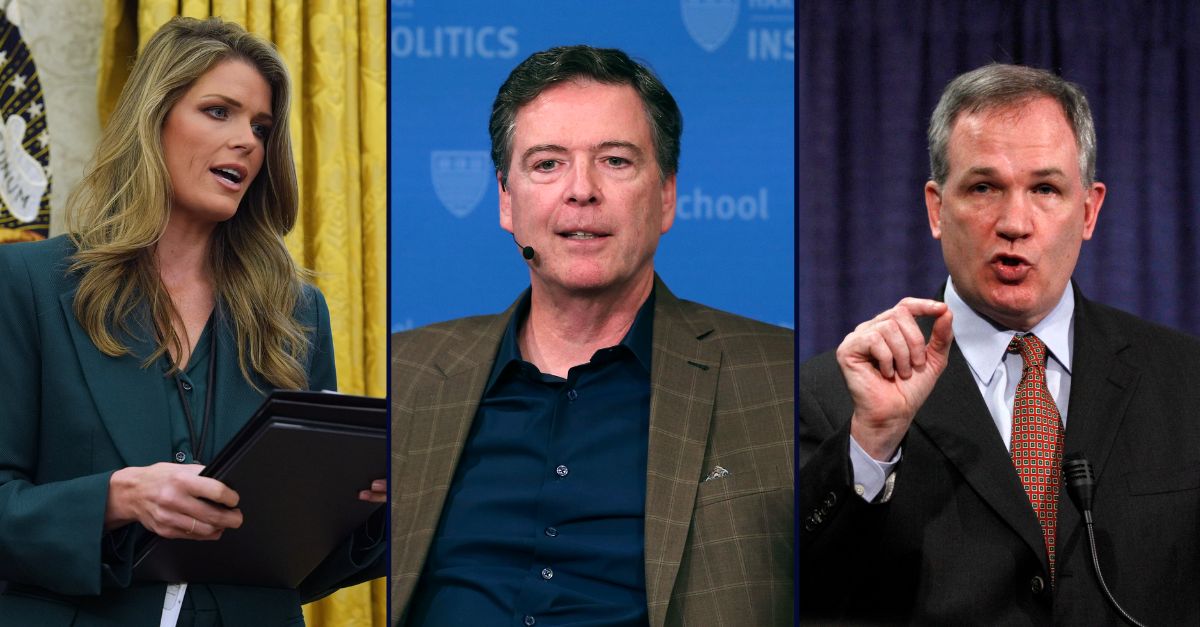
Left: Lindsey Halligan speaks as President Donald Trump signs executive orders in the Oval Office of the White House, Friday, Jan. 31, 2025, in Washington. (AP Photo/Evan Vucci). Center: Former FBI director James Comey gestures while speaking at Harvard University”s Institute of Politics’ JFK Jr. Forum in Cambridge, Mass., Feb. 24, 2020. (AP Photo/Charles Krupa, File). Right: Patrick Fitzgerald, then U.S. Attorney for the Northern District of Illinois gestures during a news conference at the federal building in Chicago, Thursday, May 24, 2012, a day after he announced in a written statement he was resigning from the post he held for more than a decade. (AP Photo/Kiichiro Sato).
Just days after the Trump administration requested a federal judge to limit a magistrate’s directive concerning grand jury materials, the Department of Justice’s case against former FBI Director James Comey resurfaced in court. This brief status conference, lasting under ten minutes, concluded with the DOJ committing to submit grand jury transcripts and audio recordings to the court. This allows the judge to review everything and determine whether the defense should access these materials.
U.S. Magistrate Judge William Fitzpatrick opened the swift 4 p.m. hearing on Monday by expressing his opinion that it seems logical for the grand jury materials requested by Comey’s legal team to be examined privately, away from both the defense and the public eye.
Last Wednesday, Fitzpatrick stirred controversy during a hearing by criticizing the government for an “indict first, investigate later” approach. He ordered the DOJ to provide grand jury transcripts and audio from late September, along with evidence from an old “Arctic Haze” leak investigation, to the defense the following day.
However, on Thursday, DOJ attorneys Tyler Lemons, Gabriel Diaz, and interim U.S. Attorney Lindsey Halligan quickly appealed to U.S. District Judge Michael Nachmanoff, arguing that Fitzpatrick’s order overstepped his “delegated authority.”
The DOJ contended that the magistrate issued the discovery order without the necessary findings, arguing that Comey’s defense had not sufficiently overcome the public’s long-standing interest in grand jury secrecy with specific and factually based reasons for disclosure.
The evidence in question is crucial for Comey’s defense, as it could potentially demonstrate misconduct in Halligan’s solo presentation to the grand jury, warranting a case dismissal. Comey has suggested that an FBI special agent who provided testimony might have been compromised and possibly exposed to attorney-client privileged information.
The transcripts would reveal to the defense what Halligan told grand jurors about Comey’s alleged Sept. 30, 2020, lie to Sen. Ted Cruz, R-Texas, and the special agent’s testimony.
Nachmanoff, a Joe Biden appointee, responded Friday by returning the issue to Fitzpatrick for analysis on “whether there are particularized and factually based grounds for disclosure.”
Notably, the district judge found the magistrate’s grand jury materials order fell “within the matter referred to him,” that the “topic of potential privilege spill was raised” by Comey, and that Fitzpatrick “properly addressed the need for the disclosure of the grand jury transcripts.”
Fitzpatrick thereafter ordered up a Monday afternoon status conference. Before then, the government shot back one more time that Comey had “offered only conjecture” in support of overriding grand jury “secrecy.”
“[T]he defendant was provided with affidavits by two FBI special agents who possibly reviewed privileged materials,” the filing said, rejecting Comey’s “tainted” agent theory. “As their affidavits indicate, neither agent was involved in the grand jury presentation, nor was the agent that testified at the grand jury presented with the alleged privileged materials.”
Comey himself was on the call-in line Monday, along with his attorneys Rebekah Donaleski, Patrick Fitzgerald, and Jessica Carmichael. Diaz and Lemons were on the call for the DOJ.
Donaleski, taking the lead for Comey, asserted the defense was “best positioned to determine whether misconduct or irregularities that occurred would be the basis to dismiss the indictment for two reasons.”
“First, the defense is most familiar with the defendant’s attorney client privilege and the materials at issue. And second, the defense is best positioned to identify where particular pieces of evidence came from with respect to these warrants, and I’m specifically referring to the materials the government produced to us last week, which we’ve now reviewed,” Donaleski continued. “That being said to the extent that there can be an ex parte submission from the defense with respect to what we’ve seen in the warrants or the privileged materials, where we’re open to doing so, but our view is that, and we cite a case law to this effect, that the defense is really best positioned to do this.”
Asked what she meant by the “ex parte submission,” a one party only submission for the judge, Donaleski said that “the materials that the defense believes are at issue with respect to Mr. Comey’s privilege.”
“We’ve now seen what the agent saw from the materials obtained pursuant to the Arctic Haze warrants that were not reviewed for responsiveness and that are clearly privileged. We’ve now seen those. That’s one aspect of the submission,” she said. “The second would be outlining what we’ve seen in terms of the materials produced by the government and where we believe those materials came from, with respect to the four search warrants at issue.”
“So it would better enable the court to understand what the defense has access to with respect to taint and the unconstitutionally obtained material,” Donaleski added, stating she could file ex parte by Tuesday.
Fitzpatrick, shifting to Lemons, quickly realized that he was hearing instead from Diaz.
“Your Honor, we could provide the grand jury materials to the court in camera, not sure what the ex parte submission is going to be on the defense’s side. But again, it seems that they are talking about information that would be attorney-client privileged, or possibly gained, as they say, in violation of Fourth Amendment,” Diaz said. “Neither of those two issues go to whether an irregularity occurred in the grand jury proceeding that would cause a basis for the dismissal of that indictment, meaning something that occurred before the grand jury.”
“We don’t believe that either of those issues would get them to to be able to dismiss the indictment and, therefore, the grand jury materials should not be provided to the defense,” he added.
After clearing up that Diaz was the one speaking, the magistrate said the question he has to resolve is “really a very narrow” one. To order up the disclosure of grand jury materials in “whole or in part,” despite general secrecy over such information, he needs to make an “informed decision,” and to do that he needs to review the materials at issue.
“I do think review of the grand jury materials in camera would be helpful, put me in a far better position than I am now to make an informed decision about again, whether or not any of these materials should be released. So I will grant the government’s request in that regard,” Fitzpatrick said.
With Donaleski promising her filing by noon on Tuesday, Diaz stated he “could file the materials shortly after this hearing ends.”
“If you wanted the audio version, I think we could send that electronically,” Diaz said. “If there’s a way to get it to your clerk or someone else. We could do that within few minutes after the hearing, sir.”
To make extra certain what materials he wants to review in camera, Fitzpatrick stated that it involves “all materials up to and including how the grand jury was instructed, any other questions, communications, in addition to any testimony by any witness.”
“Correct, your honor, we also have a 14 exhibits that we can provide,” Diaz confirmed.
“I’ll enter in order to that effect shortly, and then I’ll obviously consider the ex parte submission,” Fitzpatrick concluded. “I’ll review the materials in camera, and I will endeavor to get out in order an opinion soon as we can. I understand that there is a sense of urgency for everybody on this issue, and we will get it out as quickly as we can.”